
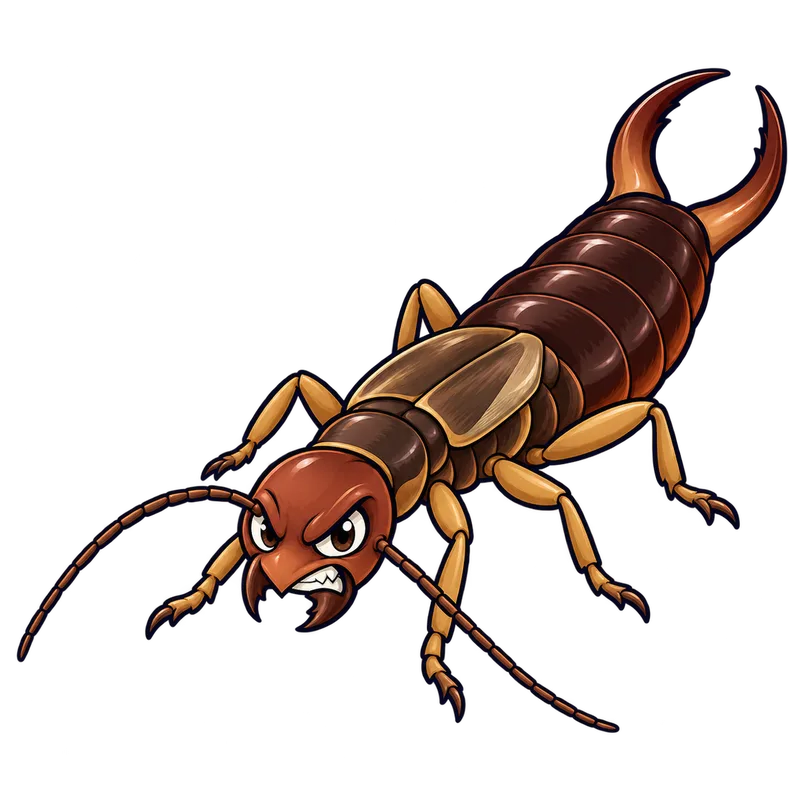
European earwig
Forficula auricularia
- Size
- Up to 3/4 inch long
- Color
- Dark brown to reddish-brown
- Habitat
- Damp, cool, shaded outdoor areas and humid indoor spaces
- Diet
- Decaying organic matter, soft plant tissue, fungi, insects, and garbage
- Life cycle
- Eggs, nymphs, and adults
You are probably looking at a flattened, elongated insect that reaches up to 3/4 inch in length, colored a rich dark brown to reddish-brown, and tipped with a pair of unmistakable curved tail forceps. That scientific name is Forficula auricularia, belonging to the insect order Dermaptera, though everyone just calls them European earwigs or simply earwigs.
Identity
You do not need a hand lens to know what you have found. Those prominent pincers at the rear are visible to the naked eye. If you want to confirm the exact species against other members of the order, a 10x magnification glass helps you inspect the fine details of the head capsule and antennae.
People love to repeat the old urban legend that these creatures burrow through human ears to lay eggs in the brain. It is entirely false folklore. Those tail pincers are not weapons meant to hunt you down, either. They are evolutionary tools used for defense, mating rituals, and catching small prey. If you pick one up and it pinches your skin, it feels like a minor nip and nothing more. If a pinch ever breaks the skin and shows signs of a secondary infection, you should have a clinician take a look, but otherwise, they carry no disease and pose no real medical threat.
Habitat & behaviour
Earwigs are creatures of moisture and shadow. Outdoors, you will find them living in cool, damp, shaded organic zones close to your house foundations, such as thick mulch beds, rotting leaf piles, dense ground cover, and under heavy rocks or decaying woodpiles.
They are strictly nocturnal. By day, they stay hidden in damp cracks, crevices, and soil voids, waiting for the sun to drop. When night falls, they emerge to feed as opportunistic scavengers. Their menu is surprisingly varied, ranging from decaying organic matter, mold, algae, and fungi to soft garden plants, fruits, vegetables, and even other small insects or spiders. They are also strongly attracted to artificial outdoor lighting, so you might spot them congregating near porch lights after dark.
When dry weather bakes the soil and moisture vanishes, your real trouble begins. Driven by a desperate need for cool damp shelter, these wanderers abandon the parched dirt and crawl straight toward your house. They squeeze through tiny foundation gaps, unsealed weep screeds, loose door sweeps, and poorly fitted window frames. Once inside, they make a beeline for high moisture zones like bathrooms, kitchens, laundry rooms, basements, crawl spaces, and the dark voids underneath sinks or bathtubs.
Visual variations
Earwigs skip the complex colonies built by ants or termites. You will find no queens, no sterile workers, and no rigid social roles here. Every single insect you run across is an independent operator handling its own affairs.
The life cycle moves through three distinct phases: egg, nymph, and adult. Newly hatched nymphs look like miniature copies of the grown insects, carrying the same flattened, elongated shape, though they lack full adult size and coloring. They start out pale and darken over time.
Grown earwigs reach that top length of 3/4 inch and sport a solid brown or reddish brown coat. Both males and females feature those signature pincers on the rear of the abdomen, using them for defense and courtship. While they belong to a winged family, you will almost never see them fly. They prefer to sprint on their three pairs of walking legs, darting away the second a flashlight beam lands on them.
Why it matters
Spotting a few of them indoors does not mean your house is dirty or hosting a breeding colony behind the drywall. It usually means your foundation perimeter holds too much moisture or the outdoor weather has turned punishingly dry.
They will not chew through your wall studs or destroy your household furniture. Out in the garden, however, they can feed on tender flower petals and leaves, leaving ragged cosmetic holes in your favorite plants. Finding them clustered in numbers around your exterior walls simply tells you there is excess moisture and decaying debris that needs clearing out.