
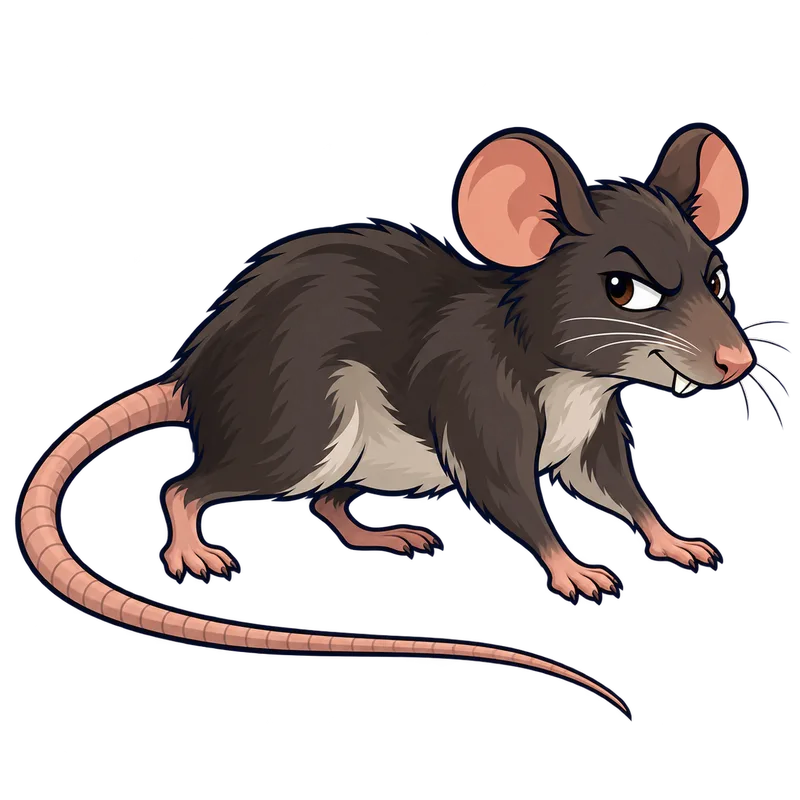
Roof rat
Rattus rattus
- Size
- 12 to 18 inches long including tail
- Color
- Brownish-black to gray
- Habitat
- Elevated spaces, attics, and trees
- Diet
- Omnivorous, preferring fruits, seeds, and grains
- Life cycle
- Up to 1 year, multiple litters annually
This rodent, known scientifically as Rattus rattus, is commonly called the roof rat, though other English-language regions refer to it as the black rat or ship rat. Telling it apart from related rodents often comes down to proportions that require a closer look under good light. Inspecting a specimen reveals a slender body profile ending in a scaly, hairless tail that tends to be equal to or longer than the head and body combined. The head carries a noticeably pointed snout and large, prominent ears that can fold forward past the eye.
Identity
Footprints left in a layer of fine dust or flour reveal four toes on the front feet and five toes on the hind feet, a pattern shared by other rodents but instantly separating them from larger three-toed birds or five-toed mammalian carnivores. Droppings left behind are small, tubular pellets with slightly pointed or blunt ends. It is tempting to point at a mysterious skin mark and blame the creature scurrying in the rafters, but a bite or a lesion can never identify a pest on its own. Physical signs, tracks, or the animal itself are the only reliable proof.
Habitat & behaviour
True to its common name, this rat spends a disproportionate amount of time looking upward, favoring elevated structural spaces like attics, roof lines, soffits, and higher tree branches over subterranean burrows. They are nimble climbers, which explains why you are far more likely to hear them scrambling above your head than digging in the crawl space below. Once they find a way inside, they follow predictable daily pathways along structural edges, pipes, and wooden beams.
What usually draws them close to human habitation is an easy meal paired with shelter from the elements. Unsecured pet food bowls left on a back patio, open garbage cans, fallen fruit in the yard, and poorly stored pantry grains act as powerful invitations. They are omnivorous scavengers by trade, and their presence is almost always tied to whatever food sources are currently sitting out in the open. Closing off these supplies lowers the carrying capacity of your property, meaning the environment simply cannot support as many animals. Relying solely on lethal trapping without cleaning up these attractants is an exercise in frustration, as neighboring individuals quickly move in to take the place of the ones you remove.
Visual variations
Mammalian pests skip the complicated transformations and distinct ranks found in social insects, meaning you will not dig up pupae or stumble across winged castes in the attic. The life cycle moves straightforwardly from blind, hairless pups tucked away in a hidden nest to exploring juveniles and eventually fully grown adults ready to breed. There is no major visual difference between males and females at a glance, since both share the same general slender frame and long, scaly tail.
Fur color can shift from one group to another, though those specific color phases matter less than the primary body shape when you are trying to figure out what is up there. The most consistent visual markers remain the slender build, the long tail, and the large ears relative to the pointed snout. If you are examining tracks in the dust, the four-toed front prints and five-toed hind prints look identical whether left by a young juvenile or a mature adult, differing only in overall size.
Why it matters
Sharing your house with these animals overhead means dealing with persistent structural damage. Their teeth never stop growing, which forces them to gnaw constantly on wood framing, insulation, electrical wiring, and cardboard storage boxes, introducing genuine fire risks into a home. Beyond the chewed drywall and frayed wires, they contaminate stored food and living spaces with urine and droppings, occasionally carrying pathogens and serving as hosts for unwanted parasites.
Excluding them permanently requires sealing every structural gap and opening down to one-quarter of an inch, because a surprisingly small gap is all an adult needs to squeeze its way inside. If an infestation is heavily established in inaccessible wall voids, or if you need professional-grade exclusion work and pesticide applications, those tasks belong in the hands of a licensed pest management professional or wildlife control operator. For any health concerns involving animal bites, open wound contacts, or unexplained fevers, skip home remedies and direct your questions straight to a medical clinician or public health authority.
Similar species
 Deer micePeromyscus species
 White-footed mousePeromyscus leucopus
 Wood mouseApodemus sylvaticus
 House mouseMus musculus
 Norway ratRattus norvegicus