
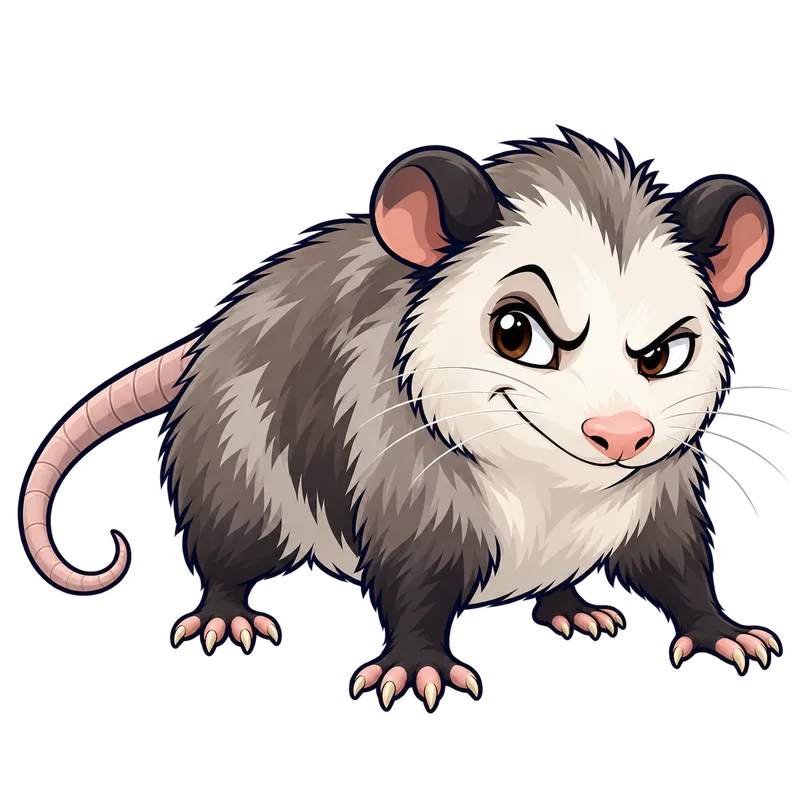
Virginia opossum
Didelphis virginiana
- Size
- Not established
- Color
- Not established
- Habitat
- Suburban, rural, and agricultural edge habitats
- Diet
- Opportunistic omnivore and scavenger
- Life cycle
- Not established
You are dealing with the Virginia opossum, North America's sole native marsupial, which treats suburban backyards and agricultural fringes as its own personal highway system. Looking at one scurrying past the trash cans, you notice a cat-sized mammal with a pointed snout, coarse grayish fur, and a scaly, hairless tail that drags like a thick rat cord. That tail is prehensile, meaning it can wrap around branches, though adults do not hang by it from trees the way cartoons love to suggest. International readers should note that while North Americans call this animal an opossum, the term possum in Australia and New Zealand refers to distinct arboreal marsupials belonging to a completely different suborder.
Identity
When you do not see the animal itself, you see its handiwork in the dirt. Opossums leave five-toed tracks on both their front and rear feet, a feature that separates them from local rodents like rats or squirrels, which manage only four toes on their front paws. The hind foot features an opposable, thumb-like inner toe that sticks out at a wide angle. It looks remarkably like a tiny human hand stamped into the mud. Precise identification in complex cases or anatomical checks, such as counting fifty teeth or verifying the internal marsupial pouch, requires physical examination by a wildlife specialist rather than a quick glance.
If you are trying to tell its tracks apart from a raccoon, look closer at the print. Raccoons leave a distinct bulge right before their toes and tend to drop neat, tubular scat in communal latrines. Opossums leave wider, sprawling five-toed impressions without that distinct palm pad, and their droppings are deposited haphazardly wherever midnight foraging happens to take them. Dogs and cats leave four-toed prints, often with claw marks in the case of canines, which keeps them out of the running once you count the digits.
Habitat & behaviour
Opossums are nocturnal creatures, preferring to sleep away daylight hours in a hidden sanctuary and emerge only after dark. If you have ever heard a heavy rustling beneath your deck just as you are turning off the downstairs lights, you have likely interrupted a tenant that moved in without asking. They are not master architects. They rarely dig their own dens from scratch, choosing instead to occupy abandoned burrows dug by other animals, hollow logs, or whatever dark, dry cavity they can find beneath unsealed crawlspaces, sheds, and porches.
What draws them into human spaces is simple and predictable: easy calories. An opossum is an opportunistic omnivore with a palate that includes fallen garden fruit, uncollected household refuse, and agricultural crops. Most frequently, though, they are drawn right up to the back door by bowls of dry or wet cat food left on the patio for outdoor pets. Once they find a reliable kitchen porch buffet paired with a warm cavity beneath the floorboards, they settle in for the long haul.
They stay awake and moving through every season, ignoring the cold instead of settling down to hibernate. When the calendar turns to late winter and early spring, you will spot them more often near houses because insects and wild berries are hard to find, which pushes them right toward your backyard. If you want one to leave, getting rid of it without traps or poison takes steady annoyance using sound, bright lights, and everyday disruption, and you have to keep at it every single day for two to three weeks until the animal decides the place is simply too much bother.
Visual variations
Because the Virginia opossum is a mammal instead of an insect, it skips the whole nymph and colony routine entirely. There is no queen, no worker class, and no flying adult stage to fret over, since furry vertebrates stay firmly on four feet.
When newborn opossums arrive, they are about the size of a honeybee and must crawl on their own from the birth canal into the mother's stomach pouch. Once inside, they clamp onto a nipple and stay tucked away for weeks while they grow up. When they finally get too big for the pouch, you might catch sight of a mother heavy on her feet crossing the lawn with a dozen youngsters clinging tightly to her back fur like a living backpack.
Grown males and females look pretty much alike at first glance, sporting the same sharp nose, dark eyes, and grizzled coat. Figuring out which is which means handling the animal or using professional checks like counting fifty teeth or looking for the pouch on females. Out in the yard, you are just looking at general size and paw prints instead of worrying about male and female differences.
Why it matters
An opossum living under your deck is usually just a quiet neighbor with poor table manners, but trouble starts when it ruins garden vegetables, knocks over garbage cans, or moves into tight spaces like chimneys and crawlspaces. On the serious side, because they are warm-blooded animals that can carry diseases, any bite, scratch, or suspected rabies contact means the person involved needs to see a doctor or public health worker right away for proper care.
When dealing with these visitors, never take illegal shortcuts. Putting out poisons like antifreeze or chemical baits is against the law, and it causes slow, agonizing suffering while killing dogs, cats, and other wildlife by accident. If you decide to trap one alive, keep in mind that moving it somewhere else is tightly controlled by state rules to stop diseases from spreading, and you usually need written permission or a special agency permit before transporting the animal anywhere. When an animal gets stuck inside a wall or removal poses safety risks, a licensed wildlife control expert or local official is the one who needs to handle the job.