
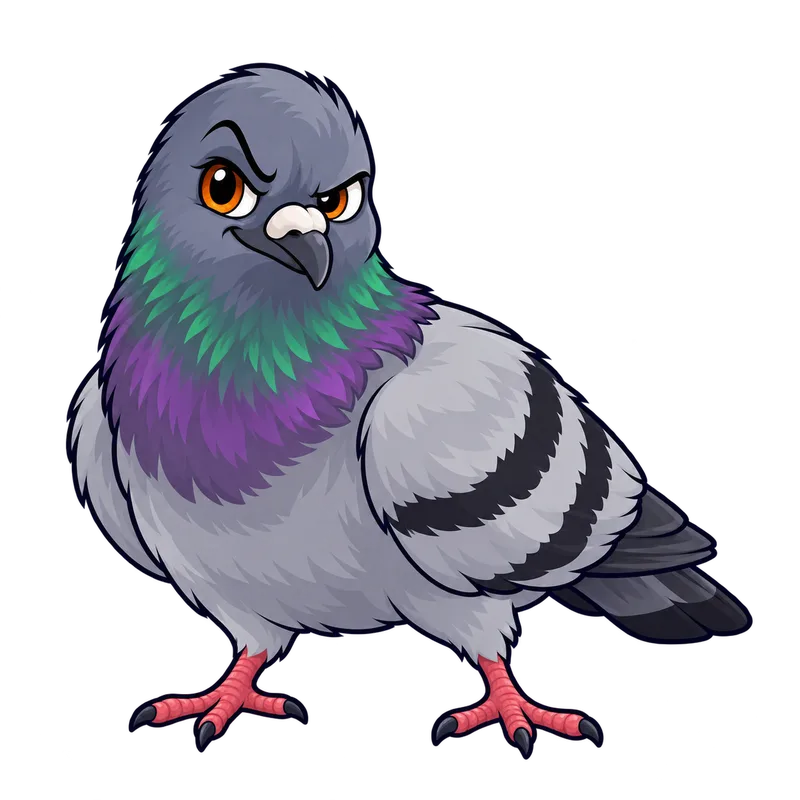
Rock pigeon
Columba livia
- Size
- 12 to 15 inches tall
- Color
- Bluish-gray with two black wing bands
- Habitat
- Urban and suburban buildings, bridges, and ledges
- Diet
- Grains, seeds, and human food scraps
- Life cycle
- Year-round breeding in crude platform nests
The rock pigeon is the familiar gray bird that treats every urban bridge girder, city square, and commercial rooftop as its personal ancestral cliff. You usually spot them strutting across concrete, bobbing their heads in that rhythmic way they have, entirely unbothered by the foot traffic around them.
Identity
The rock pigeon, scientifically known as Columba livia, presents a stout, slate-gray profile. You can identify them by their bluish-gray plumage, which is accented by two prominent black bars across the wings and a broad dark band finishing off the tail. Up close, the neck feathers flash an iridescent, metallic sheen of green and purple that shifts in the sunlight. Their feet are a dull reddish-pink, featuring three toes pointing forward and one smaller toe pointing backward without any webbing. When they walk across a dusty sidewalk, their tracks show this clear unwebbed pattern, which helps separate them from local waterfowl or gulls.
Habitat & behaviour
Urban environments suit these birds remarkably well because modern architecture provides a very convincing imitation of the rocky precipices where their wild ancestors evolved. Flat, sheltered building ledges, overhanging eaves, bridge beams, and unprotected ventilation ducts offer ideal shelter for roosting and raising broods. Pigeons are active during daylight hours and prefer to live, forage, and roost in large flocks. Their diet consists primarily of seeds and grains, but their urban adaptability makes them opportunistic scavengers. They readily consume discarded food scraps in public trash cans, livestock feed in agricultural settings, and birdseed provided by well-meaning residents. Once they find a sheltered ledge or a warm exhaust vent that protects them from the elements, they exhibit extreme site fidelity, meaning they will return to the exact same spot day after day.
Visual variations
Generations of selective breeding, followed by centuries of casual mixing in city alleys, mean you will rarely find a uniform look in a modern flock. While the baseline wild ancestor wears that reliable slate-gray with twin black wing bars, city pigeons show off an unpredictable mix of all-black bodies, rusty red variants, checkered piebald patches, and stark white feathers. They do not run on complex insect hierarchies or cast systems. You cannot tell a male from a female just by looking at their plumage or size, and the transition from a dull juvenile feather coat to an adult coat happens so gradually that you will usually just see another pigeon.
Why it matters
Finding a flock settling onto your roof or window sill goes far beyond a simple aesthetic annoyance. Pigeons leave behind heavy loads of droppings and nesting material that routinely block drainage gutters, choke ventilation ducts, and stain building facades with concentrated uric acid. More seriously, dry roost dust and accumulated waste carry genuine public health risks if you disturb them. Inhaling dust stirred up from a contaminated site can expose you to serious fungal and bacterial pathogens, including the microbes behind cryptococcosis, histoplasmosis, and psittacosis. Managing pest birds on a building involves navigating strict federal and state wildlife protection laws, so property owners should always check local regulations through state conservation agencies or professional wildlife services before trying any physical removal or exclusion work.