
Skunks
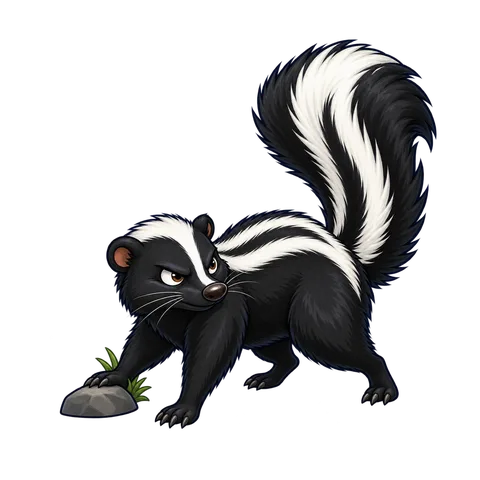
Picture stepping out onto your back porch at dusk to grab the recycling bin, only to catch a faint, unmistakable whiff of sulfur in the damp air while your porch light catches a stocky, waddling shape slipping beneath the wooden deck stairs. What puts these creatures in one group is not just their membership in the mammalian family Mephitidae, but their shared reliance on a slow, deliberate ground gait, five-toed tracks featuring prominent non-retractable claw marks, and that infamous defensive musk, all anchored in this library by the striped skunk.
Telling this group apart from its neighbors comes down to a few field-observable giveaways that rule out lookalikes like raccoons, badgers, domestic cats, and opossums. While a raccoon features a distinctive dark facial mask, a ringed tail, and hand-like front toes that leave dexterous prints, and a cat leaves a round four-toed track with no visible claw marks, a skunk leaves an unmistakable jet-black coat divided by bold white dorsal stripes, coupled with tubular scat packed with insect fragments and signature shallow, cone-shaped holes dug into turfgrass during midnight grub hunts.
Explore skunks
Questions about skunks
Research sources
This page was researched with publications from these institutions, then written and reviewed by The Pest Guide Team:
- University of Wisconsin Extension
- Internet Center for Wildlife Damage Management
- Texas Department of State Health Services
- New Mexico State University Extension
- Pesticide Environmental Stewardship
- University of Nebraska-Lincoln
- U.S. Centers for Disease Control and Prevention (CDC)