Snow flea
Hypogastrura nivicola
- Size
- Little more than 1/8 inch long
- Color
- Grayish-white
- Habitat
- Soil and moist substrates
- Diet
- Algae, bacteria, fungi, decaying matter
- Life cycle
- Direct development through primitive stages
Snow fleas are wingless hexapods belonging to the order Collembola, turning up in massive numbers on winter snowpacks or around building foundations. They look like tiny, moving specks that vanish the moment you try to get a closer look, propelled by a specialized tail mechanism that acts like a coiled spring. People often mistake them for fleas because of this sudden leaping ability, but these creatures have no interest in blood or skin. They spend their lives quietly going about the business of breaking down decaying organic matter in damp earth. When winter thaws saturate the soil, rising water pushes them out of their subterranean homes and forces them upward. They crawl toward any available warmth or light, which frequently leads them right onto basement floors or into ground-level living spaces where the dry indoor air finishes them off quickly.
Identity
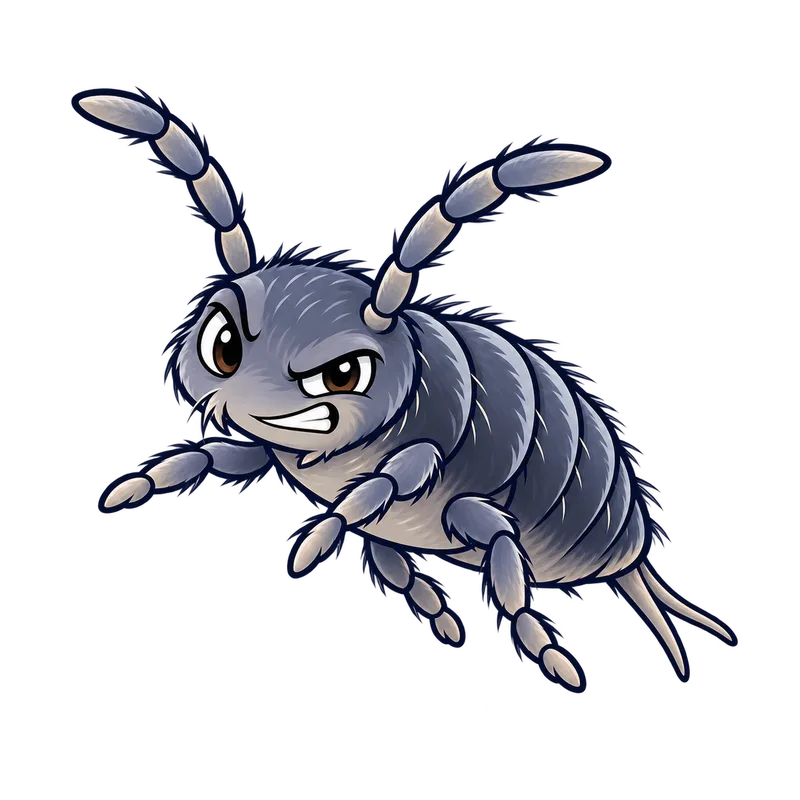
Snow fleas are tiny, soft-bodied creatures that grow to little more than 1/8 inch long and display a grayish-white coloration. They are primitively wingless across all life stages, lacking both wings and wing pads entirely. Their most reliable field mark is a ventral jumping apparatus known as a furcula, which acts like a coiled spring and causes them to leap abruptly when approached or disturbed. To an unassisted human eye, they appear simply as moving specks. Confirming finer structural details requires a hand lens or 10x magnification, which reveals six legs, long antennae, and the absence of any biting mouthparts.
Habitat & behaviour
Outside, you find these creatures living in damp soil, leaf litter, decaying plant matter, and the organic mulch piled against building foundations. In fertile ground, populations can reach tens of thousands per cubic foot. Their diet consists of microscopic algae, bacteria, fungi, and decaying organic detritus. Their daily routine is tied directly to moisture and temperature shifts. Major indoor invasions typically happen in winter and spring when melting snow or heavy rain floods the topsoil. Saturated earth forces them out of their underground homes and drives them to climb foundation walls. After dark, outdoor lights draw them in, and they slip inside through tiny cracks, gaps, and pipe penetrations. Once they cross the threshold, standard living spaces prove far too dry, causing them to dry out and die very quickly.
Visual variations
These insects do not form social colonies like ants or termites, and you will not spot any obvious differences between the sexes with the naked eye. Across every stage from nymph to adult, their basic body plan stays the same. They keep an elongate, soft-bodied form with six walking legs, a pair of slender antennae, and no wings. The main difference between a growing nymph and a mature adult is simply scale. Both share the same grayish-white tone and that distinctive jumping mechanism tucked along the underside of the abdomen. Because they grow directly rather than going through a complete transformation with a resting pupal stage, young ones look like miniature versions of their parents the moment they hatch.
Why it matters
Finding thousands of jumping specks in your basement after a thaw looks alarming, but these creatures are entirely non-parasitic. They never bite humans or pets, and they pose zero threat to structural timber, drywall, or fabrics. Their arrival simply serves as a natural indicator of elevated moisture, water seepage, or poor crawlspace ventilation. The main concern involves massive indoor die-offs. When large numbers perish in dry indoor air, their accumulated bodies, shed skins, and waste can trigger allergic responses or asthma in sensitive people, while also drawing in secondary scavenger pests. Chemical treatments are rarely necessary. Fixing outdoor drainage, sealing foundation gaps, and lowering indoor humidity will naturally end the visit.