
Hemlock woolly adelgid
Adelges tsugae
- Size
- Not established
- Color
- Dark brown to blackish, obscured by white waxy secretions
- Habitat
- Coniferous and mixed forests, urban parks, and landscape plantings
- Diet
- Phloem sap of hemlock and cedar trees
- Life cycle
- Annual generations with parthenogenetic reproduction
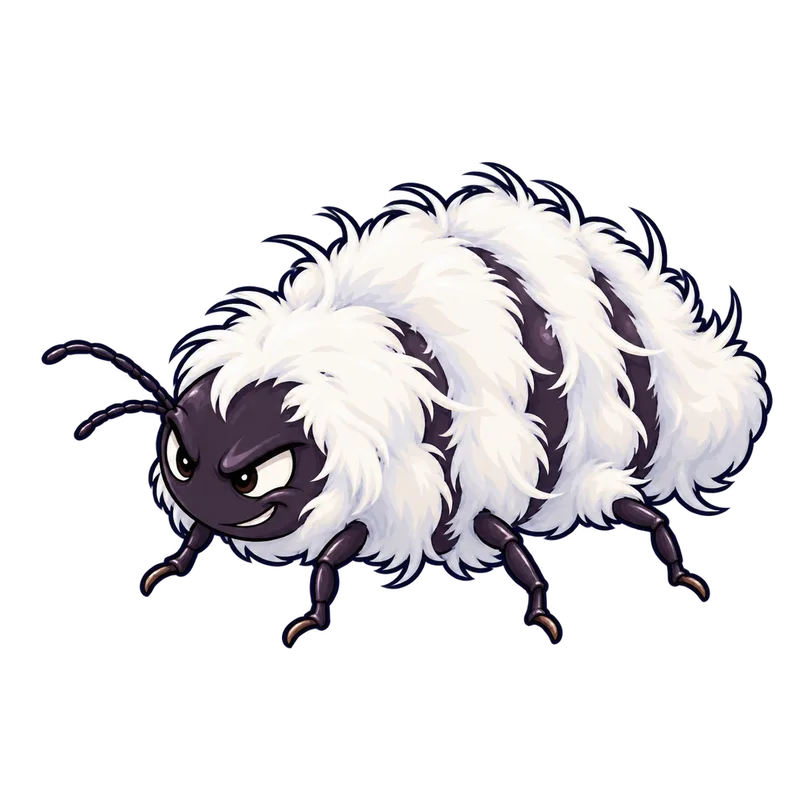
The hemlock woolly adelgid is an introduced invasive insect native to Japan that targets conifers in North American forests and landscapes. Looking at an infested branch without magnification, you will not see an insect body at all. You will see what looks like the tips of cotton swabs stuck to the plant.
Identity
The primary diagnostic sign is the presence of bright white, cottony or wool-like waxy sacs located specifically on the underside of hemlock twigs. These masses are attached directly at the base of individual needles where they join the stem.
Adult females are microscopic, dark brown to blackish, oval, and segmented. Because they live entirely encased inside their protective waxy secretions, confirming the actual insect body requires high-power magnification, such as scanning electron micrographs at 100x magnification, to observe thoracic and abdominal segmentation and piercing-sucking stylets.
This insect is frequently confused with other conifer pests, but simple field marks set it apart. The pine bark adelgid produces white waxy secretions on the trunks and larger limbs of pine trees rather than hemlock foliage. Spruce gall adelgids feed on spruce and Douglas fir, inducing cone-like galls on the former rather than forming cottony egg masses at the needle bases. The balsam woolly adelgid attacks true firs exclusively. Red pine scale produces cottony filament masses on red pines. Fungal pathogens like needle blight can cause shoot dieback and discolored needles on hemlocks and cedars, but they never produce the white woolly insect egg sacs found at the base of hemlock needles.
Habitat & behaviour
This species lives in natural coniferous and mixed hardwood forests, riparian corridors, urban parks, green spaces, and residential landscape plantings containing host trees. The primary host in North America is the Eastern hemlock, which possesses no genetic host resistance to attack. Secondary regional hosts include Western hemlock and Mountain hemlock, alongside associated genera monitored in biosecurity surveys such as true cedars.
Activity occurs year-round, though the white cottony egg sacs are most prominent and visually distinct from late winter through spring. Eggs hatch into mobile crawlers between April and June. These crawlers move along twigs to find feeding sites, settling exclusively at the base of current and previous year needles. Once they insert their stylets into the plant tissue, they become sessile and remain in place for the rest of their lives.
Dispersal across distances relies heavily on human-assisted transport. Moving infested nursery stock, hemlock logs, commercial timber, and firewood carries the pest to new regions. Crawlers also hitchhike on outdoor equipment, camping gear, vehicles, tarps, and clothing. Natural spread occurs when wind, birds, and mammals dislodge and carry the tiny mobile crawlers to neighboring trees.
Visual variations
You are dealing with a creature that moves through eggs, nymphs, and adults, though the family tree keeps things remarkably simple by skipping males entirely in North American populations. These introduced lines reproduce through parthenogenesis, meaning females crank out offspring without needing a partner, which helps explain how a single wanderer can start a forest-level problem. Most of what you see on the tree will be wingless adult females holding their ground.
Eggs sit tucked safely inside those fluffy white waxy sacs plastered across the undersides of young hemlock twigs. When they hatch, the tiny youngsters are called crawlers, and they do not have the heavy cottony armor yet. They have to hoof it along the branch to find a decent spot to eat.
Once a crawler picks a needle base, it drives its straw-like mouthparts deep into the plant, settles down for good, and starts spinning the waxy threads that build its signature woolly coat. By the time those nymphs grow into adults, they turn into dark, oval, segmented bugs completely hidden under the white masses that eventually guard the next round of eggs.
Why it matters
An infestation does not just sit there looking odd. It thins out the foliage, makes the needles cup inward, turns them from a healthy green to a dull grey-green, and drops them prematurely. When the attack gets heavy, twigs swell up, die off, and the whole canopy collapses. A tree usually goes downhill and dies anywhere from 4 to 10 years later, though some hold on for up to 20 years if they are lucky, and dry spells speed up the decline.
Eastern hemlock is not just another tree in the woods. It forms foundational ecosystems that keep streams cool in summer, hold the soil together, and give countless forest animals a place to live and eat. When the canopy goes, the whole forest around it changes character.
The good news is that these bugs do not bite, sting, carry human diseases, or drop irritating hairs, so they will not hurt you or your pets. They also leave your house and wooden furniture completely alone, as they are strictly botanical diners.
You cannot just treat this pest however you like because it sits on high-priority quarantine lists managed by federal and state or provincial agriculture departments. Laws tightly control moving hemlock nursery plants, logs, raw timber, and firewood out of quarantined zones to keep the bugs from hitchhiking into new areas. If you spot one outside a known quarantine zone, you need to report it to the local forestry or agriculture authorities right away.