
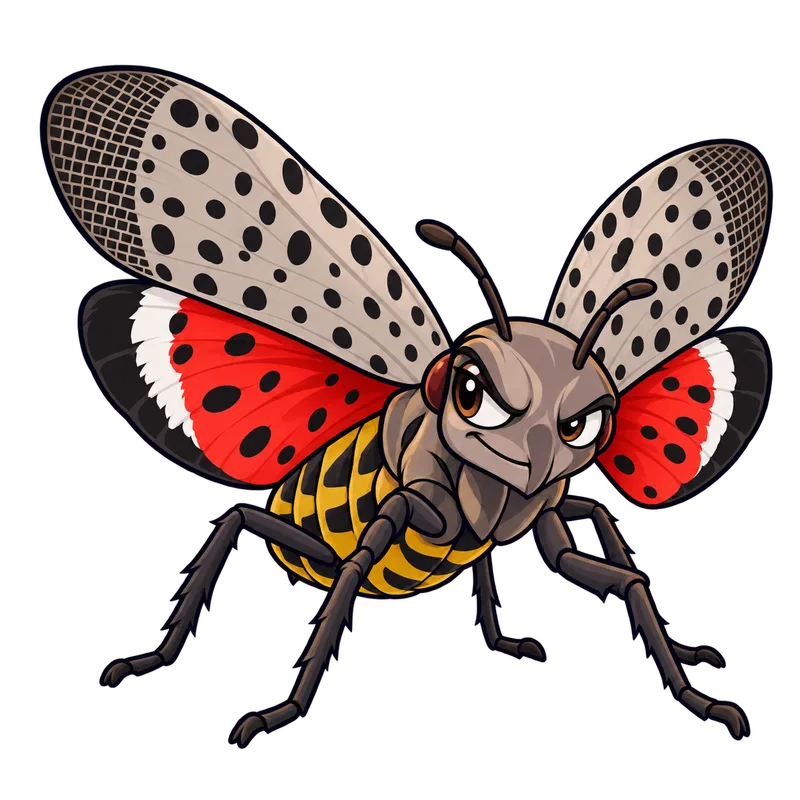
Spotted lanternfly
Lycorma delicatula
- Size
- 20 to 26 mm long as adults
- Color
- Grey-tan forewings with black spots, bright red hindwings
- Habitat
- Woody plants, trees, and outdoor man-made structures
- Diet
- Phloem sap from over 70 plant species
- Life cycle
- One generation per year with incomplete metamorphosis
The spotted lanternfly is an invasive planthopper that spends most of its life masquerading as something else until it flashes its hidden colors. At 20 to 26 mm in body length, an adult at rest looks like a muted, grayish-pink or tan leafhopper with black spots folded tent-like over its back. A closer look at the outer third of those forewings reveals a fine, dark, net-like reticulation that looks remarkably like lace. If the insect startles and opens its wings, the surprise is total: the hindwings flash a brilliant crimson red with black spots, split by a solid white transverse stripe and tipped with dark blackish-brown. The abdomen underneath is a striking bright yellow barred with horizontal black bands. People frequently confuse the adult lanternfly with native leafhoppers and spittlebugs, but those native insects are drastically smaller, usually measuring just 3 to 10 mm long, and completely lack that vibrant red underwing. The confusion gets even more interesting when looking at where the creature leaves its signature. Female lanternfly egg masses are 30 to 50 mm long and contain 30 to 50 eggs laid in straight lines. They are covered in a smooth, glossy, mud-like secretion that hardens into a greyish-tan crust. Over the winter, that crust darkens, dulls, and develops fine vertical cracks that look like a splash of dried soil on bark or stone. That natural camouflage often leads to mix-ups with the spongy moth, another unwelcome visitor that leaves egg masses on outdoor surfaces. However, spongy moth egg masses are much larger, holding anywhere from 100 to 1,000 eggs under a soft, velvety, tan or buff-colored coat of hairs. Another lookalike, the Asian longhorned beetle, is actually a wood-boring beetle with chewing mouthparts, smooth black elytra with white spots, and extremely long black-and-white banded antennae, meaning it lacks both the red hindwings and the sucking mouthparts of the lanternfly. For early first to third instar nymphs, which are glossy jet-black with stark white stippling, or for inspecting the fine margins of an egg mass crust, pulling out a 10x hand lens helps clear up any doubt.
Identity
Telling the spotted lanternfly apart from other insects comes down to spotting specific structural and color clues at the right distance. At a casual glance, a resting adult shows greyish-tan forewings marked with black spots and a lace-like texture at the tips, measuring 20 to 26 mm long. If you suspect you are looking at something else, check the underside or wait for it to jump, because native leafhoppers and spittlebugs stay much smaller, between 3 to 10 mm, and never reveal a bright red hindwing marked with black spots and a white band. When inspecting outdoor surfaces for overwintering signs, remember that spongy moth egg masses look like soft, buff-colored velvet patches packed with hundreds of eggs, whereas a lanternfly leaves a smaller, 30 to 50 mm mass containing 30 to 50 eggs arranged neatly in parallel lines beneath a mud-like grey crust. For tiny first-stage nymphs or the crisp edges of an egg mass, a 10x hand lens provides the necessary magnification to confirm the stark white spots on a glossy black or bright red body.
Habitat & behaviour
This insect is a master hitchhiker, which explains how it manages to show up in unexpected places far from the nearest forest. While its native home spans across Asia, it has made itself thoroughly at home across parts of North America by latching onto the human habit of moving things around. Long-distance travel happens almost entirely by accident. An adult settling onto a camping trailer in late autumn, or an egg mass glued silently to the underside of a shipping container, rides across state or provincial lines without a ticket. Once it arrives, it zeroes in on the tree of heaven, its preferred host plant, alongside more than 70 other species of trees, vines, and woody ornamentals, including commercial grapevines, apples, stone fruits, maples, and oaks.
The daily life of a lanternfly centers entirely on group dining and intense crowding. Nymphs and adults are social creatures in the practical sense, refusing to live solitary lives and instead packing into massive, heaving congregations that completely encircle tree trunks, grape vines, and woody stems. They rely on specialized mouthparts shaped like tiny, rigid straws, driving straight into the plant vascular network to draw up nutrient-rich phloem sap.
That relentless feeding produces an enormous quantity of liquid waste called honeydew. As the swarm gorges on sap, it discharges a clear, sugary fluid that showers down from the canopy onto whatever rests below. Step beneath a heavily infested tree on a warm afternoon, and you might easily mistake the fine spray for a passing rain shower. This sticky rain coats patio tables, wooden decks, vehicles, and lower plants, quickly sprouting a heavy coat of dark sooty mold that blocks out sunlight and halts photosynthesis. The continuous drain on plant resources stresses trees and can wipe out entire commercial vineyards in just one growing season.
Visual variations
Watching these insects shift through a single year can easily make you think you are looking at entirely different creatures. There are no social castes like workers or soldiers here because each insect lives an independent life, and physical differences between sexes are so minor that only an expert spots that females are slightly larger when carrying eggs. Both males and females share the exact same adult dimensions and striking wing colors. The life cycle follows an incomplete metamorphosis, stepping straight from egg to nymph to adult without a resting pupal phase.
The process kicks off inside the egg stage, where tiny brown embryos remain tucked safely beneath a mud-colored crust on tree bark, rusted tools, or concrete walls. When warm weather arrives in late spring, the first-stage nymphs emerge as wingless, energetic jumpers. Through their first three growth stages, they resemble shiny black beetles heavily marked with sharp white dots, springing away in a hurry whenever a shadow crosses their path.
By the time they reach the fourth and final juvenile stage in mid-summer, their appearance shifts dramatically. The body grows longer, and the shiny black coat trades places with a vibrant scarlet red covered in black patches while retaining those familiar white spots. Small wing pads start expanding along the back, showing that the final molt into a winged adult is near. Once that skin splits open in July, the insect exchanges its red-and-black ground look for the muted grey-tan forewings that conceal those brilliant red hindwings until it takes flight.
Why it matters
Finding a spotted lanternfly on your property is rarely quiet, and it brings a distinct set of problems for homeowners and farmers alike. Although the insect does not bite, sting, or carry diseases that threaten people or pets, its overwhelming numbers make it a major pest. The sugary waste dripping from overhead crowds ruins outdoor seating areas, and the dark mold that follows leaves a stained, fermented mess on cars and patios. On top of that, this sweet mess draws in hordes of hornets, yellowjackets, and wasps, turning a peaceful backyard into a buzzing hazard.
For the wider environment and local farming, the consequences are much more severe. Commercial vineyards, apple orchards, fruit farms, and hardwood forests suffer serious decline when massive swarms drain plant vitality season after season. Because of this high agricultural threat, many regions classify the insect as a regulated quarantine pest under government guidelines. Spotting one can trigger mandatory reporting rules or strict compliance guidelines for anyone transporting nursery plants, timber, or outdoor gear away from quarantined areas.
Proper identification plays a vital role when managing these populations. Scraping an egg mass off a fence or a stack of firewood is an effective way to stop them, but it has to be done correctly. Simply knocking the eggs onto the soil leaves them fully capable of hatching in the spring. Instead, those eggs must be scraped firmly using a rigid tool directly into a jar filled with rubbing alcohol or soapy water to ensure they are destroyed, helping protect local orchards and vineyards for another year.