
Which official map shows current spotted lanternfly status in Pennsylvania?
The official map tracking spotted lanternfly status in Pennsylvania is the interactive regional distribution map published by the New York State Integrated Pest Management Program at Cornell University. This live online tool relies on color coding to show current boundaries, marking established infestations in blue, state quarantine zones in red, and isolated sightings in purple.
What is actually going on
You are loading up the car for a weekend camping trip, or maybe you just noticed a strange, greyish smudge on your backyard patio table that looks like dried-out mud. Someone mentioned spotted lanternflies, and now you are wondering if your specific Pennsylvania county is officially under quarantine, or how far these bugs have actually spread. You want an official map you can trust, not a random blog post from five years ago showing outdated boundaries.
The primary official map tracking spotted lanternfly status in Pennsylvania and the broader eastern United States is the interactive regional distribution map published by the New York State Integrated Pest Management Program at Cornell University, working alongside the Pennsylvania Department of Agriculture and federal agriculture agencies. You can find this live spatial tool online by heading to the NYS IPM spotted lanternfly mapping page. It cuts through the confusion by breaking down regions into clear regulatory tiers using color coding. Blue shading marks where established infestations are present, red outlines show internal state quarantine zones, and purple markers point out individual finds or isolated sightings where no reproducing population has taken root yet.
Why does this map matter so much right now? Since these plant-hopping insects first showed up in Berks County, Pennsylvania, back in 2014, they have steadily expanded across seventeen states. Pennsylvania now has internal quarantine rules covering nearly all of its counties. That means if you live in the state, chances are high you are already inside a regulated zone. The map gives residents, business owners, and travelers a reliable way to check boundaries before moving firewood, outdoor furniture, or commercial freight.
How to tell for sure
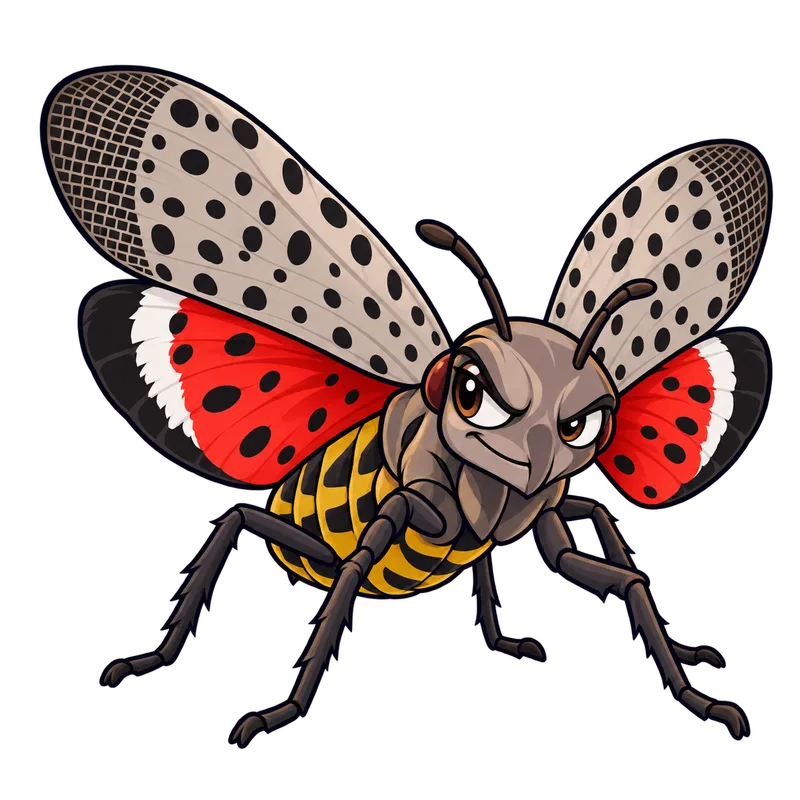
Before you start panicking or trying to control a bug you cannot identify, you need to know what you are actually looking at. Spotted lanternflies are not flies or moths at all, despite their name, but rather planthoppers that feed on plant sap. Adults usually measure about 20 to 26 mm long, which is roughly an inch. When they rest, their greyish-tan forewings display black spots near the base and a fine grid pattern at the tips. If they open their wings, you will see a flash of bright pinkish-red underneath, marked with bold black spots and a white bar. Their abdomens are yellow with clear black horizontal stripes.
If you are looking at trees, fences, or vehicles between October and May, you are usually searching for egg masses instead of live adults. A fresh egg mass usually looks like a smear of grey putty or wet mud, measuring roughly 30 to 50 mm long. Inside, the eggs are arranged in neat, vertical, parallel lines. As winter sets in, that putty-like covering dries out, darkens, and cracks so it resembles dry mud splattered against the bark.
People often confuse these egg masses with harmless dirt or lichen on a tree trunk. If you want to check closely, you can use a hand lens at 10x magnification to spot the tiny, cylindrical individual egg shapes or the open pores left behind by hatched eggs in the spring. If you find a single suspect bug or egg mass in an area far outside known quarantine zones, you usually need to pause and contact your local state department of agriculture or extension office rather than assuming you have a massive local infestation.
What usually comes next
After you check the official map and figure out your local standing, you generally face a straightforward choice about yard work. If your address sits comfortably inside an active quarantine boundary in Pennsylvania, your main goal changes from keeping them out to keeping their numbers down and stopping them from catching rides on your stuff. You can stop calling the authorities for every lone insect if your whole county is already colored in on the tracking chart, but you still need to protect your maples, fruit trees, and garden fences from getting overrun.
When those mud-like egg clumps turn up on your patio chairs, wood piles, or camping gear through the colder months, you can easily scrape them off with a plastic scraper, a drywall knife, or an old kitchen spatula. Here is the detail everyone misses, though: knocking the eggs off onto the grass does not actually stop them. Plenty of those tiny nymphs will still hatch when the weather warms up in April. You have to scrape them straight into a jar of rubbing alcohol or concentrated dish soap to destroy them before you throw the container in the garbage bin.
If your routine takes you outside the quarantined region, you need to pick up a new road trip habit. These insects are terrible flyers over any real distance, but they are world-class hitchhikers. An adult or an egg patch hiding out on your wheel wells, roof cargo box, or camper can easily catch a free ride to a clean part of the state. Taking thirty seconds to walk around your car and check the hot spots before you hit the highway usually keeps you from spreading them by accident.
When to get help
There are moments when scraping and squishing in the backyard just will not cut it, and you need to bring in someone with professional tools or official backing. If you spot a suspected population in a county that is still clear on the official map, you need to reach out to the Pennsylvania Department of Agriculture right away with clear pictures and exact directions before you start trying to kill them yourself.
Handling massive numbers of bugs on huge shade trees or commercial farmland takes serious care with chemical treatments. The product label is the final legal rule, meaning you cannot make up your own mixing ratios, use sprays on crops that are not listed on the bottle, or dump leftover mixtures down street gutters where they can run straight into local streams. On top of that, tree trunk injections or soil drenching with systemic products like imidacloprid or dinotefuron usually demand specialized gear and safety training. If you are facing a heavy canopy attack or need compliance permits to move business freight across borders, call a licensed pest control professional to do the work the right way.