
Flies & Gnats
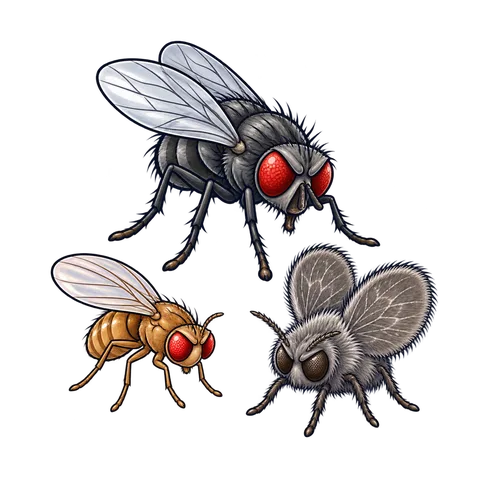
What gathers these thirteen creatures into one catalog group is a streamlined flight plan built on a single pair of membranous wings, while their hind wings have evolved into tiny balancing organs called halteres that act like biological gyroscopes. Even though common names shove delicate drain gnats and bulky horse flies under the same broad umbrella, this group actually splits down the middle into delicate, long-antennaed gnats and stout, short-antennaed true flies that share little evolutionary kinship beyond that two-winged blueprint.
Telling this group apart from its four-winged neighbors in your home or garden usually comes down to counting wings, checking antennae, and looking at where the pests are congregating. If you see a furry little insect resting with its wings held in a tent shape over its body near a damp sink, you are looking at a drain fly rather than a moth, which has dusty, overlapping wing scales and a coiled mouthtube. If a pest has a narrow waist and four distinct wings like a wasp or a bee, it does not belong here either, since every fly and gnat in this collection relies exclusively on its two front wings to navigate.
Explore flies & gnats
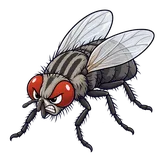 House flyMusca domestica
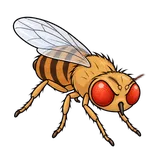 Fruit fliesFamily Drosophilidae
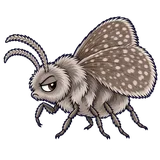 Drain fliesFamily Psychodidae
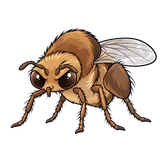 Phorid fliesFamily Phoridae
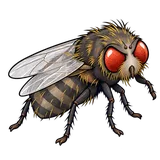 Cluster fliesPollenia species
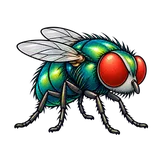 Blow fliesFamily Calliphoridae
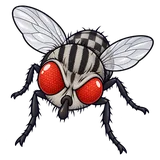 Flesh fliesFamily Sarcophagidae
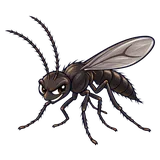 Fungus gnatsFamily Sciaridae
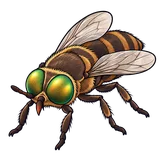 Horse fliesFamily Tabanidae
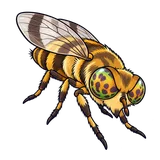 Deer fliesChrysops species
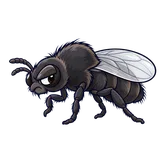 Black fliesFamily Simuliidae
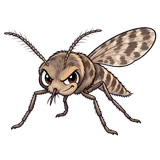 Biting midges / no-see-umsFamily Ceratopogonidae
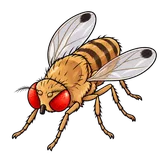 Spotted wing drosophilaDrosophila suzukii