
How do you get rid of flesh flies?
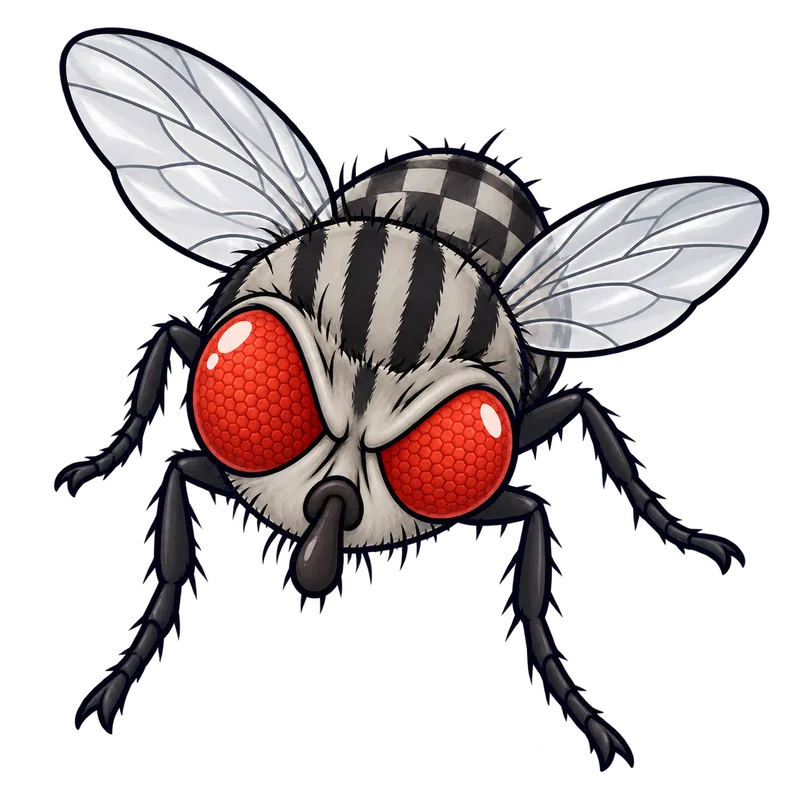
To get rid of flesh flies, you must find and physically remove the primary breeding source, which is almost always a dead animal carcass or rotting waste hidden inside the structure. If the source is completely inaccessible, seal all cracks around baseboards and outlets with caulk, then use sticky traps or a vacuum cleaner to catch the adult flies as they emerge for one to three weeks.
What is actually going on
You walk into the living room on a quiet Tuesday afternoon and notice half a dozen large, sluggish gray flies pressing themselves flat against the sunny windowpane. They look bulkier than your average house fly, and when you get close, you spot three distinct dark stripes running down the back. A faint, earthy odor seems to drift out from the hallway or the baseboards. You grab a rolled-up magazine, but swatting them one by one feels suspiciously pointless because more keep showing up tomorrow.
To get rid of flesh flies for good, you have to find and physically remove the primary breeding source, which is almost always a dead animal carcass or a patch of rotting organic waste hidden somewhere inside the structure. Flesh flies live in close association with human buildings, but they rarely set up housekeeping indoors unless there is a specific, protein-rich medium available for their young. When you see them buzzing around indoor windows in noticeable numbers, it usually points to a dead rodent, bird, or squirrel trapped behind a wall void, inside a chimney, or up in the crawl space.
Unlike typical filth flies that lay clusters of tiny eggs, female flesh flies hatch their young internally. That means the female deposits active, wriggling larvae directly onto carrion or decaying waste. Because they skip the egg incubation stage on the host substrate, the maggots start feeding the second they hit the meat. This rapid start accelerates decomposition and leads to a short, intense cycle where fully fed larvae eventually migrate away from the carcass to find dry cracks for pupation, which is the resting stage where they transform into adults.
That wandering phase is often when homeowners first realize they have a problem. Plump, creamy-yellow maggots start crawling out from beneath baseboards or dropping through ceiling light fixtures while searching for a dry spot. Spraying an aerosol bug bomb into the room or the walls will only knock down a few adult fliers while leaving the core problem untouched. In fact, discharging foggers into enclosed structural voids often leaves masses of dead insects behind, which then draw secondary scavengers like carpet beetles and pest ants into your walls.
How to tell for sure
Adult flesh flies generally measure 10 to 14 mm in length, making them noticeably larger and stockier than common house flies. You can usually identify them with the naked eye by looking at their overall dull gray color and the three bold, dark longitudinal stripes running down the top of the middle body segment. Their abdomen features a distinct gray-and-black checkered pattern that shifts like a woven checkerboard jacket as the light hits it, and their eyes are usually a prominent reddish-brown.
People often confuse them with house flies, blow flies, or stable flies, but a few quick visual checks clear things up. House flies have four dark thoracic stripes instead of three. Blow flies usually sport a shiny metallic blue, green, or copper sheen with no stripes at all. If you are worried about bites, you can usually relax because flesh flies possess non-biting sponging mouthparts and are incapable of piercing skin. Biting insects with four stripes and a sharp, bayonet-like mouthpart are typically stable flies instead.
When you look closer with a magnifying lens, you can spot wing venation details, such as the fourth longitudinal vein bending sharply forward toward the leading wing edge. However, confident identification down to an exact species usually requires a specialist to inspect microscopic structures under high magnification in a laboratory setting. For everyday household control, confirming the broad genus through size, the three thoracic stripes, and the checkered abdomen is enough to guide your next move.
What usually comes next
Once you are sure you are dealing with flesh flies, your single most practical decision is to hunt down and eliminate the dead animal or organic waste fueling the infestation. No amount of surface spraying, sticky traps, or window swatters will solve the issue while a carcass remains tucked inside a wall void or an unsealed attic space. Put on disposable gloves, pick up the dead animal, place it inside a heavy plastic bag, double-bag it, and throw it out in an outdoor trash container with a tight-fitting lid.
If the carcass is trapped deep inside an inaccessible wall void or beneath a concrete slab where physical removal would require tearing up your drywall or flooring, you have to pivot to a containment strategy. Seal all cracks around baseboards, electrical outlets, and trim with caulk to force any newly emerging flies toward the windows rather than into your living quarters. From there, use sticky traps or a vacuum cleaner to catch the adult flies as they emerge and head for the light.
That emergence usually lasts for one to three weeks until the hidden carcass completely dries out and the food source is exhausted. After the flies stop appearing, focus on outdoor proofing to stop it from happening again. Install tight-fitting screens on your windows, repair any gaps around exterior doors with weatherstripping and door sweeps, and cap your chimney with wire mesh to keep wildlife from nesting where they should not.
When to get help
There are times when a DIY approach hits a wall and you need to bring in outside help. Call a professional pest control operator or a licensed wildlife removal service when the dead animal is lodged deep within an inaccessible structural cavity, chimney, or subfloor that requires specialized cutting or demolition to extract. Commercial buildings, food processing facilities, and healthcare settings should always rely on licensed commercial applicators to manage fly infestations and maintain sanitary compliance.
You should also consult a local wildlife management agency if the underlying cause involves protected birds, bats, or mammals nesting and dying inside your structure, as local laws often dictate how those species can be handled or excluded. Never attempt to bypass local wildlife regulations on your own when dealing with structural animal incursions.
On the health side, flesh flies pick up bacterial pathogens like Escherichia, Salmonella, and Shigella from the decaying matter they frequent, and they can mechanically transfer those organisms to food preparation surfaces. While they are primarily mechanical vectors rather than biters, if you suspect larval contamination of an open wound, accidental ingestion of maggots, or if you develop a severe allergic reaction or secondary infection, contact a qualified medical clinician, urgent care facility, or poison control center right away.