
Are flesh flies dangerous?
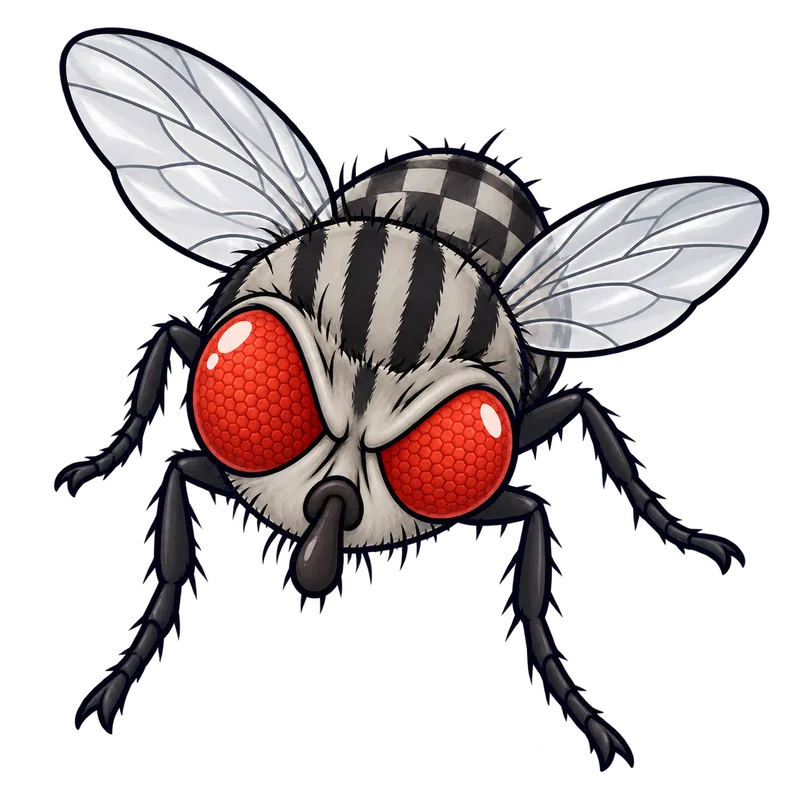
Flesh flies do not bite or sting humans because they possess soft mouthparts designed for lapping up liquids. Measuring 10 to 14 mm long, these gray-and-black insects act as mechanical vectors of filth pathogens when they land on indoor surfaces.
What is actually going on
You walk into the living room on a warm Tuesday afternoon and notice a large, sluggish gray fly sitting right on the windowpane, looking entirely too heavy to bother you. It is roughly the size of two house flies end to end, and when the sunlight hits its back, you see a distinct checkerboard pattern of gray and black alongside three dark stripes running down its thorax. You might wonder if it is going to bite you or your children, or if your living room has suddenly become a health hazard.
To answer the main question right away: flesh flies do not bite or sting humans. They possess soft, sponging mouthparts rather than piercing mouthparts or a stinger, meaning they are physically incapable of drawing blood. If you have ever felt a sharp prick or a painful bite indoors, a stable fly or a mosquito is responsible, never a flesh fly. Their mouthparts are designed strictly for lapping up liquids and dissolved organic matter, much like a tiny sponge mopping up a spill.
That does not mean you should ignore them entirely. While they cannot bite, they do present a moderate health risk as mechanical vectors of filth pathogens. They spend their time outdoors visiting animal carcasses, garbage dumpsters, and pet waste, picking up bacteria on their bodies and feet. When they wander indoors and land on your kitchen counter or fruit bowl, they can transfer those unwanted germs. Think of them like someone walking through a muddy construction site and then tracking dirt across your clean living room rug.
There is also another side to their presence. Female flesh flies give birth to live, active larvae rather than laying eggs, which gives their young a running start on decaying matter. If you suddenly find a number of flesh flies indoors or notice wandering maggots on a floor or a hearth, it almost always points to a dead rodent, bird, or squirrel hidden away in a wall void, attic, or chimney. The flies are simply acting as uninvited detectives, announcing that a small animal met its end behind the drywall a few days ago.
How to tell for sure
Before you try to fix a fly problem, you need to know what you are looking at. Flesh flies belong to the family Sarcophagidae, and they usually measure between 10 to 14 mm in length, which makes them noticeably larger than the standard house fly you see buzzing around the kitchen.
You can spot them with the naked eye by checking a few reliable features. Look for the thorax, which is gray and features three distinct dark longitudinal stripes running down its back. House flies usually have four stripes, so that count alone rules them out. The abdomen of a flesh fly displays that gray-and-black checkerboard pattern that seems to shift appearance depending on the angle of the light. In several common species, the very tip of the abdomen even has a reddish or pinkish tint.
If you happen to use a hand lens at 10x magnification, you can usually confirm the absence of a forward-projecting bayonet proboscis, which further separates them from biting flies. However, telling one exact species of flesh fly apart from another requires specialist microscopic examination of male genitalia or DNA markers, which is usually only done in forensic or laboratory settings.
Remember that a skin lesion, a mysterious mark on your arm, or a photograph alone can never confirm a flesh fly identification or a pest diagnosis. If you need absolute certainty about a biological specimen, physical collection and review by an entomologist is usually required.
What usually comes next
When you discover flesh flies indoors, your single most practical decision is to hunt down and remove the hidden breeding source rather than reaching for an aerosol spray can. Spraying an insecticide in the room might knock down a few adult flies for the afternoon, but it will never solve the underlying issue if a dead animal remains tucked inside your chimney or wall void.
You need to decide whether the source is outdoors in your waste management or indoors within your structural space. If you find a sudden cluster of adults inside during warm weather, check for structural entry points and wildlife access near your attic or crawlspace. Cap chimneys and cover roof vents with sturdy wire mesh to keep animals from getting trapped and dying in the first place.
If the flies are coming from an outdoor problem, inspect your yard for unburied pet waste, decaying organic matter, or overflowing trash cans. Keep your outdoor dumpsters tightly covered and positioned away from building entrances to avoid attracting more flies toward your doorways. Once you remove the carcass or clean up the organic breeding site, the fly population will naturally drop off. For chemical treatments or large-scale larvicides, remember that product labels govern all use, and deciding on structural perimeter treatments in commercial or shared settings usually belongs exclusively to a licensed pesticide applicator.
When to get help
There are moments when a DIY approach is no longer appropriate, and you need to bring in outside help. If you are experiencing persistent indoor fly surges where the source is entirely inaccessible, such as deep inside sealed brickwork, complex wall voids, or high chimneys, you should engage a licensed pest control operator or a wildlife exclusion specialist to locate the carcass and repair the structural entry points.
On the health side, the situation requires caution. While healthy people are at negligible risk of direct attack, neglected domestic animals, livestock with soiled fur or open wounds, or immobile humans with open necrotic lesions can occasionally attract female flesh flies seeking deposition sites, creating a risk of secondary wound myiasis, which is the infestation of living tissue by fly larvae.
Do not attempt to diagnose skin lesions, wound irritations, or gastrointestinal symptoms on your own, and never try to treat them with home remedies or guesswork. If you or someone in your household suspects accidental ingestion of maggots, a larval infestation in a wound, or a severe secondary skin infection, direct them immediately to a qualified clinician, an urgent care facility, or your regional poison control center for professional medical evaluation.