
Do flesh flies bite?
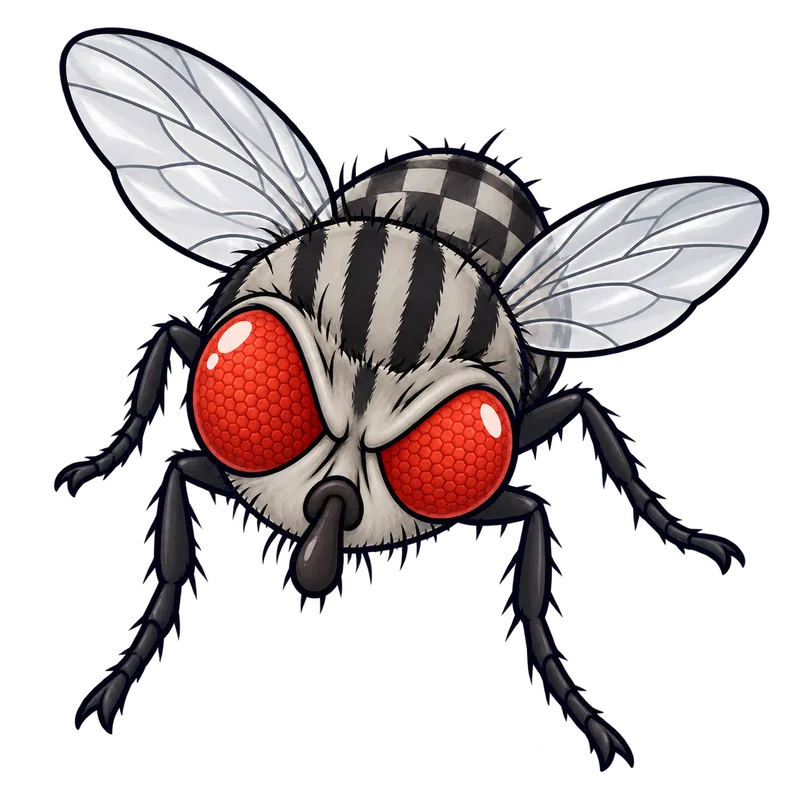
Adult flesh flies do not bite humans or animals at all because their mouthparts are soft and entirely unequipped for piercing skin. Instead of drawing blood, these three-eighths to five-eighths of an inch long gray insects use spongy mouthparts to soak up exposed liquids like sweat, nectar, or moisture from organic matter.
What is actually going on
You are sitting on the porch on a warm afternoon, and a large, intimidating gray fly lands squarely on your arm. You brace yourself for a sharp prick, but instead, you just feel a tickling sensation as the insect walks across your skin looking for a bit of moisture. You might wonder if you are about to get bitten, but the short answer is no. Adult flesh flies do not bite humans or animals at all.
Despite what their grim name suggests, these flies have mouthparts that are entirely unequipped for piercing skin. Think of a flesh fly's mouth as a soft kitchen sponge rather than a hypodermic needle. Instead of mandibles designed for cutting or drawing blood, they possess fleshy lobes at the end of a retractable proboscis. This structure is meant exclusively for soaking up exposed liquids like flower nectar, fruit juices, or moisture from decaying organic matter.
When a flesh fly lands on your skin, it is usually just investigating your sweat for salts and hydration, not sizing you up for a meal. People often confuse them with biting insects because they look rugged and tend to buzz around persistently. If you actually feel a sharp pain or a sudden jab on your ankle, you are dealing with a completely different pest, such as a stable fly or a horse fly, which carry rigid, piercing mouthparts for blood-feeding.
So why are they called flesh flies if they do not bite flesh? The name comes from their reproductive habits and the behavior of their offspring. Female flesh flies skip laying traditional eggs and instead deposit live, wriggling maggots directly onto carrion, garbage, or animal waste. Those larvae feed voraciously on proteinaceous material, which is where the family earns its unappealing moniker.
How to tell for sure
Spotting one of these insects on your windowsill usually comes down to a few distinct physical traits that set them apart from standard house flies. Flesh flies are noticeably larger and chunkier than a typical house fly, usually measuring about three-eighths to five-eighths of an inch long. If you look at one resting nearby, you will usually notice a dull, matte gray body accented by three distinct dark stripes running down the top of the thorax just behind the head.
Their abdomen features another great giveaway, which is a prominent checkerboard pattern of alternating gray and black patches that shifts as the light hits it. In many cases, especially with males, the very tip of the abdomen glows with a subtle reddish or pinkish hue. House flies generally lack that distinct checkerboard look and feature four dark stripes on their back instead of three, making the stripe count a reliable way to tell them apart.
Trying to name a pest from a blurry photograph or a skin reaction is a fool's errand. Skin lesions look different on everyone, and no one can identify an insect from a mark it supposedly left on you. If you need absolute proof of the exact species, an entomologist has to look at microscopic bristles or dissect the bug under high magnification. For ordinary life around the house, checking for that heavy gray body, the three dark stripes, and the checkered back will get you close enough.
What usually comes next
Finding a bunch of flesh flies indoors when the weather turns warm means you have a simple choice to make: do you hunt down the source, or do you just grab a swatter? A standard swatter or a sticky trap takes care of the individual visitor buzzing against your kitchen window, but those tools only address the symptom. Seeing several large gray flies inside your living space almost always means an animal died somewhere out of sight, like inside a wall void, an attic, a chimney, or a crawlspace.
Mice, rats, birds, or squirrels occasionally squeeze into structural gaps, pass away, and instantly turn into a nursery for fly maggots. Spray cans and standard insecticides rarely fix an indoor fly problem if the dead animal stays tucked away inside your framing. Your best bet is figuring out whether you can safely reach and remove the organic source yourself, or if you need to bring in someone with the right tools to check spaces you cannot safely access.
When to get help
Some situations move past a simple household annoyance and call for outside expertise. If you keep seeing large numbers of flesh flies inside even after checking your window screens and emptying every trash can, reach out to a licensed pest control operator or a wildlife removal specialist. They know how to track down and pull hidden carcasses out of wall voids and subfloor areas without destroying your drywall in the process.
On the medical side, you need to be careful if you ever suspect contact between these larvae and an open wound. While it does not happen often, these flies can cause an invasion of living or decaying tissue known as myiasis if the female deposits live maggots onto a neglected injury or if they are accidentally swallowed. Never try to diagnose skin lesions or mystery marks by yourself. If you notice severe swelling, spreading redness, pus, systemic reactions, or any reason to suspect larval tissue involvement, get an immediate evaluation from a licensed clinician, an urgent care clinic, or your local poison control center.