
Why are flesh flies in the house?
Adult flesh flies appear inside a house because a female found her way into a hidden structural space like a wall void and deposited live maggots onto an unseen animal carcass. After feeding on the decaying tissue for a few days, the larvae wander off to transform, and the resulting adults eventually crawl out through gaps into your living room.
What is actually going on
You walk into the living room on a quiet Tuesday morning, and half a dozen large gray flies are buzzing frantically against the window glass. You check the back door, and it is firmly shut. You look at the screens, and there are no tears. Naturally, you wonder how an army of chunky, buzzing visitors managed to move in without your permission.
The short answer is that flesh flies usually appear inside a house because an adult female found her way into a hidden structural space, such as a wall void, attic, or chimney, and deposited live maggots onto an unseen animal carcass. That carcass might be a mouse, a bird, or a squirrel that found a way in months ago and did not make it back out.
Unlike most common domestic flies that lay fragile eggs and leave them to hatch, female flesh flies give birth to active, live young. Think of it as a head start in a biological race. While other flies have to lay eggs and wait for them to hatch, the flesh fly skips the waiting room entirely. She drops fully formed, hungry larvae straight onto a fresh food source, and those maggots immediately get to work feeding on the decaying tissue.
Once those larvae finish feeding after a few days, they go looking for a dry, dark place to transform into adults. They wander away from the carcass into insulation, floor cracks, or wall voids. A couple of weeks later, a new generation of adult flies hatches. They do not want to stay trapped in the drywall, so they crawl toward the nearest light source, which usually brings them right through your baseboards, electrical outlets, or window frames and into your living room.
How to tell for sure
Before you start tearing down drywall or buying traps, you want to make sure you are actually dealing with flesh flies instead of standard house flies or cluster flies. You usually do not need a microscope for this, just a good look at the insect when it lands.
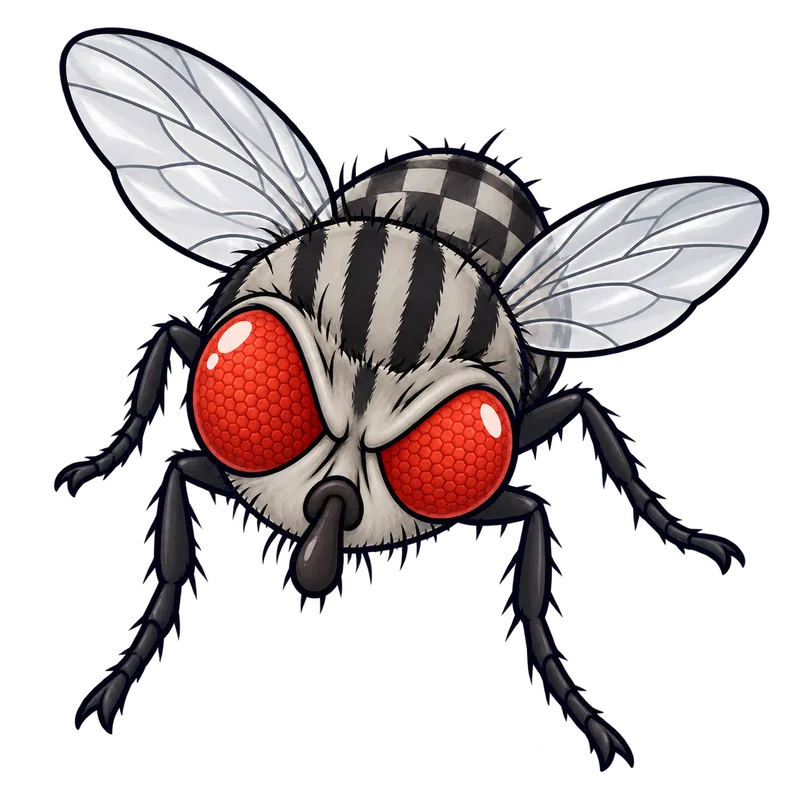
Start by checking the size and the markings on the thorax, which is the middle section of the fly's body just behind the head. Flesh flies are robust and usually measure between three-eighths and five-eighths of an inch long, making them noticeably larger than a standard house fly. Look right down on the top of the thorax. You will usually see three distinct dark longitudinal stripes running from front to back. House flies have four stripes, and cluster flies look dusty with golden or yellowish hairs instead of clear stripes.
Next, look at the abdomen. Flesh flies carry a distinct gray-and-black checkerboard pattern that seems to shift or shimmer as the light hits it from different angles, almost like a mosaic. They also tend to have reddish-brown eyes.
One important detail that usually brings immediate relief is their mouthparts. Flesh flies have soft, sponging mouths tucked beneath their heads. They are built to soak up liquids, meaning they cannot bite or pierce human skin. If something is biting you in the house, it is usually a stable fly or another biting insect, not a flesh fly.
What usually comes next
The single most practical decision you can make right now is to stop wasting money on aerosol room sprays and foggers.
It makes sense why reaching for a can of bug spray feels satisfying when you are staring down a dozen buzzing flies. Sprays offer quick relief because you can literally watch the insects drop out of the air. But aerosol cans only knock down the adult flies that happen to be out in the open at that exact moment. They do nothing to stop the steady stream of new insects hatching behind your walls.
Your real task is to locate and eliminate the source. If you find a dead mouse in an accessible attic corner or crawlspace, remove it immediately by sealing it in a heavy-duty plastic bag and throwing it into an outdoor bin. If the carcass is deep inside a sealed wall void where you cannot reach it without tearing apart your drywall, your strategy shifts. In that situation, you usually have to wait it out while sealing interior gaps around baseboards and light fixtures to keep the emerging flies trapped behind the wall until the food source is completely gone and the hatching cycle stops.
When to get help
There are moments when handling a fly problem yourself stops being practical and starts requiring outside backup.
Call a pest control operator if the source of the flies is completely inaccessible, such as deep within a main wall assembly or beneath a concrete slab, or if the infestation persists for more than a few weeks without slowing down. Professionals have specialized equipment to treat structural voids safely and can inspect for hidden plumbing failures or extensive wildlife nesting.
If the animal behind your wall turns out to be a squirrel, a bat, or another protected wildlife species, contact a licensed wildlife control operator or your local wildlife agency rather than attempting removal yourself. State and federal laws often regulate how wildlife must be handled, especially during sensitive breeding seasons.
Finally, keep medical needs in mind. Flesh flies walk on decaying organic matter and can transfer bacteria onto kitchen counters or food preparation surfaces, posing a contamination risk. If someone in the household accidentally consumes contaminated food and shows signs of severe gastrointestinal illness, or if an open wound on a person or a pet becomes infested with larvae, seek immediate help from a clinician, urgent care facility, or veterinarian.