
What smells do cluster flies hate?
Cluster flies do not hate any smells because scent does not drive their behavior. Essential oils like peppermint, lavender, and clove fail to deter cluster flies since these cool-season overwintering invaders respond exclusively to temperature and daylight rather than odors.
What is actually going on
You walk into the guest bedroom on a crisp October afternoon and find a dozen sluggish, grayish bugs crawling lazily across the windowsill, tumbling onto their backs, and spinning in aimless little circles. You have heard that peppermint oil or a concoction of citrus sprays will send them packing, so you head to the kitchen to mix up a batch. Unfortunately, that pleasant-smelling spray is not going to do a thing. Cluster flies do not care about your essential oils, and no amount of lavender or clove scent will drive them away.
That is because cluster flies are not responding to smells the way other pests might. Entomologists classify these insects as cool-season overwintering nuisance invaders rather than filth flies. Unlike house flies, which seek out garbage, rotting organic matter, and foul odors, adult cluster flies feed outdoors on flower nectar and water during the warmer months. They do not breed inside buildings, and they certainly do not care about your spice cabinet or your scented deterrents.
Instead of being guided by scent, their autumn behavior is entirely driven by temperature and daylight. As the days grow shorter in late summer and early autumn, adult flies enter a state of dormancy called reproductive diapause. Driven by a desire for warmth, they congregate on sun-warmed exterior walls, particularly those facing south and west. They squeeze through tiny cracks, siding gaps, and loose soffits, settling into dark, unheated structural voids like attics and wall cavities to ride out the cold months.
When winter sunshine hits those exterior walls or your home heating warms up the framing, those resting flies wake up prematurely. Disoriented by the sudden warmth, they crawl out of the wall voids and blunder into your living spaces, acting like clumsy, confused drones. Because they entered through physical gaps and not because they were attracted to a particular smell or food source, scent-based repellents simply miss the mark entirely.
How to tell for sure
Before you spend time trying to manage these unwanted guests, you usually need to make sure you are actually dealing with cluster flies and not standard house flies or blow flies. Misidentifying them usually leads to wasted effort, such as buying drain treatments or garbage sprays that will never work on a non-filth pest.
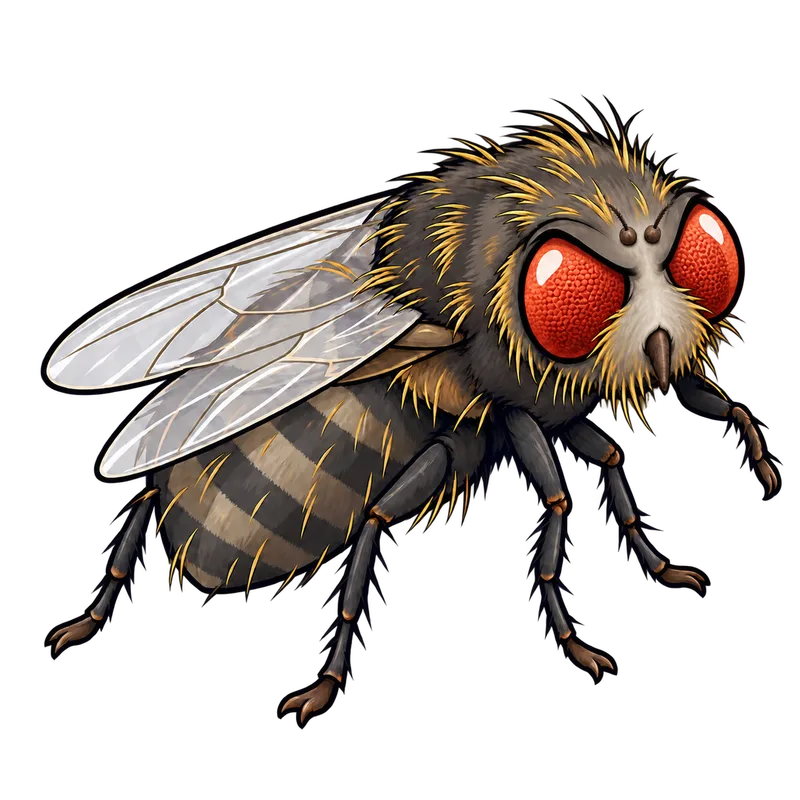
To the naked eye, an adult cluster fly is usually about 9 to 12 mm long, making it slightly larger and more robust than a typical house fly. They have a dark gray or dull grayish-brown body with an irregular checkered pattern on the abdomen. When they land, their wings overlap flat over their backs rather than resting at an angle. If you watch one die on a floor, you will usually see it fall onto its back and spin in aimless circles.
If you grab a magnifying glass, you can look for the definitive diagnostic feature that separates cluster flies from every other nuisance insect. The thorax, which is the middle section of the body, features a dense coat of crinkled, golden-yellow hairs that often look like a dusting of fine pollen or a tiny wool sweater. If the specimen is old and worn, those hairs might be rubbed off, requiring a specialist to check the fine details under a microscope.
You can usually rule out house flies because house flies have 4 distinct dark longitudinal stripes on the thorax and lack those golden hairs. You can also rule out blow flies or bottle flies, which are easily recognized by their shiny metallic blue, green, or bronze abdomens and their loud, aggressive buzzing. Cluster flies are dull, sluggish, and covered in that characteristic golden fuzz.
What usually comes next
Once you confirm you are dealing with cluster flies, you face a practical decision about how to handle them, and your best move depends entirely on the calendar. If it is late summer or early autumn, your primary task is physical exclusion, which means sealing up the exterior of your house before the migration begins. Caulking gaps around window sills, door frames, soffits, eaves, and utility penetrations is the single most important step you can take. Think of it like putting on a winter coat before you step out into a blizzard. If you wait until December when the flies are already buzzing inside your living room, sealing the front door will not undo the party happening in your attic.
If the flies are already inside your walls and emerging into your living spaces in the middle of winter, your options change. You can physically capture active or dead flies using a standard vacuum cleaner or a fly swatter, but remember to empty the canister or seal the vacuum bag immediately to prevent any lingering decay odors. Avoid the temptation to set off a total-release aerosol fogger or bug bomb in the attic. Foggers do not penetrate wall voids where the bulk of the insects reside, and leaving massive piles of dead flies inside your walls is essentially setting out a free buffet for secondary scavengers.
Those masses of dead insects will inevitably attract larder beetles, carpet beetles, and even rodents, turning a minor fly annoyance into a much more complicated pest situation. If you choose to use indoor aerosols, treat only active flying adults as a short-term knockdown measure, and accept that physical removal and tight seasonal sealing are your most reliable tools.
When to get help
There are times when handling a cluster fly issue yourself stops being practical and starts requiring outside help, particularly when structural access or specialized equipment is involved. If sealing upper-story eaves, soffits, and rooflines requires walking on steep roofs or handling ladders and scaffolding in unsafe conditions, you should bring in a professional pest control operator. Reaching those high-elevation sun-warmed walls safely often takes specialized rigging that goes beyond standard household maintenance.
You should also involve a licensed professional if your building requires exterior pyrethroid barrier treatments or the injection of desiccant dusts into enclosed wall voids. Applying dust formulations deep inside cavities requires specialized application equipment and expert knowledge of local regulations and product labels, which govern how these materials can be used without risking environmental runoff.
Furthermore, if the accumulation of dead insects inside your walls triggers a secondary infestation of carpet beetles, larder beetles, or rodents, a pest management professional can properly inspect the voids, clear out the organic debris safely, and treat the secondary pests before they spread into your clothing closets and pantry items.