
Cluster flies
Pollenia species
- Size
- One-quarter to one-half inch in length
- Color
- Dark gray or charcoal with golden-yellow hairs
- Habitat
- Lawns, pastures, and indoor wall voids for hibernation
- Diet
- Flower nectar, plant sap, and surface water as adults
- Life cycle
- Two to four generations per growing season
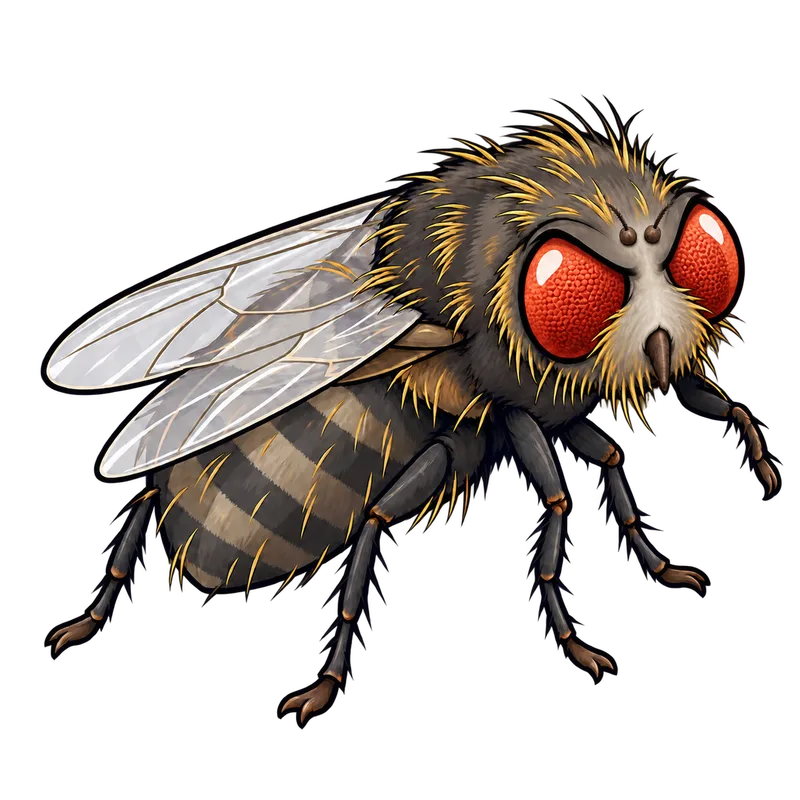
Cluster flies belong to the genus Pollenia, acting as a subgroup within the blow fly family rather than a single isolated species. While Pollenia rudis is the classic name most people know, state extension sources confirm that indoor infestations often involve a complex of closely related species. You are looking at a robust insect measuring one-quarter to one-half inch in length, which places them noticeably larger and broader than a standard house fly.
Identity
The most reliable field mark is the coat of short, crinkled, golden-yellow hairs covering the dark gray or charcoal thorax. These hairs give the upper body a distinct woolly or dusted appearance, though older specimens can lose them from friction. Under good lighting, you can spot these golden threads with the naked eye, but confirming the species requires a ten to thirty times hand lens to rule out other flies. Their nonmetallic abdomen shows a checkered pattern of black and silvery gray patches, and at rest, their transparent wings fold completely flat over the back with the tips directly overlapping along the midline.
Habitat & behaviour
These flies live a double life, spending their summers outdoors in lawns, pastures, and fields where topsoil supports high populations of earthworms. The larvae are obligate internal parasites of those earthworms, meaning they develop entirely underground inside a host before pupating in the soil. They complete two to four generations each growing season, feeding exclusively on flower nectar, plant sap, and surface water as adults. You will never find them breeding in garbage, rotting meat, or animal manure.
The autumn migration makes them a household fixture. As day lengths shorten and outdoor temperatures drop through the mid-fifties Fahrenheit in late summer and early autumn, the final generation stops reproducing and seeks shelter. They congregate on sun-warmed exterior walls, particularly those facing south and west, and slip through tiny gaps into attics, soffits, and wall voids to hibernate. On warm winter days, central heating or winter sun warms those hiding spots to fifty-five degrees Fahrenheit or higher, waking the flies up. They emerge sluggishly, blundering toward living areas with a clumsy, drunken flight pattern, landing on windowsills, flipping onto their backs, and spinning in helpless circles while buzzing weakly.
Visual variations
Pollenia species are solitary insects without castes, social hierarchies, or division of labor. Males and females share the same general coloration, robust build, and checkered abdominal patterns, though females have slightly wider spacing between their eyes. The life stages shift dramatically in appearance as the insect develops. Eggs are small, white, and elongated, laid singly in damp soil cracks. The resulting larvae are cream-colored, legless, wedge-shaped maggots that stay entirely underground feeding on earthworms.
When those maggots mature, they form smooth, barrel-shaped, dark reddish-brown puparia in the topsoil. Emerging adults sport the signature dark gray thorax and golden-yellow crinkled hairs, along with a pair of transparent wings and soft, sponging mouthparts tucked beneath the head. When crushed or vacuumed in large quantities, these adult flies emit a distinct, sickly sweet odor often compared to buckwheat honey.
Why it matters
Cluster flies cause zero structural damage. They do not bore into wood, chew electrical wires, or build nests, and because their larval diet consists entirely of soil earthworms rather than filth, they carry minimal disease risk compared to house flies or blow flies. They cannot bite or sting humans, as their mouthparts are designed strictly for liquid imbibition.
Their presence inside a home during winter or spring means they simply chose your wall voids or attic to ride out the cold months the previous autumn. They are not breeding indoors. The main nuisance comes from the sheer volume of their aggregations, the dark greasy spots they can leave on curtains or windows, and the secondary problem of larder beetles or carpet beetles moving in to feed on dead fly carcasses left hidden inside wall voids. Proper identification is important because standard sanitation and garbage control do nothing to stop them, and treating outdoor lawns with insecticides fails to prevent adults from migrating in from neighboring fields.
Similar species
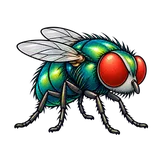 Blow fliesFamily Calliphoridae
 Flesh fliesFamily Sarcophagidae
 Fungus gnatsFamily Sciaridae
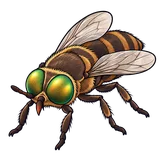 Horse fliesFamily Tabanidae
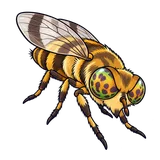 Deer fliesChrysops species
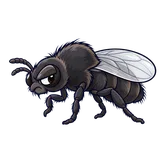 Black fliesFamily Simuliidae