
Why do cluster flies appear in winter?
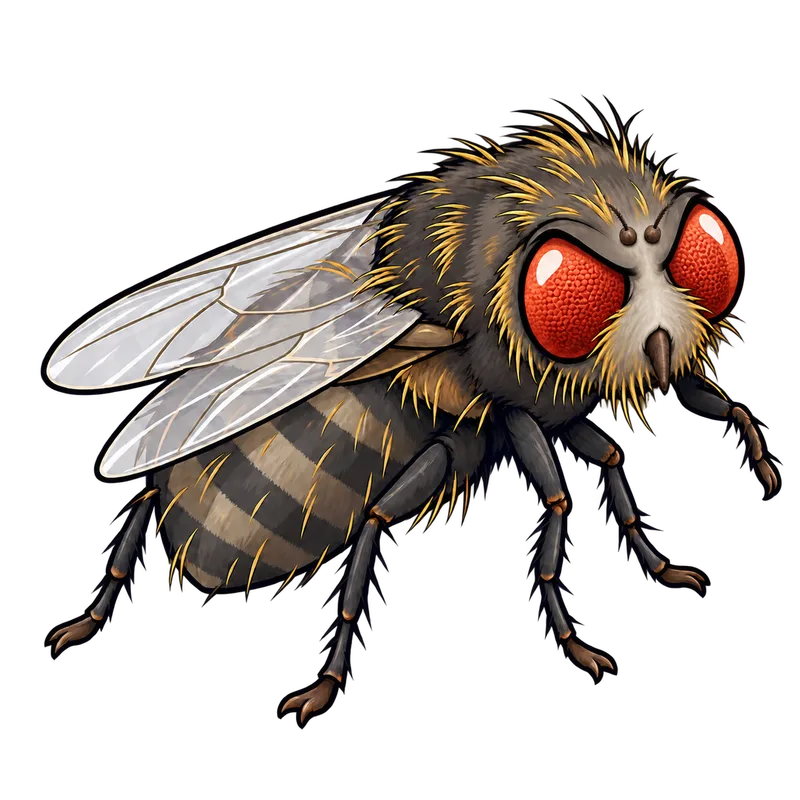
Cluster flies appear in winter because winter sun or heating warms up wall voids and attics past about fifty degrees, waking them from hibernation. They moved in months ago during late summer and early autumn, slipping through tiny gaps around windows and soffits to wait out the cold.
What is actually going on
Picture a bright, bitterly cold January afternoon. You walk into the living room and there they are: half a dozen fat, sluggish flies crawling across the south-facing window, so slow and clumsy you could almost pick them off the glass with your fingers. It is the middle of winter, when insects are supposed to be someone else's problem, and yet here is a small convention of them in your house.
Here is the short answer. Those flies did not come from your drains, your trash can, or anything you did wrong in the kitchen. They moved in months ago. Back in late summer and early autumn, cluster flies gathered on warm, sun-baked exterior walls, and as the days shortened they slipped through tiny gaps around window frames, soffits and siding to spend the winter inside your walls and attic. Once tucked in, they dropped into a deep dormant state called diapause, which is basically insect hibernation: metabolism slowed, no feeding, no breeding, just waiting out the cold in a dry, dark void.
So why are they stumbling around your living room right now? Because something woke them up early. When strong winter sun beats on the south or west side of the house, or your furnace runs hard during a cold snap, the temperature inside those wall voids and attics can creep past about fifty degrees. To a sleeping fly, that warmth reads as spring. It wakes up, groggy and disoriented, and follows the light. The trouble is that the light it finds is often on the wrong side of the wall: gaps around electrical outlets, window pulleys and trim lead into your heated rooms instead of back outside. The fly was aiming for the sky and got your lampshade instead.
You might reasonably ask why your house gets them while a neighbor's stays clear, or why they only turn up in certain rooms. It usually comes down to architecture and location. Upper floors, attics and rooms with south or west exposure warm up fastest during a winter thaw, so that is where the sleepers stir first. Homes with dark, unshaded siding absorb more solar heat, and houses near open fields, pastures or well-watered lawns sit closer to where the flies spent their larval stage in the soil. None of this says anything about your housekeeping. It says your attic is a convincing winter hotel.
How to tell for sure
Before you decide what to do, it is worth confirming you are actually dealing with cluster flies and not ordinary house flies, because the two have completely different backstories and the response is different too. House flies breed in garbage and decaying matter, move fast, and hang around your food. Cluster flies want nothing to do with any of that.
Caught and examined up close, a cluster fly is noticeably bigger and bulkier than a house fly, roughly three-eighths to half an inch long. The body is a dull dark gray or grayish brown, and the abdomen carries an irregular checkered pattern of dark and silvery patches. The easiest cue to spot without any equipment is the wings: at rest, a cluster fly folds them flat over its back so they overlap like a pair of scissors, while a house fly holds its wings more spread apart.
If you get close enough to see the thorax, the middle section of the body, you will usually find a dense coat of short, crinkled golden-yellow hairs. That golden fuzz is the classic giveaway, though it tends to wear off as the fly ages, so an older specimen may not show it. A hand lens helps if you want to be thorough, but most people can make the call from size, posture and behavior alone.
Behavior is honestly the loudest clue. Cluster flies drift around with a lazy, erratic sluggishness, because they are half asleep. They cluster (the name is not subtle) near windows, light fixtures and upper walls, always trying to get to the light, and they ignore your counters, your fruit bowl and your pantry entirely. One more odd detail: if you swat or vacuum one, you may notice a faint sweetish smell, often compared to buckwheat honey. If your winter flies are slow, window-obsessed and smell faintly of breakfast when crushed, you can stop wondering what they are.
What usually comes next
The choice in front of you is simpler than it feels. Do you deal with the flies already wandering around the house, and then seal the place later so next winter’s crowd never gets inside? That is the whole decision. Everything else is noise, and there is plenty of it. Spraying the lawn to kill the earthworms the larvae develop in will not solve this, because the adults can fly in from hundreds of yards away. Your yard is not the source. Spraying the outside walls in spring is just as pointless, since by then the flies are trying to leave, not move in.
For the ones blundering around your rooms this winter, keep it mechanical. A flyswatter works. A vacuum works better when there are numbers involved, as long as you empty the canister or bag promptly so crushed flies do not leave that honey-like smell hanging around the house. If they are scattered, darken the room and open the blinds on one sunny window. They will usually gather where the light is, which lets you collect the lot in one pass.
What you should not do is set off a total-release fogger or bug bomb in the attic or inside wall voids. It feels decisive, which is exactly its appeal, but all it really does is leave a hidden pile of dead insects inside the structure. That pile is an open invitation to scavengers such as carpet beetles and larder beetles. You would be trading a visible nuisance for an invisible one that is harder to fix.
The job that actually matters waits until late summer. That is when you walk the perimeter with a good silicone caulk and seal gaps around window frames, door trim, utility penetrations and soffits, before the next generation starts shopping for a winter room. It is not glamorous work. It is also the one approach that reliably gives you a fly-free living room next January.
When to get help
First, the reassuring part: cluster flies are a nuisance, not a health threat. They do not bite, they do not sting, and they are not known to spread human disease. There is no reason to see a doctor or treat this as any kind of medical event. Nobody needs to panic over a sleepy fly on a windowsill.
That said, there are two situations where calling a licensed pest control professional is the sensible move rather than a defeat. The first is access. If the entry points and fly aggregations are high along rooflines, gables or upper soffits on a multi-story home, then sealing and any exterior treatment belong to someone with proper ladders, safety rigging and equipment. Winter roofs and icy ladders do not care how motivated you are.
The second is a specific warning sign. If you start seeing larder beetles or carpet beetle larvae near baseboards or attic hatches, that usually means a large accumulation of dead cluster flies is sitting inside a wall void, quietly feeding a second pest population you never invited. At that point the problem is inside the structure, and a professional can inspect those cavities and treat them appropriately instead of leaving your walls to function as a beetle buffet.
For the ordinary case, though, the answer stays modest: a vacuum, a swatter, and a tube of caulk in late summer. That will carry you through.