
Horse flies vs deer flies: how can you tell them apart?
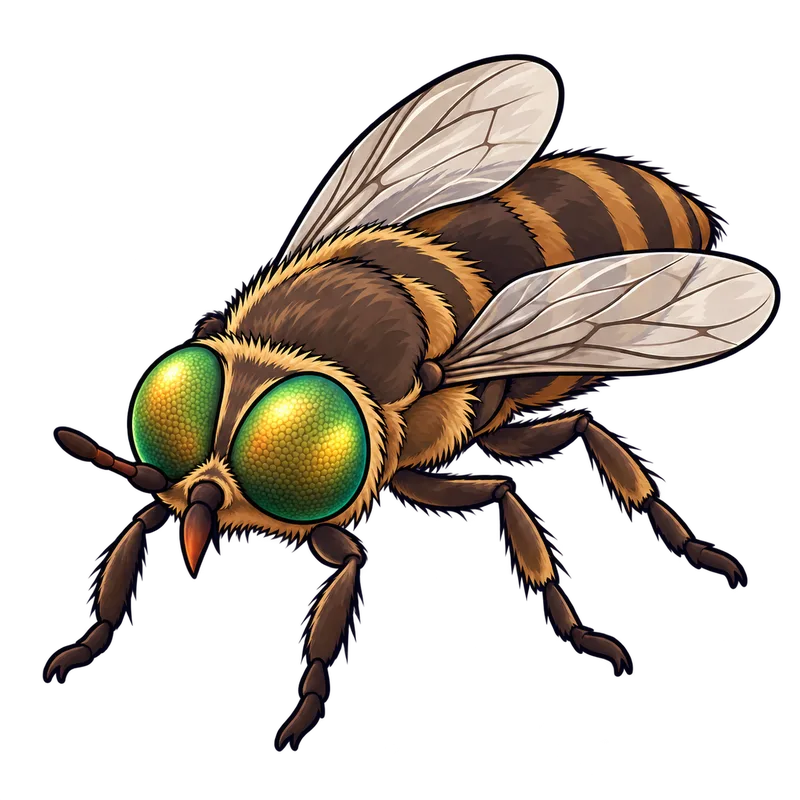
You can tell horse flies and deer flies apart by looking at their size and wing patterns. Horse flies are heavyweights measuring three-quarters to an inch and a quarter long with clear or uniformly smoky wings. Deer flies are smaller at a quarter to half an inch long and feature distinct dark bands on their wings.
What is actually going on
You are standing by the edge of a quiet lake on a warm July afternoon, towel in hand, when a heavy, menacing buzz announces you are no longer alone. A moment later, a sharp, sudden pain bites into your arm as if someone took a box cutter to your skin. You swat wildly, catching a glimpse of a thick-bodied, aggressive insect making a sharp turn for a second pass. Is it a horse fly or a deer fly? Both belong to the same family of daytime biters known as tabanids, and both leave behind a welt that throbs for hours, but telling them apart comes down to a couple of straightforward physical clues you can spot without a microscope.
People often mix them up because both bugs share an aggressive streak and a taste for warm-blooded targets, but size usually tells the story right away. Horse flies are the heavyweights of the group, measuring anywhere from three-quarters of an inch to a staggering inch and a quarter long. They are built like miniature helicopters and make a loud, unmistakable drone as they circle. Deer flies are noticeably smaller and more compact, growing to roughly a quarter or half an inch long, which puts them in the same size category as a standard house fly.
If you are close enough to catch a glimpse of the wings while it hovers near your head, the mystery deepens or clears up instantly. Horse fly wings are generally clear or uniformly smoky brown without any striking patterns. Deer fly wings, on the other hand, feature distinct dark bands and patches that look a bit like stained glass or smeared ink against clear film. It helps to know that only the females of both species are out for your blood. Male horse flies and deer flies lack the specialized mouthparts required for biting and spend their time quietly feeding on plant nectar and pollen. The females need a protein-rich blood meal to develop their eggs, and they use bladelike, slicing mouthparts to open a small pool of skin rather than using a needle-like stinger. That unique slicing action is why their bites hurt immediately compared to the stealthier approach of a mosquito.
Size and wing markings are your best field guides, though nature occasionally throws a curveball. While horse flies are usually large and deer flies are usually small, a few smaller horse fly species overlap in length with larger deer flies. When you encounter a medium-sized fly and cannot judge the scale accurately, look closely at the wings. Deer flies almost always carry dark cross-bands, while horse flies keep their wings plain or solidly tinted.
You can also pay attention to where the insect hangs out and how it behaves. Deer flies tend to swarm around wooded trails, tall grass, and shaded stream banks, and they have an annoying habit of targeting your head and shoulders, often hovering just above a dark baseball cap. Horse flies prefer wide-open spaces like pastures, lake margins, and sunny marshes, and they frequently zoom straight at your legs or torso with direct, relentless flight paths.
Both groups possess brilliant, oversized compound eyes that flash with iridescent greens, bronzes, or purples when alive, though those vivid colors fade quickly after the insect dies. While those colorful eyes look fascinating up close, trying to inspect them on a live, biting fly is generally a good way to get bitten again. Rely instead on the overall build and wing pattern to make your call.
How to tell for sure
Once you realize you are dealing with tabanids rather than mosquitoes, your practical choice boils down to whether you can outlast them or if you need to alter your plans entirely. Standard pest control sprays or yard treatments rarely make a dent in these populations because their larvae develop across vast, damp wetlands, mud flats, and wooded drainage areas far beyond your property line. Spraying your lawn with a garden hose applicator will not stop adults from flying in from nearby woods or ponds on a hot afternoon.
Your most reliable decision is defense. If the weather is warm and sunny and you are heading near a wetland, stream, or hiking trail during peak daytime hours, dress for the occasion. Avoid dark, tight clothing, which acts like a beacon for host-seeking females that use silhouettes and warmth to zero in on targets. Swap your dark ballcap and black t-shirt for loose-fitting, light-colored long sleeves and long pants, and apply an EPA-registered repellent containing DEET, Picaridin, or IR3535 to exposed skin. Treating your outer garments with permethrin ahead of time also discourages them from landing.
If the flies are swarming thick and refuse to be deterred by repellents, the simplest move is to postpone your outdoor chores or recreation until the sun dips lower or the weather turns cooler, as these insects prefer bright, warm daylight for their patrols.
What usually comes next
Most horse fly and deer fly bites result in localized pain, swelling, and itching that clear up on their own after a few days, but certain situations call for outside intervention. If you develop signs of a severe allergic reaction, systemic illness, or extreme swelling that causes joints to stiffen or eyes to swell shut, stop guessing and seek prompt evaluation from a qualified medical clinician or urgent care service. Scratching open the bite wounds can also introduce secondary bacterial infections, so consult a healthcare professional if a lesion begins to show spreading redness or pus.
When to get help
On the property and livestock front, these flies are more than just an outdoor nuisance. Because their feeding is frequently interrupted by defensive movements from animals, they act as mechanical vectors for blood-borne diseases like equine infectious anemia, anthrax, and tularemia. If you keep livestock and notice your animals suffering from heavy fly attacks, anemia, or drastic drops in milk production, you should consult a large animal veterinarian or a licensed agricultural extension agent for guidance on herd protection strategies.
When dealing with large-scale management around commercial facilities, stables, or agricultural operations, leave complex barrier treatments to a licensed pesticide applicator who understands local regulations and proper product application methods.