
How do you reduce fungus gnats without damaging a houseplant?
You can reduce fungus gnats without harming your houseplants by letting the top of the potting media dry out between waterings and applying a soil drench of the biological larvicide Bacillus thuringiensis var. israelensis. You can also trap adult gnats with yellow sticky cards and empty standing water from drainage saucers.
What is actually going on
Picture yourself walking over to water your favorite fiddle-leaf fig on a quiet Sunday morning. As the water hits the soil, a small cloud of tiny, weak-flying black gnats suddenly lifts into the air, drifting lazily toward your living room window or hovering right around the glowing screen of your laptop. It is a familiar, mildly maddening household scene. You might wonder how a single potted plant indoors managed to host an entire flying squadron.
The short answer is that you can reduce fungus gnats without harming your houseplants by letting the top of the potting media dry out between waterings, emptying standing water from drainage saucers, trapping the adults with yellow sticky cards, and applying a soil drench of the biological larvicide Bacillus thuringiensis var. israelensis to target the grubs living below the surface.
What is actually happening inside that pot comes down to moisture and invisible food sources. Fungus gnats are small flies whose life cycle depends entirely on damp organic matter and the microscopic fungi that thrive in it. When potting soil stays constantly wet, acting much like a damp dish sponge left in a warm corner, it grows a lush layer of fungal material and decaying debris. Adult female gnats find this damp haven and lay tiny eggs in the upper layers of the soil. Those eggs hatch into translucent, worm-like larvae that feed on the fungi and organic material.
The real trouble starts when the population swells or the soil stays wet too long. Hungry larvae will shift from eating harmless fungi to chewing on the delicate feeder roots and root hairs of your houseplant. This root loss causes foliage to wilt, stunts growth, and opens the door for plant pathogens. Simply spraying an aerosol insecticide into the room will not fix the issue because it only kills the flying adults for a moment while leaving the eggs and larvae safe in the soil to hatch another day.
How to tell for sure
Before you start changing how you water or buying biological controls, you need to make sure you are actually dealing with fungus gnats and not some other tiny indoor visitor. Houseplants and damp corners can attract a few different small flies, and misidentifying them usually leads to wasted effort.
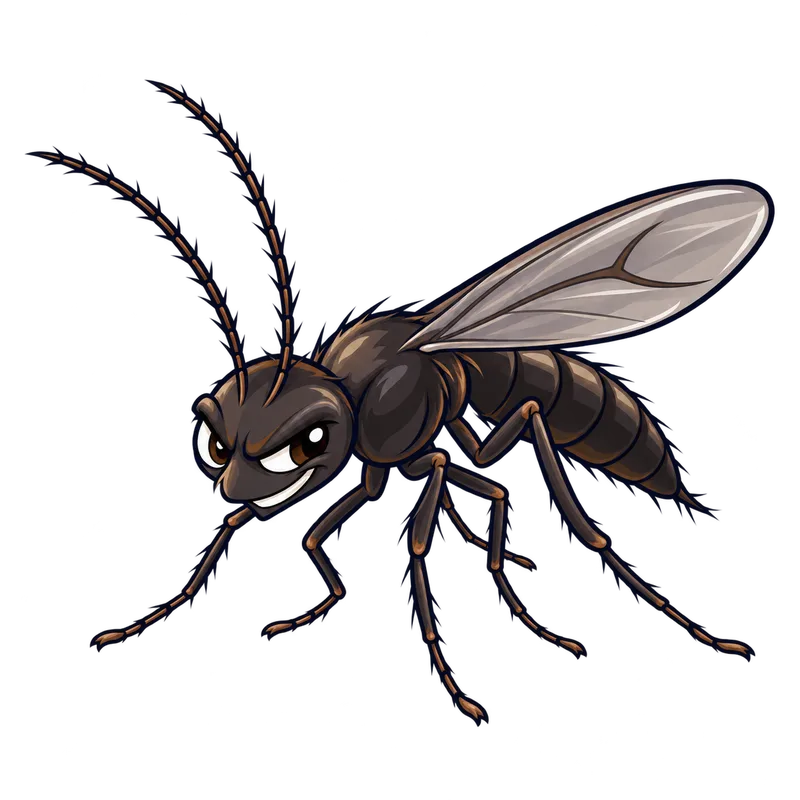
Adult fungus gnats are tiny, delicate, mosquito-like insects usually measuring one-sixteenth to one-eighth of an inch long. They usually have a dark body, long legs, and noticeably long bead-like antennae. You will usually see them walking weakly across the potting soil or fluttering clumsily near the base of the plant rather than taking strong, purposeful flights across the room. If you happen to look closely at a larva in the soil, you will spot a legless, translucent white or gray body featuring a distinct, shiny black head capsule that looks like a tiny speck of black enamel paint.
You can usually tell them apart from lookalikes by their habits and appearance. Fruit flies have stout bodies and prominent red eyes, and they breed in overripe fruit or recycling bins rather than plant pots. Drain flies have fuzzy, moth-like bodies with hairy wings held roof-like over their backs, and they emerge from the gelatinous scum inside sink and floor drains. Phorid flies have a humpbacked thorax and run across surfaces in rapid, jerky bursts before taking off. Mosquitoes possess an elongated piercing proboscis for biting, whereas fungus gnats are strictly non-biting nuisance insects that cannot pierce human skin and pose zero health threat to you or your pets.
What usually comes next
Once you have confirmed you are dealing with fungus gnats, you have to figure out how to manage the moisture in your pots without putting your plants through unnecessary drought stress. The single most effective cultural control is allowing the top few inches of potting media to dry out completely between waterings. Eggs and young larvae need moisture to survive, and letting that surface layer dry out neatly breaks their life cycle.
You should verify this dryness by sticking your finger straight into the soil rather than just glancing at the surface crust. Of course, this creates a practical dilemma if you grow moisture-loving tropicals, ferns, or delicate seedlings that cannot tolerate deep soil drying without wilting or dropping their leaves. For those sensitive plants, you can skip aggressive drying and rely instead on physical traps and biological drenches.
When moisture management alone is not enough, you can introduce a targeted biological larvicide containing Bacillus thuringiensis var. israelensis, often called Bti. This bacterium produces proteins that disrupt the digestive tract of fly larvae when ingested, while leaving plant roots, earthworms, and your pets completely unharmed. You must pay close attention to the subspecies here. Using a caterpillar-targeted Bt product on your houseplants will do nothing because the chemistry is entirely wrong for fly larvae. Mix and apply the Bti as a soil drench strictly according to the product label instructions.
Alongside the soil drench, place small yellow sticky cards vertically at the soil line near the plant stems. These traps catch adult fliers to help reduce the breeding population and let you monitor whether your numbers are dropping. Finally, never let your pots sit in standing water. Empty the drainage saucers immediately after watering and wash them periodically to remove any organic sediment that could host another round of pests.
When to get help
Most indoor gnat issues clear up nicely with a combination of adjusted watering, sticky cards, and a Bti soil drench. However, there are times when you need outside assistance or a different perspective.
If your houseplants show severe signs of decline like sudden wilting, extensive yellowing, or stunted growth despite moist soil, the root system may have suffered heavy damage from larval feeding. This root loss can invite secondary soil-borne fungal pathogens into the plant. When a large collection of valuable houseplants or commercial indoor plants experiences a widespread infestation that resists standard cultural and biological methods, it is time to contact a licensed pest control operator.
On the human health side, fungus gnats are completely harmless and do not bite. If you or someone in your household experiences persistent skin irritation, rashes, or sensations of biting insects when no physical pests are present, you should consult a medical clinician or a dermatologist for a proper evaluation.