
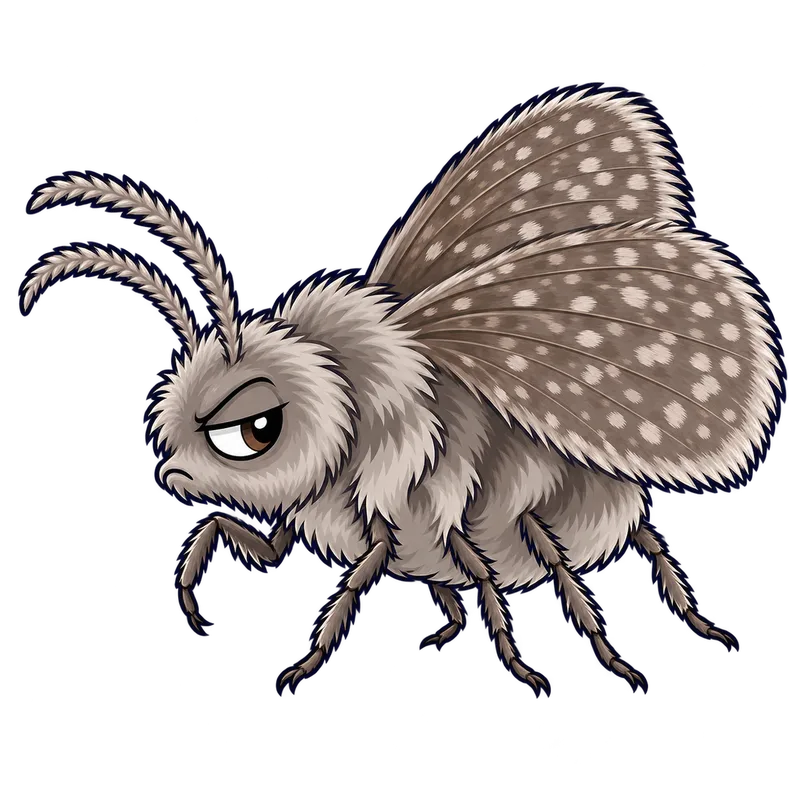
Drain flies
Family Psychodidae
- Size
- 1/16 to 1/5 in (2 to 5 mm)
- Color
- Dark gray to black, dark-grayish brown, or black
- Habitat
- Gelatinous organic film lining plumbing drains and sewer lines
- Diet
- Algae, fungi, bacteria, and decaying organic debris in drain slime
- Life cycle
- Approximately 20 days under uniform indoor conditions
Drain flies are small insects belonging to the family Psychodidae, often recognized by their distinct, moth-like appearance when resting on bathroom tiles or kitchen walls. They measure 1/16 to 1/5 in (2 to 5 mm) in length, featuring a compact body covered in soft, fine hairs. When you accidentally crush one against the tile, it leaves a powdery residue of shed scales rather than the wet mess you might expect from a standard housefly.
Identity
The most reliable diagnostic feature requires looking closely at the wings. Unlike many other small flies, drain fly wings display parallel veins running the length of the wing without cross-veins branching toward the margins. The single pair of broad, leaf-shaped wings is densely clothed in hairs, which gives them a fuzzy texture visible under low magnification. At rest, they hold their wings roof-like over the body at a sloping angle, closely resembling a tiny moth taking a nap.
Habitat & behaviour
These flies live indoors and outdoors wherever moisture and decaying organic matter intersect. Their primary habitat is the gelatinous film or microbial scum that coats the interior of drain pipes, sewer lines, septic fields, and condensate drip pans. If you notice them clustering around a sink, it means that exact pipe has built up enough slime to support a colony.
Adults are weak, clumsy fliers that make short, irregular hopping flights rather than long journeys across the room. They are nocturnal or crepuscular, spending daylight hours resting stationary on walls, ceilings, or near light sources because they are drawn to light. Indoors, they breed continuously year-round in heated structures, while outdoor populations peak during the warm summer months.
Visual variations
Drain flies do not have social castes or distinct sex differences that are easily spotted without high magnification, but their life stages show significant physical changes.
The egg stage consists of tiny, pale eggs laid in irregular clusters of 20 to 100 on moist organic sludge. These hatch in under 48 hours into mature larvae that grow up to 3/8 in (4 to 10 mm) long. The larva is a slender, worm-like creature with a pale body, a distinct darkened head capsule, and a functional breathing siphon at the rear end that lets it breathe while submerged in liquid scum.
The pupal stage is small and dark, lasting only 1 to 2 days within the same organic substrate before transforming into the fuzzy adult winged form.
Why it matters
Common indoor drain flies are non-biting nuisances that do not damage structures or feed on human food, but their persistent presence points to underlying sanitation or plumbing issues. Because they emerge from raw sewage and slime, they can mechanically carry microorganisms on their body hairs. Furthermore, the disintegrating bodies of dead flies and shed hairs can produce fine dust that triggers allergic rhinitis or asthma in sensitive individuals.
When adults persistently emerge despite thorough mechanical cleaning of the traps, it can indicate a broken sub-slab sewer pipe or cracked plumbing line leaking sewage beneath a concrete floor, requiring professional plumbing evaluation to resolve the root cause.
Similar species
 Phorid fliesFamily Phoridae
 Cluster fliesPollenia species
 Blow fliesFamily Calliphoridae
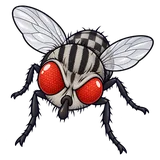 Flesh fliesFamily Sarcophagidae
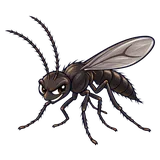 Fungus gnatsFamily Sciaridae
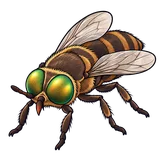 Horse fliesFamily Tabanidae