
Do fungus gnats kill plants?
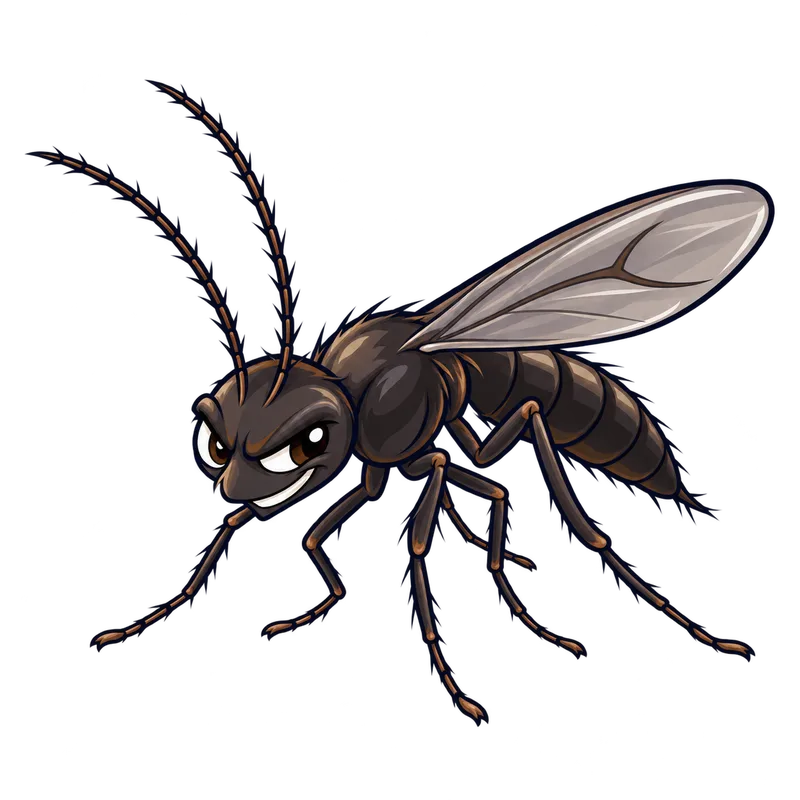
No, fungus gnats do not typically kill healthy and mature plants. While adult gnats are harmless nuisances, their larvae can damage roots and prove fatal for fragile seedlings or unrooted cuttings when soggy soil causes the gnat population to explode.
What is actually going on
You are sitting on the couch on a rainy Tuesday evening, scrolling through your phone, when a tiny, mosquito-like speck drifts past your face and lands on the glowing screen. You swat at it, look over at your beloved fiddle-leaf fig in the corner, and notice a few more of the little ghosts hovering lazily just above the soil. Naturally, you wonder if your favorite houseplant is about to give up the ghost entirely.
To give you the short answer right away, no, fungus gnats do not typically kill healthy, mature plants. The tiny flitting adults you see buzzing around your living room are completely harmless nuisances. They do not have chewing mouthparts, they do not bite humans or pets, and they certainly do not munch on your plant leaves or stems. Their only real talent in life is annoying you by flying into your face and living for about a week.
The real story, however, happens out of sight down in the dirt. Those flying adults lay eggs in damp potting mix, and out hatch translucent, wormlike larvae with distinct shiny black head capsules. Under normal conditions, these little maggots mind their own business, munching quietly on soil fungi, decaying organic matter, and harmless molds. Think of moist potting soil as an all-you-can-eat fungal buffet where the larvae are just cleaning up the crumbs.
Trouble only starts when you overwater your pots. When the soil stays soggy week after week, the gnat population explodes into the thousands. Once they run out of fungi to eat, those crowded larvae turn desperate and start treating your plant roots like an emergency meal. They chew through fine root hairs and strip lateral roots, which leaves the plant unable to drink. For fragile seedlings, unrooted cuttings, or delicate greenhouse starts, that root damage is often fatal. But if your houseplant is mature and established, it can usually shrug off a moderate gnat party without kicking the bucket.
Before you declare war on your houseplants, you usually want to make sure you are actually dealing with fungus gnats and not some other uninvited guest. Adult fungus gnats are tiny, measuring roughly one-sixteenth to one-eighth of an inch long, with long legs and delicate, smoky or clear wings. If you happen to look at one under a magnifying glass, sciarid gnats usually display a faint, characteristic shape on their wing veins, while other types have a noticeably humped thorax and spiny legs.
When you investigate the soil, you are looking for larvae that reside in the top two to three inches of damp media. These tiny maggots grow up to a quarter of an inch long, and their most reliable identifying mark is that translucent white body paired with a jet-black, shiny head capsule. That black head separates them instantly from fruit fly larvae or other common household critters.
People frequently confuse fungus gnats with phorid flies or springtails, but their habits give them away. Phorid flies have a humped back and scuttle across the soil in frantic, jerky sprints rather than flying smoothly. Springtails are microscopic, wingless creatures that literally jump into the air using a specialized tail mechanism. If your tiny visitors are fluttering weakly toward your table lamp or bouncing off your computer monitor, you are usually looking at classic fungus gnats.
How to tell for sure
Faced with a cloud of gnats every time you water your parlor palm, you have to decide whether to change your watering habits or start treating the soil. The single most effective move you can make right now is to let the top two to three inches of your potting mix dry out completely between waterings. Fungus gnat eggs and young larvae are intensely sensitive to drought, and simply withholding water until the surface crusts over will usually break the reproductive cycle without costing you a dime.
Of course, if you have a massive infestation in a sprawling indoor jungle, letting the soil dry out might stress your moisture-loving ferns or prove difficult during the dark winter months when indoor heating keeps soil damp longer. In that case, your practical choice shifts from passive drying to active intervention using targeted biological treatments like microbial soil drenches containing specific bacteria that target fly larvae in the soil. Whatever you choose, skip the aerosol bug sprays in your living room, because fogging the air only kills the adult flies buzzing around today while leaving the next generation safely buried in the dirt.
What usually comes next
Most indoor fungus gnat situations are a mild gardening annoyance rather than an emergency, but certain circumstances call for outside backup. If you run a commercial greenhouse, a large indoor nursery, or a mushroom production facility and find your crops wilting despite careful irrigation, you should contact a university extension entomologist or a licensed agricultural advisor. Commercial crops represent a financial investment where standard household tricks will not save thousands of propagation trays from root loss and disease vectoring.
On a different note, because adult fungus gnats are entirely non-biting and harmless to human skin, you should never assume that unexplained skin irritation or crawling sensations in your home are caused by gnats. If you or someone in your household experiences persistent biting symptoms, mysterious rashes, or skin lesions, step away from the garden center and schedule an appointment with a medical clinician or a dermatologist to evaluate your health.
When to get help
Getting rid of fungus gnats is mostly a matter of patience and moisture control. By keeping the surface of your soil dry and avoiding the temptation to drown your plants every few days, you can usually keep the population down to a level where your plants will not even notice they are there.