
Can no-see-ums get into a house?
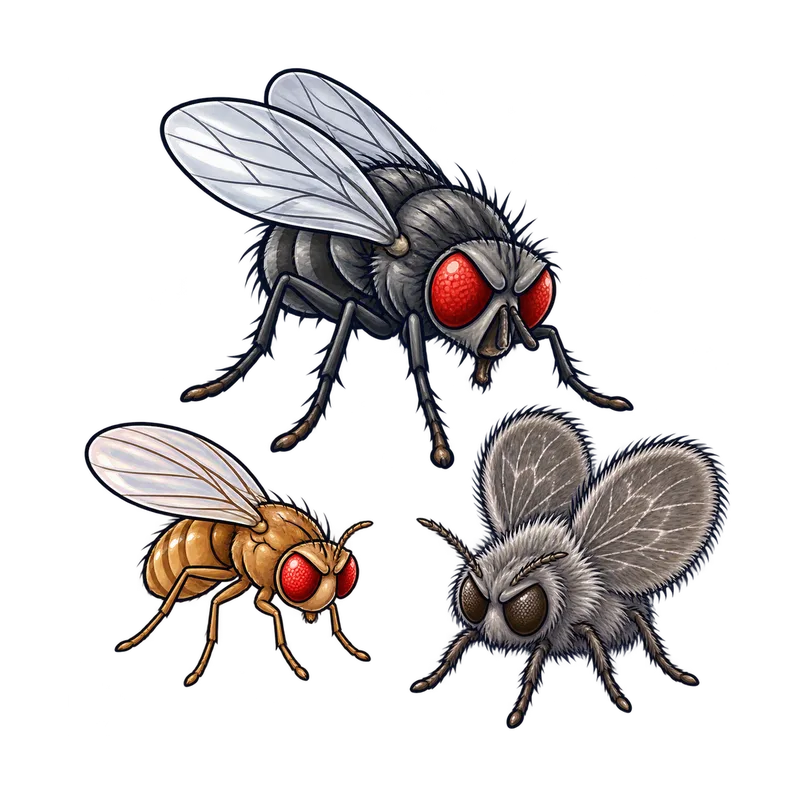
Yes, no-see-ums can easily get into a house because they measure only 1.0 to 3.0 millimeters in length. Their narrow bodies slip straight through the standard woven holes of household window and door screens. They are also drawn indoors by artificial night lighting when windows are open or poorly sealed.
What is actually going on
You are sitting on the couch on a warm summer evening, reading a book near an open window. Your window screens are firmly in place, so you feel entirely secure against bugs. Yet, after a few minutes, you notice tiny, sharp pinpricks around your ankles and wrists, followed by an intense itch. You look closely at the window sill, and it appears as though someone has sprinkled fine black pepper across the white paint, except the specks are moving.
Yes, no-see-ums can easily get into a house, and this frustrating scenario is the exact reason why. Also known as biting midges or punkies, these tiny creatures measure only 1.0 to 3.0 mm (1/32 to 1/16 inch) in length. Because their bodies are exceptionally narrow, they slip straight through the standard woven holes of household window and door screens without encountering any physical resistance.
You might wonder why they bother coming inside in the first place if they naturally live outdoors. Adult female midges are strongly attracted to artificial night lighting. When you have lamps turned on inside a house with windows open or poorly sealed, that light spills out into the evening and draws the midges right to your window frames. Once they land on a standard screen, the grid spacing is simply too wide to keep them out, letting them wander indoors to seek the blood protein they need to develop their eggs.
Fortunately, they cannot set up housekeeping inside your living room. No-see-ums require damp outdoor environments like coastal salt marshes, muddy riverbanks, or decaying organic matter to lay their eggs and complete their life cycle. Once they find their way indoors, they usually die within a few days from the dry indoor air. But that offers little comfort when you are trying to watch television while enduring a fresh batch of itchy bites.
You are dealing with a physical mismatch between standard home construction and the sheer size of the insect. Standard fly screens are built to keep out larger pests like house flies and mosquitoes, which means they feature wider grid patterns. A biting midge has a thorax width narrow enough to bypass these openings entirely. Furthermore, structural gaps around unsealed door frames, loose weather-stripping, and utility penetrations give them alternative pathways inside. Because females rely on vertebrate blood to mature their eggs, they actively track down hosts by following warmth, carbon dioxide plumes, and escaping indoor light after dusk.
How to tell for sure
Before you try to fix the problem, it helps to make sure you are actually dealing with no-see-ums rather than another type of tiny flying insect. People usually mistake them for other small household pests because almost everything tiny and winged gets lumped together under the general name of gnats.
If you see tiny, dark specks crawling on a window sill near a lamp, or if you feel sharp biting sensations before you ever spot the insect, you are usually dealing with biting midges. Under a magnifying glass, a no-see-um reveals a stocky body, a distinctive humpbacked thorax, feathery antennae, and often patterned wings. The females are the only ones that bite, using short, bladelike mouthparts to slice the skin surface, while the males feed harmlessly on plant nectar outdoors.
You should also check whether these bugs are actually breeding inside your home, which changes the identification entirely. If you find tiny flies hovering around indoor houseplants, they are usually fungus gnats emerging from overwatered soil. If they are clustering near your kitchen sink or bathroom drain, they are usually drain flies or fruit flies feeding on organic sludge. None of those other insects bite. If the tiny flies are emerging from indoor sources, they are not no-see-ums, because biting midges cannot reproduce indoors.
Another possibility in certain warm regions is the true sand fly, which belongs to a completely different insect family. True sand flies are delicate, hairy little flies that hold their wings in a distinctive V-shape over their backs when resting. While they also bite, they differ physically from the stocky, humped biting midges. Taking a moment to look closely at the insect under simple magnification helps you avoid treating the wrong problem with the wrong approach.
What usually comes next
Once you realize that standard window screens are letting these pests march right into your living space, your most important practical decision involves upgrading your physical barriers. Patching holes or hoping for the best will not solve the issue because the mesh itself is simply too coarse for the job.
Standard window and door screens usually feature a 16 mesh weave, which leaves square openings wide enough for a small midge to crawl through with room to spare. To stop them at the perimeter, you need to replace standard screening with ultra-fine midge screening, which uses a 20x20 mesh weave or finer. This tighter grid narrows the openings below the size threshold of the adult midges, effectively closing the open door your old screens were providing.
Choosing to upgrade your screening changes the dynamic immediately, but you have to commit to doing it across all operable windows and doors that you plan to open during warm weather. Doing only one window leaves an easy alternate route for the insects. Paired with turning off unnecessary porch lights at dusk and running indoor ceiling fans to create air currents that disrupt their weak flight, tightening up your screening turns your home back into a comfortable place to sit by the window.
When to get help
There are times when a pest problem moves past simple do-it-yourself fixes and requires outside intervention. If you experience severe allergic reactions, significant swelling, or signs of secondary bacterial infection from excessive scratching, such as pus, spreading redness, or skin warmth, you should consult a clinician or visit an urgent care clinic. Do not attempt to diagnose or treat infected bite sites at home.
When treating the structural exterior of your home with chemical barriers or perimeter sprays, remember that the product label is a legally binding document. Never invent your own mixtures or apply treatments outside of what the manufacturer allows. If the infestation is severe or involves complex multi-story exclusion work, contact a licensed pest control operator to handle the application safely and correctly.
Finally, keep in mind that natural breeding grounds like coastal salt marshes, tidal creeks, and estuarine mudflats are protected ecosystems. Broad-scale chemical spraying in these public wetlands is strictly regulated by environmental agencies and local authorities. If outdoor populations near your property are overwhelming your defenses, reach out to your local vector control district or environmental health department for guidance rather than attempting environmental treatments yourself.