
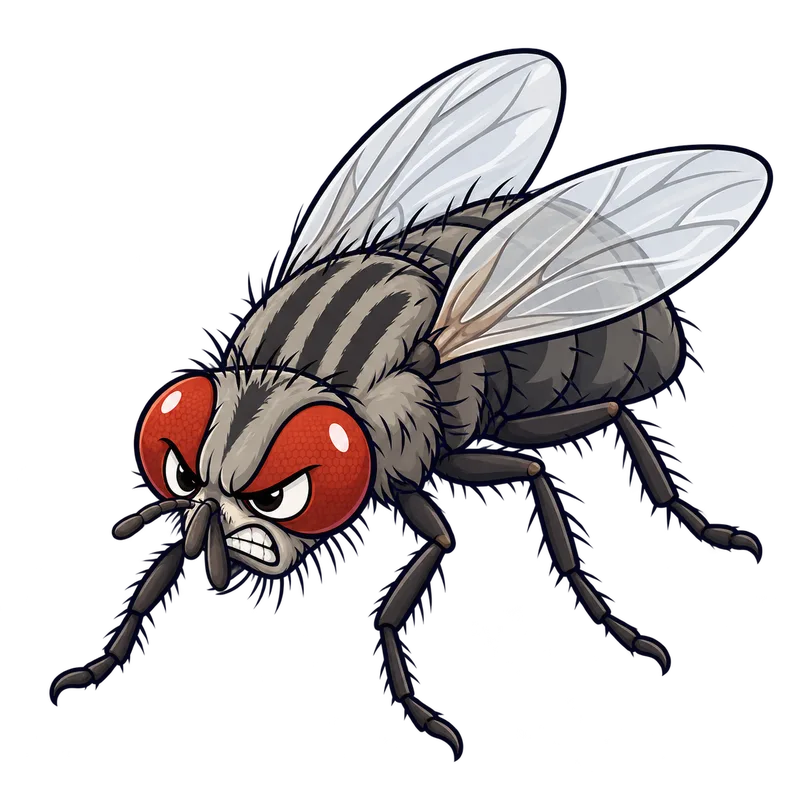
House fly
Musca domestica
- Size
- 1/6 to 1/4 inch (4.2 to 6.4 mm)
- Color
- Gray thorax with 4 dark stripes, gray-tan abdomen
- Habitat
- Synanthropic environments near human activity and animal waste
- Diet
- Omnivorous, liquid or dissolved decaying organic matter
- Life cycle
- Complete metamorphosis from egg to adult in 7 to 45 days
You are likely looking at a medium-sized gray fly, measuring anywhere from 1/6 to 1/4 inch long, covered in short bristle-like hairs. If you grab a 10x hand lens, you can check for the three features that tell you for certain you have a house fly. First, look at the back between the wings. The upperside of the thorax displays exactly four dark, longitudinal parallel stripes running down its length. Second, look at the mouthparts underneath the head. You will see a soft, fleshy, pad-like proboscis tucked away, designed strictly for sponging up liquids. Third, look closely at the clear, transparent wings. The fourth longitudinal wing vein makes a sharp, distinct upward curve toward the leading margin near the wing tip.
Habitat & behaviour
House flies do not live in the wild by choice. They are deeply tied to human activity, following us around barns, stables, commercial food kitchens, garbage transfer stations, and backyard patios. Warm weather brings them out in force, with populations peaking from late spring through the summer months. They are drawn to anything moist and decaying, including animal manure, rotting garbage, and spilled food detritus. Because they cannot chew solid food, they have a rather unsettling feeding habit. A house fly will regurgitate digestive fluids and liquid from its stomach directly onto solid materials to liquefy them, and then suck that resulting soup back up using its pad-like mouth. Every time they land on your kitchen counter, they leave behind tiny vomit spots and pale yellow to brown fecal specks. While most adults stay within 0.5 to 2 miles of where they hatched, they are strong fliers capable of traveling up to 20 miles when the wind aids them or commercial vehicles carry them along.
Visual variations
House flies do not have social castes, meaning every adult you spot is simply an independent male or female trying to find a meal or a spot to drop eggs. Females tend to run a bit larger than the males. If you take a closer look, you will see that the gap between the big compound eyes on top of the head is noticeably wider in females, while the eyes on males sit right next to each other. Females also carry a faint golden dusting along the inner edges of those eyes.
Before they turn into those winged pests, they go through a full four-stage life cycle. It kicks off as a tiny oval white egg, roughly 1 mm long, usually tucked into damp organic waste in piles. That egg hatches in about a day into a squiggly legless maggot, cream-colored with a pointy front and a blunt rear end. The maggot moves through 3 growing stages, stretching from 1/8 inch up to 1/2 inch long before crawling away from the wet mess into drier dirt or debris to pupate. The pupa stays tucked inside a barrel-shaped shell that hardens and shifts from a reddish chestnut shade to dark brown or black.
Why it matters
Having house flies around is a real sanitation and health hazard, since they act as physical carriers for more than 100 disease-causing germs and over 65 human and animal illnesses. Nasty pathogens like Salmonella, E. coli, and Shigella hitch a ride on the fly's hairy legs and body or pass straight through its gut, ready to get dropped onto your lunch through that messy habit of vomiting and pooping while it eats. In a restaurant or food plant, spotting them brings an instant health code failure that demands serious cleaning and tight physical screening to keep them out.
If a fly lands on you and starts biting your legs, you can rest assured it is not a house fly, because house flies do not have the mouthparts to pierce skin. You are probably dealing with a stable fly instead, which looks nearly identical at first glance but carries a stiff, needle-like snout. In the same way, tiny flies buzzing around your house are never baby house flies, because insects stop growing the moment they get their wings. When you see sluggish swarms gathering on a sunny indoor window in the dead of winter, those are usually cluster flies or face flies waking up from a nap inside your walls rather than house flies breeding in your kitchen.
Similar species
 Fruit fliesFamily Drosophilidae
 Drain fliesFamily Psychodidae
 Phorid fliesFamily Phoridae
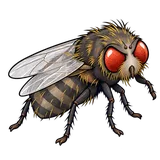 Cluster fliesPollenia species
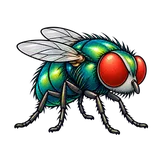 Blow fliesFamily Calliphoridae
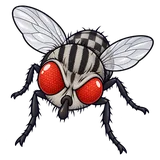 Flesh fliesFamily Sarcophagidae