
What are no-see-ums?
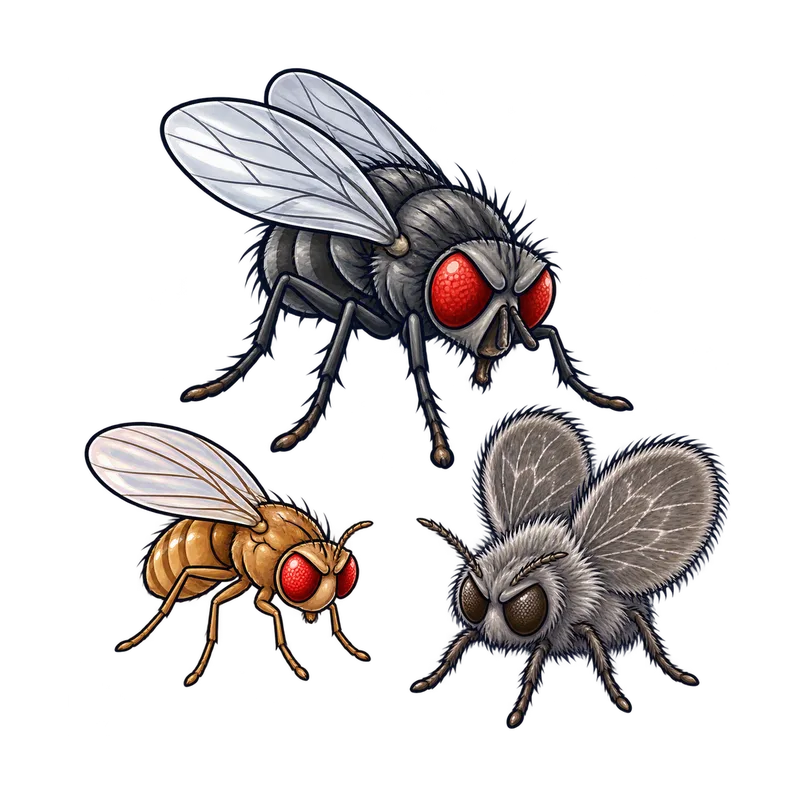
No-see-ums are tiny biting midges in the family Ceratopogonidae that measure roughly 1.0 to 3.0 mm in length. These true flies look like specks of black pepper and vanish against your skin. Only the females bite, using bladelike mouthparts to feed on a pool of blood that leaves itchy red welts.
What is actually going on
You are sitting on the back patio just as the sun dips below the trees, enjoying a quiet evening with a cold drink. Suddenly, your ankles and arms start stinging, as if someone is jabbing you with tiny pins. You slap at your skin, expecting to swat a mosquito away, but your hand comes away empty. When you look closer, you see nothing in the air at all, yet the burning pinpricks keep coming.
What you are dealing with is a swarm of no-see-ums, known formally as biting midges in the family Ceratopogonidae. Specifically, they belong to the genus Culicoides, and they earn their famous common name honestly. Measuring roughly 1.0 to 3.0 mm, or about one-thirty-second to one-sixteenth of an inch in length, these true flies are so diminutive that they literally vanish against your skin or clothing. To the naked eye, they look like little more than specks of coarsely ground black pepper scattered across your porch.
Despite their microscopic size, female no-see-ums pack a disproportionate punch because they need a blood meal to develop their eggs. Unlike mosquitoes that use a slender needle-like mouthpart to tap a capillary, a female midge uses tiny, bladelike mouthparts to slice open the skin and feed on the resulting pool of blood. Males, on the other hand, stay entirely out of trouble by feeding exclusively on plant nectar and pollen.
The trouble with these insects goes beyond a simple outdoor annoyance. When a female cuts your skin, she injects saliva containing proteins and anticoagulants that trigger an immune response. That is why the initial pinch often fades, only to be replaced hours later by intensely itchy red welts that can linger for days.
If you want to confirm what you are fighting, you usually need some optical help because standard eyesight struggles with insects this small. Under a ten-power hand lens, a biting midge reveals classic fly features: a single pair of wings, a stout and compact body, feathery antennae, and a distinctively humped thorax. Their wings often feature faint spots or mottled patterns, and they tend to hold those wings flat over their abdomen when they land.
You can also identify them by their habits and habitat. Unlike mosquitoes, which require standing water in old tires or birdbaths to complete their lifecycle, no-see-ums usually breed in damp, saturated organic substrates. You will find their worm-like larvae thriving in muddy soils, salt marshes, decaying leaf litter, livestock waste lagoons, and pasture seep areas.
People often confuse them with other tiny nuisances, but the distinctions matter. Black flies develop in fast-flowing streams and tend to bite during the day in wooded or mountainous regions. True sand flies, which vector serious tropical diseases, belong to an entirely different insect family and are rarely an issue in North American backyards. No-see-ums are also distinct from drain flies, which simply hang around damp indoor plumbing without biting anyone.
Geography and climate usually dictate when and where you encounter them. Coastal species emerge in massive waves that often synchronize with the new and full moon tides in salt marshes and mangrove swamps. Inland species prefer humid, calm evenings around dusk and dawn, though overcast days can keep them active around damp fields and woodland cabins.
How to tell for sure
When you realize that standard window screens are doing nothing to keep these insects out of your living room, you face a choice about how to secure your space. Because standard residential window screens feature a mesh size designed to stop mosquitoes and houseflies, tiny midges walk right through the openings without slowing down.
To solve this, your most reliable practical decision is to upgrade your physical barriers rather than relying solely on chemical sprays. You can replace your standard window and door screens with fine-mesh screening specifically rated for midges and no-see-ums, which features tighter weaving that physically blocks their entry.
If rescreening the entire house feels like a heavy lift for a seasonal problem, you can disrupt them using active mechanical air barriers. Biting midges are exceptionally weak fliers that struggle against even modest wind currents. Deploying ceiling fans or portable oscillating fans on your porch or patio creates enough air movement to keep them from landing on you.
When you do venture out where fans cannot reach, personal protection usually requires chemical help. Repellents containing DEET or Picaridin provide reliable multi-hour protection when applied to exposed skin. Natural or organic alternatives exist, but they generally demand much more frequent reapplication to keep the biters at bay.
What usually comes next
Most midge encounters end with annoying itchy welts, but certain situations demand outside intervention. If intense scratching breaks your skin and introduces bacteria, you risk developing a secondary infection. Should a bite area become hot to the touch, increasingly painful, red, or filled with pus, you need to consult a clinician or urgent care center for proper medical evaluation and potential treatment. On rare occasions, severe systemic allergic reactions involving difficulty breathing, facial swelling, or dizziness require immediate emergency medical care.
Animals face distinct risks that call for professional attention as well. Horses frequently suffer from a severe allergic dermatitis known as sweet itch when hypersensitive to midge bites, leading to intense scratching and hair loss. Furthermore, certain Culicoides species serve as biological vectors for the Bluetongue virus in cattle and sheep. If you suspect an outbreak of this livestock disease in your herd, you must report it immediately to your state or national agricultural authorities.
When to get help
Finally, if indoor infestations persist despite fine-mesh screening and your best efforts to seal up the house, bringing in a licensed pest management technician makes sense. A professional can inspect your property, identify structural entry points, and apply permitted residual barrier treatments to exterior resting harborage sites like walls, eaves, and dense perimeter foliage.