
How did the spotted lanternfly get to the United States?
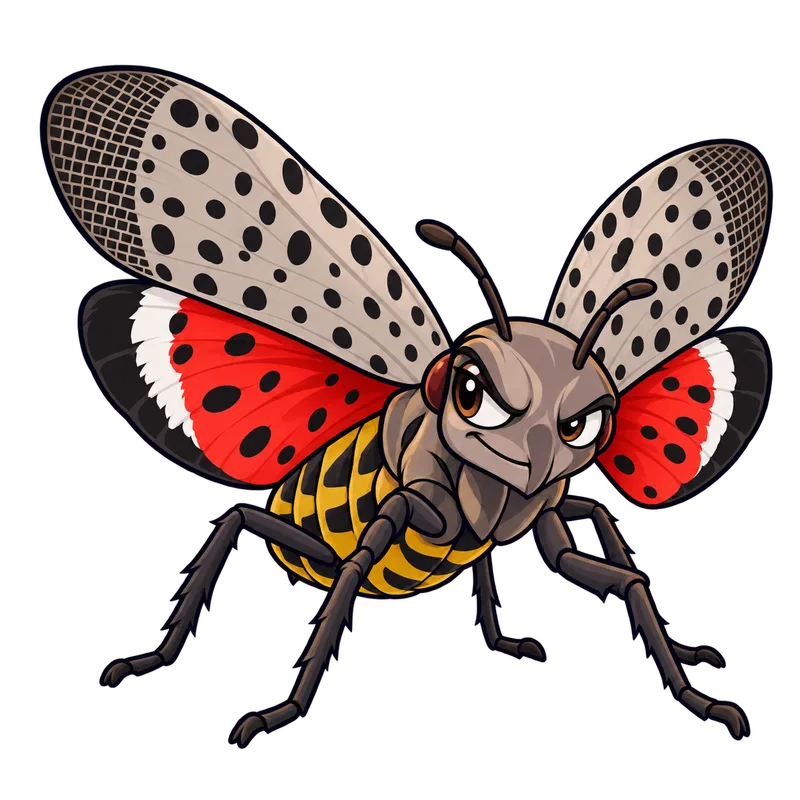
The spotted lanternfly arrived in the United States through international trade when females laid camouflaged egg masses on outdoor equipment, stone shipments, and wooden pallets. These weatherproof egg masses survived ocean transport from Asia and hatched after arriving in Pennsylvania in 2014, allowing the sap-feeding insect to spread widely.
What is actually going on
You are out in the yard on a crisp October morning, putting away the patio chairs and checking the camper before winter, when you notice a strange, dull grey smear on the metal trailer frame. It looks almost like a splash of dried mud or wet mortar left behind by a mason. You reach out to wipe it off with your thumb, but it feels surprisingly firm, like a row of tiny, well-hidden capsules tucked beneath a protective crust. That unassuming little patch of hardened putty is how one of the most destructive agricultural pests in recent memory managed to cross an ocean and quietly take up residence across a large swath of the United States.
The spotted lanternfly, a striking sap-feeding insect native to parts of East Asia, made its official debut in North America in 2014 in Berks County, Pennsylvania. It did not fly across the Atlantic Ocean on its own, nor did it hitch a ride on migrating birds. Instead, it arrived through the mechanics of modern international trade. Female lanternflies possess an unfortunate habit of depositing their eggs on virtually any flat, hard surface they can find, ranging from wooden shipping pallets and stone masonry to outdoor machinery, steel cargo containers, and recreational vehicles.
Those egg masses contain roughly 30 to 50 eggs arranged neatly in parallel lines, all sealed beneath a weatherproof coating that disguises them as ordinary blemishes on wood or stone. When cargo ships and freight liners carry imported goods, stone shipments, or industrial equipment from Asia to North American ports, these camouflaged egg masses easily slip past standard visual inspections. Once the cargo arrives and moves inland on trucks and trains, the hidden eggs hatch when spring arrives, releasing hungry nymphs ready to establish a brand-new local population.
This human-mediated hitchhiking explains why the insect has managed to spread so rapidly across the Mid-Atlantic, Northeast, and Midwest regions, reaching confirmed populations in seventeen states by early 2024. While adult lanternflies are capable of short, hopping flights between neighboring trees, their long-distance journeys are almost entirely driven by human transport. A female deposits her eggs on the bumper of a delivery van, the side of a camping trailer, or a stack of nursery stock, and that vehicle carries the next generation hundreds of miles away in a single afternoon.
How to tell for sure
Spotting this pest usually depends heavily on the time of year, because the insect transforms dramatically as the seasons change. Adult lanternflies measure roughly 20 to 26 mm in length, making them fairly easy to spot when they are fully grown in mid-to-late summer. Their forewings are a greyish-tan color speckled with distinct black spots, while their net-like wing tips feature darker block patterns. When they open their wings to fly or escape a predator, they usually reveal brilliant red hindwings marked with deep black spots and separated from a black tip by a bold white band.
Before reaching adulthood, the insects go through several immature stages known as instars. The early instars are usually tiny, wingless, and jet black with bright white spots, scampering around host plants like small beetles. As they grow through their final nymphal stage, their bodies usually transform into a vivid red color accented with striking black and white markings. People often mistake these colorful nymphs for exotic spiders or beetles until they notice the characteristic way they leap when disturbed.
When searching for the pest during the dormant autumn and winter months, your focus usually shifts away from the live insects and toward their egg masses. A typical egg mass usually looks like a smooth, rectangular patch of dried mud or cracked putty, measuring a few centimeters long. They are usually found on flat outdoor surfaces such as tree bark, house siding, fence posts, stone walls, patio furniture, and vehicle wheel wells.
It is easy to confuse these egg masses with those of other invasive pests, such as the spongy moth. However, spongy moth egg masses are usually covered in fuzzy, sponge-like tan hairs and contain hundreds of eggs, whereas spotted lanternfly masses usually look like smooth, mud-colored rows that crack and weather over time. If you happen to spot a suspicious grey smudge on an outdoor surface, taking a close-up photograph is usually the best first step before attempting any further action.
What usually comes next
When you discover a suspected egg mass on your property, your immediate practical decision involves choosing whether to scrape and destroy it yourself or report it to agricultural authorities, depending entirely on where you live. In regions where the pest is already heavily established across multiple counties, local extension services generally encourage homeowners to take matters into their own hands to reduce local population pressure. If you live in an area where the insect has not yet established a foothold, your primary responsibility is usually to preserve the evidence and alert biosecurity officials right away.
For those tackling an egg mass on their own property in an infested zone, the process requires a bit of care. First, take a clear photo of the suspected mass for your records. Next, put on safety glasses and protective gloves. Take a firm scraping tool, such as an old credit card, a putty knife, or a stiff butter knife, and slide it flat against the surface to pop the eggs loose.
How you dispose of those scraped eggs usually depends on local regulations. In the United States, extension guidelines typically recommend scraping the eggs directly into a small container filled with 70 percent isopropyl alcohol or hand sanitizer to kill them, or crushing them thoroughly before throwing them in the trash. In Canada, where the insect remains a regulated quarantine pest with no established populations, the official protocol is slightly different. Biosecurity guidelines there usually require you to scrape the eggs into a rigid, sealable container without liquid, report the finding immediately to the Canadian Food Inspection Agency or a provincial tracking platform, and then place the sealed container into your regular household garbage.
Timing also usually dictates your next steps. Physical scraping only works from autumn through early spring while the eggs are dormant on hard surfaces. Once spring arrives and those eggs hatch into mobile nymphs, scraping becomes useless, and management shifts toward monitoring preferred host plants, clearing out invasive trees of heaven, or installing approved barrier traps around tree trunks.
When to get help
There are moments when dealing with this invasive insect moves past a simple DIY weekend project and requires outside intervention from government agencies, licensed arborists, or medical professionals. Knowing when to hand the problem over to someone else keeps you safe and protects the surrounding environment.
You should contact your state department of agriculture or national plant protection agency immediately if you spot a live spotted lanternfly or a fresh egg mass in an area where the pest is not known to occur. Because early detection can prevent a localized introduction from turning into a regional infestation, these official bodies rely on public reports to track hitchhiking insects.
When dealing with severe infestations on mature trees around your home, large-scale chemical treatments or systemic insecticide applications must be handled by a licensed pesticide applicator in accordance with local laws and product labels. Attempting to mix unapproved concoctions or applying commercial chemicals without proper training can harm beneficial wildlife and violate local environmental regulations.
If an infestation reaches high into the canopy and requires removing hazard trees or scraping egg masses near electrical lines, bring in a certified arborist equipped with proper fall protection and safety gear rather than risking a fall from a ladder.
Finally, while these insects do not bite, sting, or transmit human diseases, spending time outdoors clearing brush, scraping decks, or managing garden pests can sometimes expose you to other hazards. If you or someone in your family experiences an unexplained insect bite, a severe skin rash, an allergic reaction, or a potential encounter with a rabid wild animal while working outside, step away from the garden chores and contact a qualified medical clinician, an urgent care facility, or your local poison control center right away.