Eastern carpenter bee
Xylocopa virginica
- Size
- 3/4 to 1 inch
- Color
- Metallic black with yellow or orange thorax
- Habitat
- Weathered softwoods in eastern North America
- Diet
- Floral nectar and pollen
- Life cycle
- 36 days from egg to adult
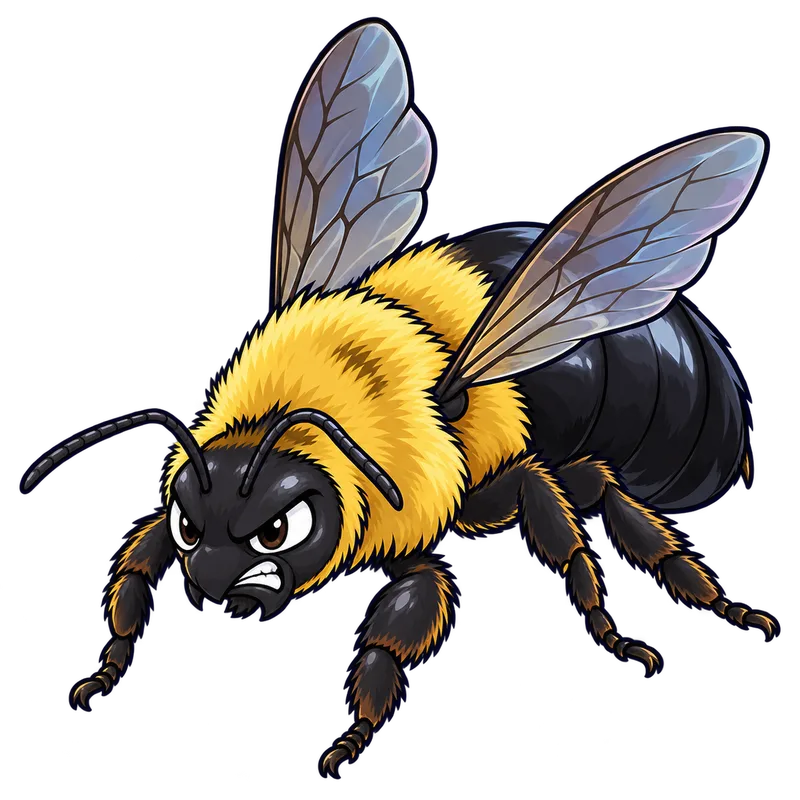
The eastern carpenter bee stands out from other large insects by its combination of size and a distinctively shiny body. Adults measure 3/4 to 1 inch in length, making them comparable to common bumble bees at a glance. However, a closer look at arm's length reveals the key difference. While bumble bees wear a heavy coat of fuzzy hair across their entire bodies, the carpenter bee sports an abdomen that is completely bare, smooth, and polished metallic black. The thorax carries a dense covering of yellow or orange hair, contrasting sharply with that slick, naked abdomen. Two pairs of dark, dusky wings fold flat over the back when the insect is at rest. On closer inspection, sexual differences become apparent. The male features a conspicuous white or yellow patch on its face, 13 antennal segments, and no stinger. The female has an entirely black face, 12 antennal segments, two apical spines on her hind tibia, a dense brush of scopal hairs used for carrying pollen, and a functional stinger. This species is frequently confused with bumble bees, but the hairless abdomen settles the question immediately. Another common mix-up involves carpenter ants, which have constricted waists and lack wings during most of their life cycle, or powderpost beetles, which leave tiny pinprick holes rather than the signature clean-cut 1/2-inch round entrance hole bored by carpenter bees.
Habitat & behaviour
This bee is native to eastern North America, ranging from Maine south to Florida and westward to Nebraska and Texas. It targets seasoned, exposed, and weathered softwoods, showing a particular fondness for unpainted or unvarnished cedar, redwood, pine, and fir. Homeowners usually spot them around outdoor wooden building elements such as eaves, fascia boards, porch ceilings, deck railings, window sills, and wooden siding. Activity picks up in the spring between April and June, right as winter hibernation ends. This is when homeowners notice male bees hovering aggressively near rooflines and porches. These males are defending their territory, darting outward to investigate any moving object or person. Despite their intimidating, helicopter-like flight pattern, these hovering males cannot sting. Females spend these warm months searching for timber to bore into, selecting exposed wood to carve out nesting galleries. They do not eat the wood they excavate, as they lack the internal biology to digest cellulose. Instead, they rely entirely on floral nectar and pollen for nourishment, while gathering pollen to provision their hidden brood cells.
Visual variations
Carpenter bees do not form complex colonies with true worker castes like honey bees or ants. Every single female is fully capable of mating, boring wood, provisioning cells, and laying eggs. The life cycle moves through distinct stages, starting with a tiny, elongate, cream-colored egg deposited inside the timber. From that egg hatches a robust, legless, yellowish-white larva. These larvae do not chew wood at all. They feed exclusively on bee bread, a dense paste of pollen and regurgitated nectar prepared and left behind by the mother. The larva eventually transforms into a pupa within its individual brood cell, which the mother seals at both ends using disks made of chewed wood pulp mixed with saliva. Under standard field conditions, the entire developmental journey from egg to adult emergence takes 36 days. The newly emerged adult generation appears in late August. Unlike their parents, these young adults do not construct new galleries or mate immediately. They spend late summer foraging and storing pollen caches in old tunnels to sustain themselves through the cold winter months before their eventual spring emergence.
Why it matters
The presence of carpenter bees usually announces itself through two clear signs: a perfectly circular 1/2-inch entry hole in outdoor timber, and small piles of coarse, pencil-shaving-like sawdust on the ground or deck below. A female bores inward at a ninety-degree angle for about an inch, then turns sharply to follow the wood grain for 4 to 6 inches to create her initial gallery. While a single gallery causes minimal harm, female offspring return to the same wood year after year to extend the network. Over decades, this multi-generational reuse results in extensive honeycombing that can compromise the structural load capacity of joists, beams, and porch railings. Beyond direct timber boring, these bees attract secondary trouble in the form of woodpeckers. The sound and vibration of developing larvae inside the wood draw hungry birds, which hammer away at the siding to reach the insects, turning a neat 1/2-inch hole into a large and ragged structural tear. For humans, the main conflict stems from the territorial males. Their persistent hovering causes a great deal of panic, occasionally leading to secondary accidents like falls from ladders as people try to swat at them. Females do possess a stinger, but they are generally docile and will only sting if trapped, crushed, or handled directly. When structural damage is extensive in load-bearing timbers, or when nests are located in high elevations requiring ladders, property owners should consult a licensed pest control professional. Treatment protocols generally involve applying an approved insecticidal dust directly into the open gallery after dark, leaving the hole unsealed for 24 to 48 hours so returning bees contact the material before the entrance is finally plugged with a wooden dowel or sealant in the autumn.