Western carpenter bees
Xylocopa species
- Size
- About 12 to 24 mm, depending on the species
- Color
- Black, metallic blue or green; some males golden brown
- Habitat
- Bare seasoned wood in western foothills, valleys and deserts
- Diet
- Flower nectar and pollen; they never eat wood
- Life cycle
- Egg, larva, pupa, adult over roughly one to three months
Western carpenter bees are not one bee but a small group of related species that share a trade: they carve their nurseries out of solid wood. In the western United States the group comes down to three main players, the mountain carpenter bee, the valley carpenter bee and the California carpenter bee, and the last of those splits further into coastal, desert and southern mountain forms.
Identity
That is why the numbers above come as ranges. Size and color change from one species to the next, sometimes dramatically, so a description that fits a bee in the Sierra foothills can be wrong for its cousin in the Arizona desert. What they share is more useful than what separates them.
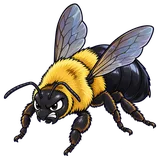
The feature that settles most arguments is the abdomen. People tend to call any big, buzzing bee near the house a bumblebee, and the confusion is understandable, since the two are about the same bulk. But look at the back end. A bumblebee's abdomen is fuzzy all over, usually striped in yellow and black. A carpenter bee's is smooth, bare and shiny, often with a metallic sheen, as if it had been polished. If you can see a glossy rear from a few feet away, you are almost certainly looking at a carpenter bee.
The females carry pollen differently too. Their hind legs wear a dense brush of hairs, where a bumblebee has a flat, smooth pollen basket. That one takes a closer look, but the shiny abdomen alone usually does the job.
Size helps with the other lookalikes. The so called little carpenter bees are only about 6 mm long and nest in hollow plant stems, not in your porch. Carpenter ants chew wood too, but they are ants, with a pinched waist, and they leave clean shavings rather than the coarse, pollen flecked sawdust a bee leaves behind.
Habitat & behaviour
These bees prefer wood that is seasoned, sound and bare. Redwood, cedar, cypress, pine and fir are favorites, and outdoors they use oaks, eucalyptus and the dried flower stalks of yuccas and agaves. Paint is a strong deterrent. Weathered, unfinished wood is an invitation.
A female picks a spot, often the underside of a beam or a fascia board where rain does not reach, and chews a hole so round it looks drilled. She goes straight in for about an inch, then turns sharply and follows the grain. Inside, she stocks the tunnel one room at a time: a ball of pollen and nectar, a single egg, a wall of chewed wood pulp, then the next room. A finished gallery holds a row of five to eight cells.
Here is the part that surprises people. All that chewing is construction, not dinner. Carpenter bees do not eat wood at all. They live on nectar and pollen, and the sawdust simply gets pushed out the front door, which is why a small pile under a round hole is such a reliable sign.
Activity picks up in spring once days reach about 68 to 70°F. Males stake out territories around the nesting area, and the new generation emerges in late summer, feeds for a while and settles back into old tunnels for the winter.
Visual variations
The males are the ones that make people nervous. They hover near nest sites and buzz straight at anyone who walks by, faces included. It looks aggressive. It is mostly bluff, because male carpenter bees have no stinger at all. Many of them also show pale or yellowish hair on the face, which helps tell them from females at close range.
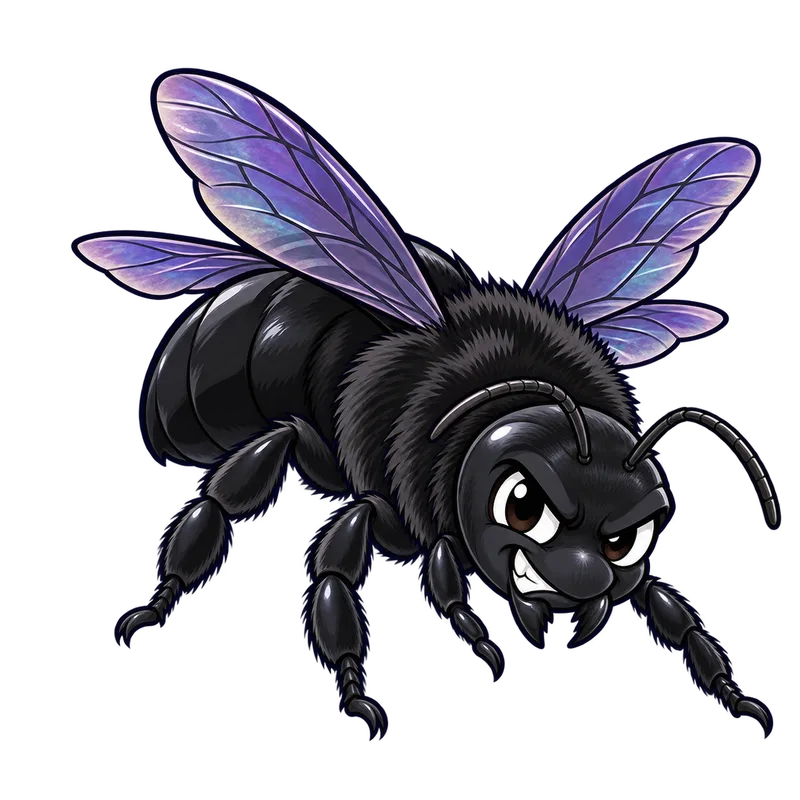
The valley carpenter bee is the most striking case of the sexes looking different. The female is glossy black with violet and bronze reflections. The male is a soft golden brown and looks like a different animal entirely, so a pair seen together is easy to mistake for two species.
The California carpenter bee leans toward metallic blue or green, with darker, smoky wings in the desert form. The mountain carpenter bee is black in both sexes.
The young never leave the wood until they are adults. The larva is a pale, legless grub sealed in its cell with its food supply, and it goes through a full change from grub to pupa to winged adult before chewing its way out.
Why it matters
One season of nesting does little harm. The trouble is that the same tunnels get reused, lengthened and branched year after year, so a single hole in a fascia board can hide a gallery system that has been growing for a long time. In dry western areas they have even tunneled into wooden water tanks and caused leaks.
The bigger damage sometimes comes from a second visitor. The larvae inside attract woodpeckers, which splinter the wood open to get at them and can do far more harm than the bees ever did.
As for people, the females can sting but rarely do, usually only when handled or trapped against skin. Anyone with a history of strong reactions to stings should treat any bee with care and see a clinician if a sting brings swelling beyond the site or trouble breathing. And the bees themselves are genuine pollinators, which is worth remembering before reaching for a spray.