
How should carpenter bee holes in wood be addressed?
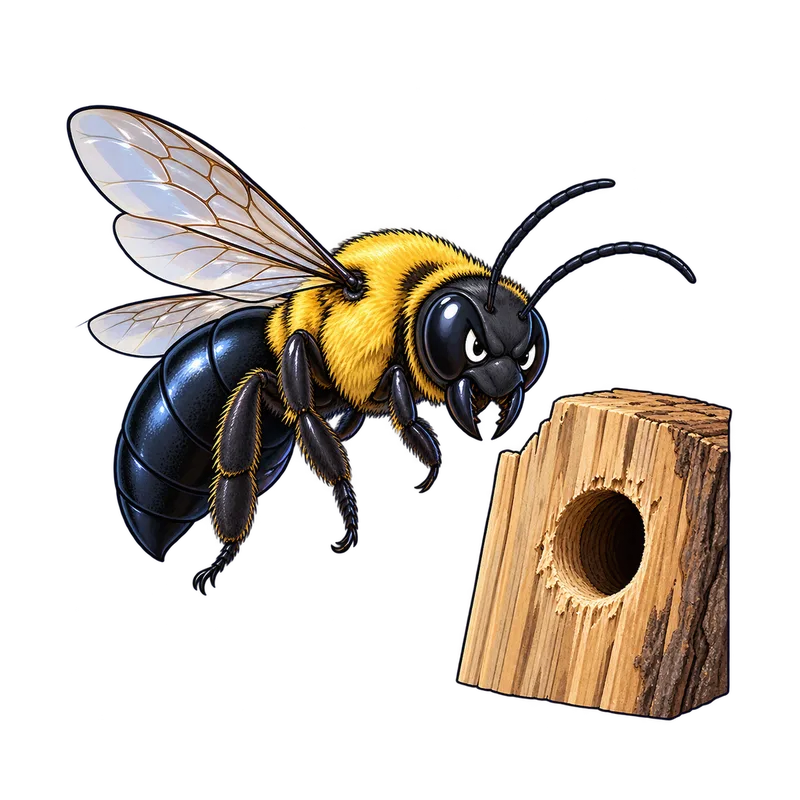
Carpenter bee holes in wood should first be treated with an approved residual insecticide dust applied directly into the active gallery. Leave the entrance open for twenty four to forty eight hours so foraging adults contact the chemical before plugging the hole tightly with a wooden dowel or wood filler and finishing with exterior paint.
What is actually going on
You walk out to the back deck on a warm spring morning, coffee in hand, and notice a small pile of coarse wood shavings on the patio tile just beneath the porch rail. You look up and spot a perfectly round hole bored into the soft cedar beam, looking for all the world like someone took a half-inch power drill to your trim work. Before you can even set your mug down, a large, heavy-looking bee with a shiny black back dives right at your face, hovering in midair and making an aggressive buzzing sound.
To properly address carpenter bee holes in wood, an active gallery entrance must first be treated with an approved residual insecticide, preferably a dry dust formulation, and left unsealed for several days so foraging adults contact the chemical. Once that waiting period passes and the insecticidal action finishes its work, the entry hole should be plugged tightly with a wooden dowel or heavy-duty wood filler, followed by a coat of exterior paint or polyurethane to keep new generations from moving back in.
The most common mistake people make is grabbing a tube of caulk and sealing up that pristine drill hole the very second they spot it. Doing that before introducing an insecticide is like locking a carpenter inside a closet with a saw. The trapped adult bees or the developing brood inside will simply chew their way out through the adjacent wood or punch straight through your fresh putty, multiplying the number of holes and turning a minor cosmetic fix into a much larger structural repair.
Carpenter bees do not actually eat wood for nutrition the way termites do, which surprises most homeowners. They chew through exterior softwoods like cedar, redwood, pine, and cypress purely to excavate shelter and rear their young. The female bores inward at a right angle for about an inch before making a sharp ninety-degree turn to tunnel along the grain, dumping all the sawdust out of the main entrance. Left alone year after year, these galleries stretch into networks spanning several feet, honeycombing structural timber and inviting secondary problems like hungry woodpeckers looking for a larva snack.
Spotting a hole in exterior timber usually points you toward carpenter bees, but you want to be certain before you start buying chemicals or cutting dowels. Look for a hole measuring about three-eighths to one-half of an inch across, with edges as clean and smooth as if a professional woodworker made them with a drill bit. Beneath that opening, you will usually find a small mound of coarse wood shavings that look remarkably like pencil sharpener debris, often accompanied by yellowish-brown streaks of fecal splatter on the wood surface.
You might also notice the bees themselves, and here is where you can let out a sigh of relief. The ones dive-bombing your head and hovering aggressively are males. They feature light facial markings, buzz loudly, and act like miniature neighborhood security guards, but they completely lack a stinger and are entirely harmless. Females possess stingers, but they usually stay tucked away inside the tunnel provisioning brood cells with a mixture of pollen and regurgitated nectar, and they rarely sting unless you grab or crush them barehanded.
How to tell for sure
Figuring out whether you are actually dealing with carpenter bees instead of other wood-damaging insects usually comes down to looking closely at the debris and the tunnel interiors. Carpenter ants leave behind irregular, slit-like windows and a fibrous, sawdust-like frass mixed with insect parts, while their interior galleries are sandpaper-smooth and entirely free of debris. Powderpost beetles leave behind tiny pinprick shot-holes accompanied by an extremely fine, flour-like powder. If your hole is large and round, sits in unpainted exterior softwood, and has coarse shavings on the ground below, you are usually dealing with carpenter bees.
What usually comes next
Your main decision once you confirm the infestation is timing. You cannot rush the repair process, because trying to solve the problem in a single afternoon by plugging and painting the hole guarantees failure. You have to commit to a multi-stage protocol that requires patience over a few days.
Start by acquiring an approved residual insecticidal dust and applying it directly into the gallery opening, ideally using a hand duster that puffs the powder deep inside where the crawling insects will brush against it. Once you apply the dust, your next move is to wait. Leave that hole wide open for twenty-four to forty-eight hours, or even up to a week depending on the product instructions and the weather. This waiting period allows returning adult bees and emerging offspring to contact the toxicant and ensure complete colony knockdown.
Only after that waiting period has elapsed should you move on to the mechanical repair. Clear any loose debris from the entrance and plug the hole tightly using a wooden dowel coated in exterior wood glue, or pack it flush with a heavy-duty exterior wood filler. Finally, finish the job by priming and applying at least two coats of solid exterior paint or polyurethane to the surrounding bare wood. Wood stains and clear water sealants usually do not deter these bees, but solid paint seals the wood pores and grain texture that females look for when selecting a site to lay their eggs.
When to get help
There are moments when a DIY approach to carpenter bee holes crosses the line into a project better handed over to someone else. If the gallery networks span critical load-bearing joists, multi-story porch supports, or historical timber that has become severely honeycombed and structurally compromised, call a professional builder or a licensed pest control operator to evaluate whether the members need total replacement.
Height and access also dictate when you should step back. If the nesting holes are scattered across high roof eaves, steep gables, or multi-story siding that requires working off a tall extension ladder, the fall risk alone makes hiring a professional service the sensible choice. All pesticide handling must strictly follow the product label instructions, and any restricted-use formulations require a licensed applicator by law.
If someone in your household has a known allergy to insect stings, do not attempt to treat active galleries yourself. A single defensive sting from an agitated female can trigger a severe allergic reaction requiring immediate emergency medical care. Similarly, if you notice that woodpeckers have started hammering massive holes into your siding and fascia boards to feed on the bee larvae inside, remember that these birds are protected under wildlife protection acts. You cannot harm or trap the woodpeckers, meaning your strategy must focus strictly on eliminating the underlying insect larvae and repairing the wood with professional guidance.