
What do carpenter bee holes in wood look like?
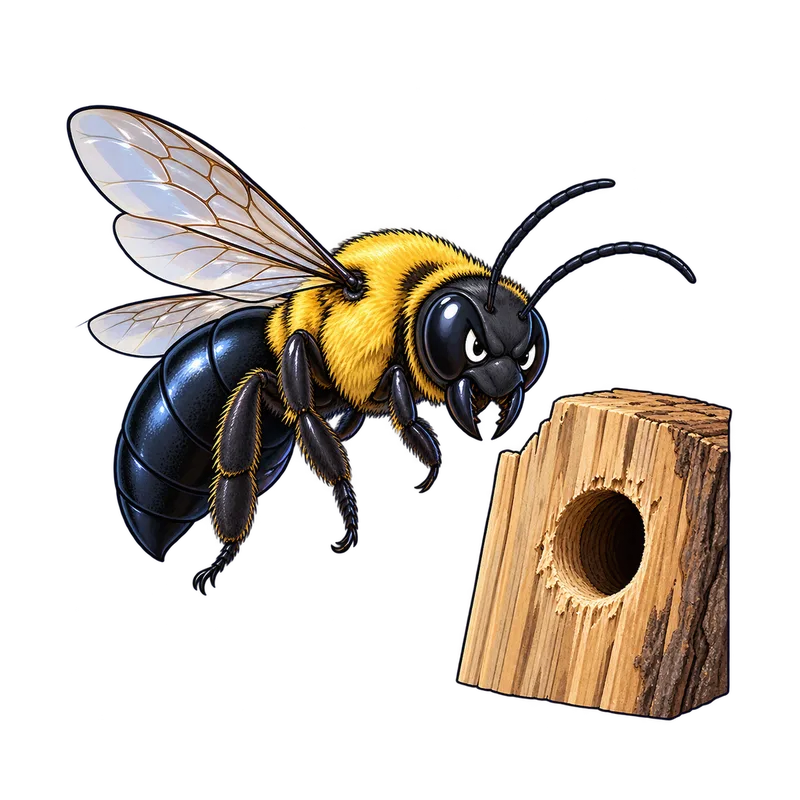
Carpenter bee holes in wood are clean, perfectly circular openings measuring roughly one-half inch across. These holes enter the timber at a strict right angle and feature a pile of coarse, curly sawdust shavings directly below. Freshly drilled holes show bright wood inside the rim, while older tunnels appear dark and gray on the edges.
What is actually going on
You walk out onto the back deck on a sunny Saturday morning, coffee mug in hand, and notice a small, perfectly round hole drilled neatly into the underside of the wooden patio roof fascia. It looks almost as if someone took a power tool to your timber while you were asleep. A small heap of coarse sawdust sits on the floorboards directly below, and you spot a large, shiny black insect hovering aggressively a few feet away, darting back and forth as if daring you to get closer. You are looking at classic carpenter bee damage. A carpenter bee hole in wood is typically a clean, perfectly circular opening measuring roughly one-half inch across. If you measured it precisely, it would usually fall between three-eighths and one-half inch in diameter. The hole enters the wood at a strict right angle, cutting straight across the surface grain for about an inch before making a sharp ninety-degree turn to run parallel to the grain for several inches. These insects do not actually eat the wood for food. Female carpenter bees chew through timber solely to excavate nesting tunnels where they can lay their eggs. Because they reject the wood fiber rather than digesting it, they push all the excavated material backward out of the entry hole. This leaves a pile of debris below that looks less like fine dust and more like the coarse, curly shavings you get when sharpening a wooden pencil by hand. You will often notice additional visual clues nearby, such as small yellow-brown streaks or splatters on the painted siding directly beneath the entrance. These stains are fecal splatters from the bees as they forage and defend their nests. While a single hole might look like a minor cosmetic annoyance, leaving it unchecked invites a cascade of problems, from multi-generational tunneling inside your support beams to hungry woodpeckers tearing the wood apart to reach the larvae inside.
Spotting a half-inch hole is a strong indicator, but verifying the culprit requires looking closer at both the insect and the surrounding debris. Carpenter bees are frequently confused with bumblebees because both are large and fuzzy-looking at a glance. However, if you look at the top of the abdomen, a carpenter bee usually has a smooth, shiny, hairless surface that catches the light like polished metal, whereas a bumblebee is densely covered in fine hair from top to bottom. Behavior is another reliable tell, particularly with the males. If a large bee is hovering inches from your face, darting aggressively around your head, you are dealing with a male carpenter bee playing the role of an overly dramatic security guard. The reassuring news is that male carpenter bees possess no stinger at all. They are completely incapable of stinging you, and their loud buzzing is just an empty bluff. Females do have a functional stinger, but they usually stay inside the nest or out foraging and only deploy it if you physically squeeze or trap them in your hand. When examining the debris pile on the ground, check the texture carefully. Carpenter bee shavings are chunky and fibrous, resembling pencil sharpenings. If you find flour-like powder instead, you are likely looking at the work of tiny powderpost beetles. If you find hard, six-sided pellet frass, you might have drywood termites. Carpenter ants, meanwhile, leave coarse wood shavings mixed with dead ant body parts, but they rarely drill clean, circular holes like the ones carpenter bees leave behind. Freshly drilled holes usually show bright, unweathered wood inside the rim, while older or abandoned tunnels appear dark and gray on the edges. If an old hole is plugged up with a packed mud wall, a solitary wasp has likely moved into the vacant real estate.
How to tell for sure
Once you confirm you are dealing with carpenter bees, you need a plan for treatment before you even think about sealing those holes shut. Homeowners usually make the mistake of grabbing a tube of exterior caulk and plugging the open tunnels right away. If you seal the entrance too soon, the trapped female simply chews a brand-new exit route through the caulk or out the side of the wood, rendering your quick fix useless. The right approach takes a little patience and a specific two-step method. You need to apply a labeled insecticidal dust directly into the open gallery entrance using a small hand duster. Dust formulations work well because they cling to the dry interior surfaces of the tunnel. Crucially, you have to leave the hole wide open for twenty-four to forty-eight hours after applying the treatment. This waiting period gives the returning adult bees time to crawl through the entrance and come into contact with the residual chemical. Only after that waiting window passes should you permanently plug the hole. Filling the entrance tightly with a wooden dowel coated in exterior wood glue, or packing it completely with wood putty, keeps the next generation or secondary pests from moving into the old tunnels. Painting exposed raw wood with a high-quality oil-based paint or thick enamel also helps deter future females from choosing your timber for their nests.
What usually comes next
Most people can manage a few isolated carpenter bee holes with standard property maintenance and careful insecticide application. Without preventative paint coatings or regular timber inspections, however, returning generations will reuse existing galleries or tunnel outward from old nests. Over several seasons, intersecting tunnels can honeycomb structural fascia boards, deck railings, and roof eaves. This internal weakening often attracts woodpeckers, which hammer along the grain to expose the brood cells. Once birds open up these channels, minor surface damage escalates into severe structural timber degradation that requires extensive board replacement rather than simple cosmetic filling.
When to get help
From a health and structural standpoint, you need to know where pest control stops and emergency or building safety begins. If a female bee manages to sting someone and that person experiences systemic allergic symptoms like hives, dizziness, facial swelling, or trouble breathing, direct the individual immediately to emergency medical care or an urgent care clinician. From a structural standpoint, pest control technicians and inspectors can identify infestations and apply treatments, but they do not provide structural engineering certifications. When carpenter bee galleries have honeycombed major load-bearing timbers, porch supports, or roof joists, or when woodpeckers have smashed jagged trenches through the wood to reach the larvae, you need to bring in a qualified builder, licensed contractor, or structural engineer. They must evaluate whether the timber still holds enough strength to support the structure or if the members require immediate replacement. If your property features high-elevation fascia boards, difficult-to-reach soffits, or large multi-family structures where treatments require specialized high-pressure equipment, contact a licensed pest management professional to handle the job safely and effectively.