Arizona bark scorpion
Centruroides sculpturatus
- Size
- 20 to 70 mm long
- Color
- Light tan, straw-yellow, or yellowish-brown
- Habitat
- Desert scrub, rock crevices, and residential structures
- Diet
- Insects, spiders, and other arthropods
- Life cycle
- Live birth followed by multiple molts
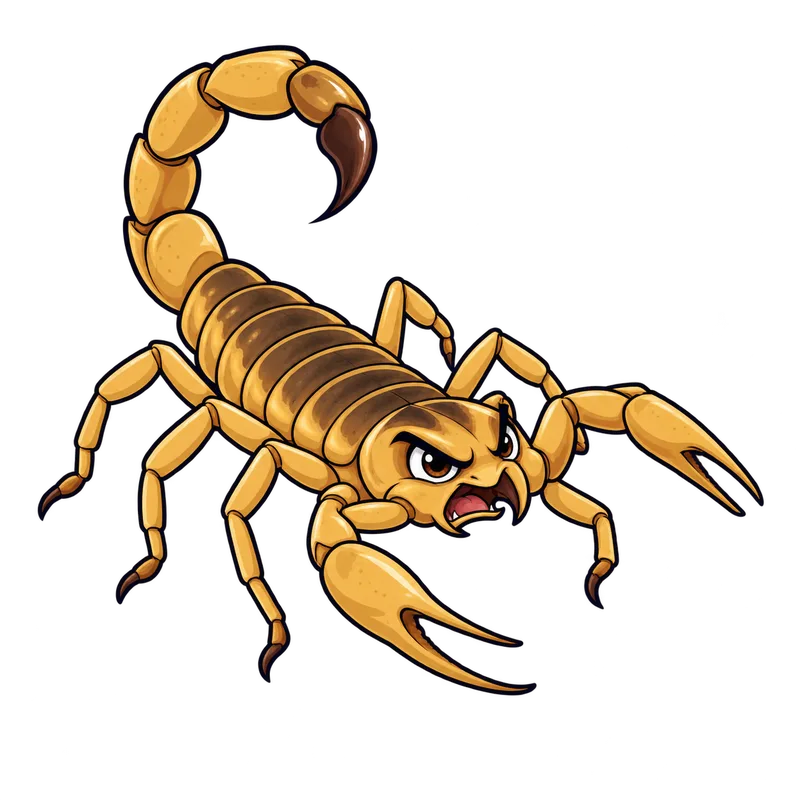
The Arizona bark scorpion goes by the scientific name Centruroides sculpturatus. If you are holding a flashlight in a dark desert hallway, you are looking for a small, slender creature with an elongated oval body, eight walking legs, and exceptionally thin pincers. Its tail is long, thin, and usually curled right over its back, ending in a curved stinger.
Identity
The color is a uniform light tan, straw-yellow, or yellowish-brown. Unlike some of its distant relatives, it does not wear bold dark stripes down its back.
If you step outside at night with a portable ultraviolet light, you will spot them immediately. Their exoskeleton fluoresces a bright green-cyan under 365 nanometers of UV light, glowing like a neon sign against the dark stucco or patio stones.
To the naked eye, a scorpion is a scorpion. You cannot tell this medically significant species apart from other regional bark scorpions or harmless lookalikes without professional help. A positive identification requires a preserved specimen, a 10x magnification hand lens or stereomicroscope, and a close look at microscopic features like the subaculear tooth. That is a tiny tubercle located right underneath the stinger on the telson. Leave the microscope work to the entomologists.
Habitat & behaviour
In the wild, these scorpions favor rock crevices, fallen logs, and loose tree bark, especially on mesquite, cottonwood, and sycamore trees. In town, they find your house far more accommodating. Outside, they tuck themselves into block walls, expansion joints, stucco weep holes, palm trees, and woodpiles. Inside, they cruise along baseboards, hide in dark closets, crawl behind wall voids, and occasionally curl up inside a shoe or a folded towel left on the floor.
They are strictly nocturnal. They spend the daylight hours tucked away in tight, dark, humid microhabitats, and then they come out after dark to hunt crickets, cockroaches, spiders, and other small insects.
They also love tight spaces. They exhibit extreme positive thigmotaxis, which is just a fancy way of saying they need to feel constant tactile contact against their bodies. When they move across a room, they hug the wall perimeters, baseboards, and structural seams.
Unlike heavy, burrowing desert scorpions that stay strictly at ground level, the Arizona bark scorpion is an elite vertical climber. Its specialized tarsal claws let it scale rough vertical surfaces like brick, stucco, wood, drywall, curtains, and ceilings. It is entirely normal for one to scale a wall, walk across a ceiling, and accidentally drop onto a bed or a piece of furniture.
When winter arrives and temperatures drop, their metabolic activity slows down. They gather in gregarious clusters of dozens inside warm wall voids or protected subterranean crevices, waiting out the cold until spring restarts the cycle.
Visual variations
You will not find any neat social castes here because these are solitary arachnids. There are no queens or workers running the show behind the drywall.
Males and females look remarkably alike at a glance. Mature males usually feature slightly higher pectinal tooth counts and slightly longer, narrower tail segments, but you would need a microscope and a serious interest in taxonomy to notice the difference from the kitchen floor.
Life begins live rather than in a protective egg case. Females give birth to live scorplings. Newborn nymphs are soft, pale, and completely lack a hardened outer shell. The moment they are born, the tiny brood climbs straight up the female's legs and piles onto her back. They stay stacked on her dorsal surface until they complete their very first molt. Once that first skin is shed, they scatter to live entirely on their own.
As they grow, they go through a series of developmental molts over several months before reaching adult maturity. They do not have wings at any stage of life. Order Scorpiones gives you eight walking legs and zero wings, period.
Why it matters
An encounter with an Arizona bark scorpion is entirely accidental. Stings usually happen when someone steps on a wandering scorpion at night, presses against one while sliding into a pair of shoes, or brushes against a hiding spot in a closet or storage box.
Its venom contains potent neurotoxins that disrupt the nervous system, but it does not cause rotting flesh or skin ulcers. If you spot a necrotic skin lesion, look for a recluse spider instead.
Most adult stings result in severe local pain, numbness, and tingling. A classic diagnostic sign is the positive tap test, where light percussion on the sting site triggers an immediate, intense spike of pain.
Vulnerable populations face higher risks. Children under 5 years old have a low body mass that concentrates the venom, making them susceptible to severe systemic reactions. Red flag symptoms include trouble breathing, difficulty swallowing, profuse drooling, uncontrollable muscle jerking, or roving, darting eye movements.
If a child under 5 is stung, or if anyone shows those red flag systemic symptoms, seek emergency medical care immediately. For general guidance, you can always contact the National Poison Control Center Helpline at 1-800-222-1222.
Finding one of these scorpions in your home means your exterior seals have small gaps, often as tiny as 1/16 of an inch around door sweeps, window frames, or utility penetrations, letting in a creature well-equipped to climb your walls and share your space.