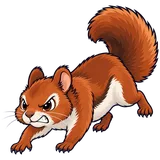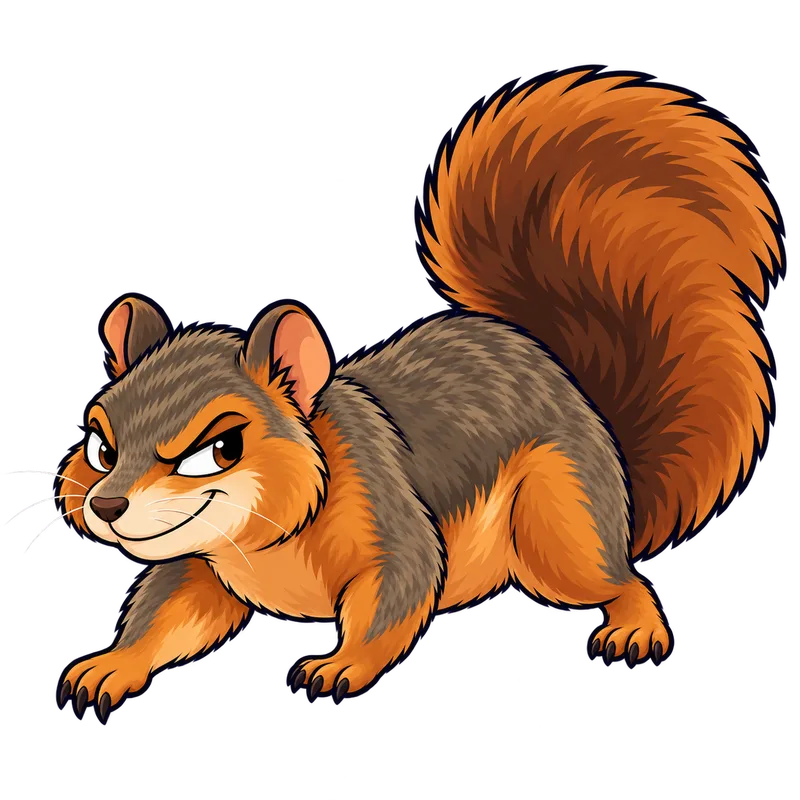
Fox squirrel
Sciurus niger
- Size
- Not established
- Color
- Not established
- Habitat
- Wooded areas and urban building attics
- Diet
- Seeds, nuts, and plant vegetation
- Life cycle
- Not established
Tree squirrels in the genus Sciurus leave behind unmistakable clues in mud, sand, or snow when they cross your property. A homeowner inspecting a fresh set of footprints on a deck railing or garden bed will notice a clear difference between the front and rear paws. The front tracks show four distinct toes, while the hind tracks display five, each finished with a sharp claw mark. When these animals travel, they move in a characteristic two-by-two bounding pattern. The larger, five-toed hind feet land side-by-side slightly ahead of or alongside the four-toed front feet with every hop. This specific rhythm separates them instantly from cottontail rabbits, which travel in a distinct I-formation gait where the elongated hind feet land directly in front of staggered forefeet, leaving dense fur impressions that squirrel paws entirely lack.
Habitat & behaviour
These mammals split their time between natural canopy habitats and the architectural vulnerabilities of modern suburbs. In the wild, they rely on tree cavities and leaf nests, but rooflines offer an irresistible upgrade. An overhanging branch acts as a natural highway, bridging the gap between the forest canopy and a vulnerable attic, roof soffit, or chimney. Activity is strictly diurnal, meaning morning light usually brings the sound of scratching or heavy thuds echoing through ceiling voids as the animals seek shelter and nesting sites. Well-fed urban populations, sustained by accessible garbage, cultivated garden crops, and residential bird feeders, reproduce rapidly and test structural boundaries with persistent gnawing. Static frightening devices fail quickly because these animals habituate to static setups within days. Effective prevention relies instead on physical exclusion, such as installing heavy-duty metal hardware cloth with mesh apertures measuring 6.35 mm or smaller over vents, alongside rigorous tree-branch trimming.
Visual variations
Flightless and entirely mammalian, these squirrels possess no wings, distinct castes, or insect-style developmental stages. They travel on four legs through every phase of life, though precise size or physical descriptions for newborns and juveniles are generally absent from standard wildlife management texts. Social structures are loose, consisting of solitary individuals or small family groups rather than complex colonies. Because source literature does not detail sexual dimorphism for this group, field observers cannot easily separate males from females by sight alone. The observable physical features remain consistent across mature populations: a small, tree-dwelling rodent form driven by fixed daily routines of foraging and shelter-seeking.
Why it matters
An animal chewing through wooden siding, stripping bark from ornamental shrubs, or raiding a backyard bird feeder is doing what comes naturally, but structural entry creates severe fire hazards when insulation and electrical wiring are compromised. Any physical contact, scratch, or bite from a cornered or trapped animal carries biological risks, meaning all bite incidents require an immediate referral to a medical clinician or public health authority rather than DIY assessment. Furthermore, state wildlife laws strictly regulate live trapping and relocation, often prohibiting the transport of wild mammals to new areas due to the spread of parasites and disease.