
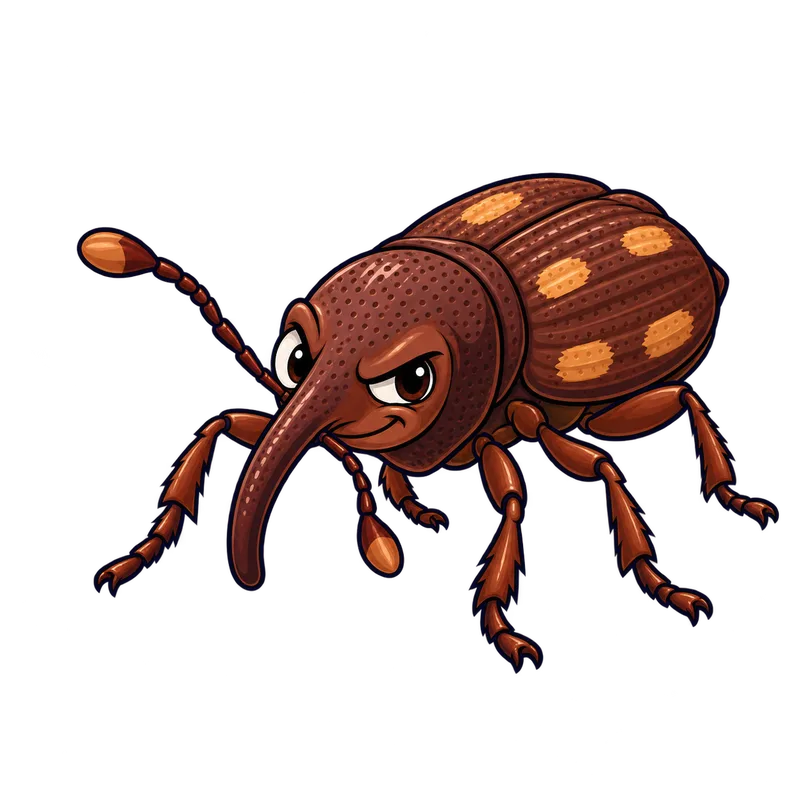
Rice weevil
Sitophilus oryzae
- Size
- About 1/8 inch long (3.175 mm)
- Color
- Reddish brown to black, four pale elytral spots
- Habitat
- Stored grains, mills, pantries, fields before harvest
- Diet
- Whole cereal kernels, pasta, processed grain products
- Life cycle
- Egg, larva, pupa, adult; about 1 month
The rice weevil is Sitophilus oryzae, a true snout beetle in the weevil family Curculionidae, and the place you usually meet it is a bag of rice, corn, wheat, pasta or pet kibble that looked fine until something small moved. The useful thing to know is that the beetle is only the visible receipt: the real feeding has already happened inside the grain.
Identity
An adult is about 1/8 inch long (3.175 mm), reddish brown to nearly black, with a slim forward snout that carries chewing mouthparts at the tip. With the naked eye you can usually make out the snout and the four reddish or yellowish spots on the wing covers, two on each side. With a 10x hand lens, the better clues appear: the shield behind the head is pitted with coarse round holes, and the wing covers have deep lengthwise grooves.
Those round pits matter because the granary weevil, the usual lookalike, has more elongated oval punctures, no neat four-spot pattern and no working hindwings. A rice weevil has fully developed wings under the hard covers and can fly well, which explains why one turned up near the window when the infested bag is across the kitchen.
Habitat & behaviour
This is a stored-grain insect with a passport. It lives in elevators, mills, warehouses, processing plants and home pantries, but unlike many cupboard beetles it also flies out to standing cereal crops and can start an infestation before harvest. Warm indoor storage lets it keep breeding all year; outdoors, flight and crop colonization rise as grain matures in summer and early autumn.
The female uses her snout like a tiny drill, boring into a whole kernel, laying one white oval egg inside and sealing the cavity. Over an adult life she may lay 300 to 400 eggs, usually one per kernel, which is why a "few beetles" can mean a few hundred future beetles already booked in. In warm conditions a generation can run from egg to adult in about 1 month, and adults commonly live 7 to 8 months, with records past 2 years.
So the pantry is not necessarily dirty. Sometimes the grain arrived with the story already written inside it.
Visual variations
You are not looking at a social insect with distinct jobs for different members. This is complete metamorphosis, meaning the creature passes through egg, larva, pupa and adult stages. The egg is tiny, white and tucked neatly into a cavity drilled inside a kernel, so you will not spot one sitting on your pantry shelf.
The larva is the unseen engine of the damage. It is a legless, white, plump, C-shaped creature with a darker head capsule, feeding quietly inside the grain like a tenant who refuses to open the door. The pupa is pale cream and transforms right there inside the hollowed grain. The adult chews a clean round exit hole and walks out, which is usually the moment you realize the bag has uninvited guests.
Males and females look almost identical from the outside. The reliable distinction is what they are doing, since females are the ones drilling the grain to lay eggs. That flying ability is not a separate phase either, but simply the adult's functional hindwings tucked neatly beneath the spotted wing covers.
Why it matters
Rice weevils do not bite, sting, carry human diseases or chew through structural wood. Their damage is entirely culinary and economic, leaving hollowed kernels, fine dust, neat exit holes and dry goods that belong in the trash rather than a mixing bowl. Discovering them is annoying rather than hazardous, though if you ever suspect a health reaction or illness, a clinician is the right person to consult instead of the pantry shelf.
Accurate identification matters most outside the home kitchen. In commercial grain storage or large agricultural fields, telling the rice weevil apart from the maize weevil affects record-keeping and management, and the maize weevil is close enough that a casual look will not cut it. The granary weevil is simpler to rule out because it cannot fly, lacks those four pale spots, and has oval rather than round pits on the thorax. Common pantry pests like flour beetles, sawtoothed grain beetles, cigarette beetles and drugstore beetles all lack that defining snout. If your suspected weevil has no snout at all, it is something else entirely wearing a brown coat.
Similar species
 Granary weevilSitophilus granarius
 Maize weevilSitophilus zeamais
 Red flour beetleTribolium castaneum
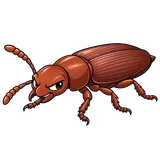 Confused flour beetleTribolium confusum
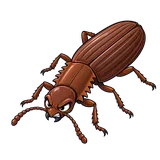 Sawtoothed grain beetleOryzaephilus surinamensis
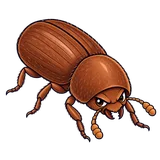 Drugstore beetleStegobium paniceum