
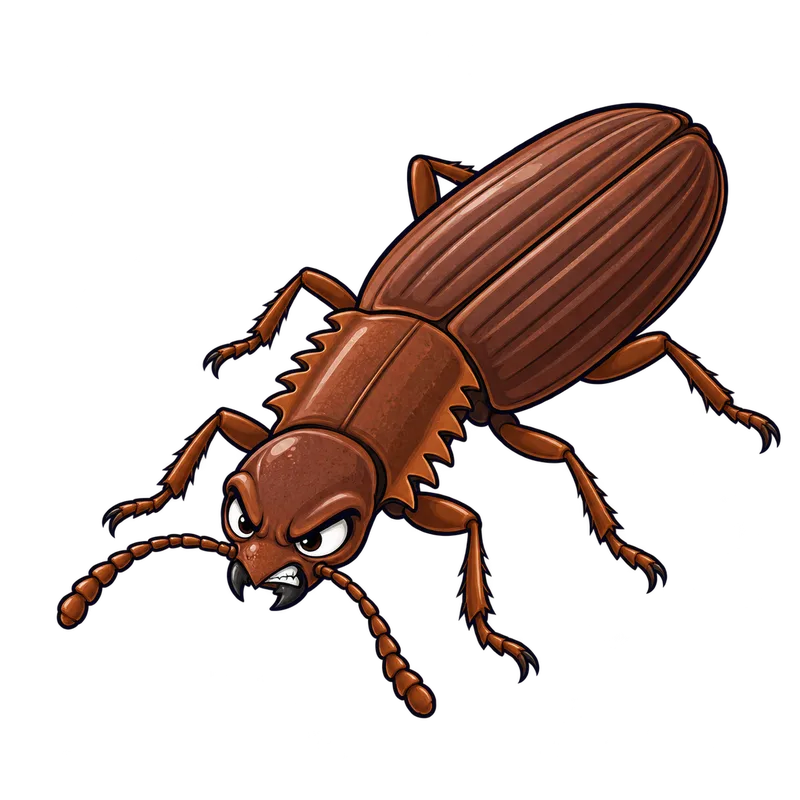
Sawtoothed grain beetle
Oryzaephilus surinamensis
- Size
- 2.5 mm (1/10 inch) to 3 mm adult
- Color
- Dark brown to reddish-brown
- Habitat
- Pantries, cabinets, warehouses, grain elevators, feed mills
- Diet
- Broken grains, flour, cereals, dried foods, pet kibble
- Life cycle
- Egg, larva, pupa, adult; 25 days at 30 to 35 C
The sawtoothed grain beetle is Oryzaephilus surinamensis, a small stored product beetle of dry food rather than gardens or timber. The usual meeting place is a pantry shelf, feed bin, warehouse or mill, often beside flour, cereal, cracked grain or pet kibble.
Identity
An adult is only 2.5 mm (1/10 inch) to 3 mm, so the first impression is often a brown fleck that refuses to stay still. Look longer and the shape does the talking: very flat, slender and elongated, dark brown to reddish-brown, with fine lengthwise grooves on the wing covers. That flat build is not decorative. It is made for sliding into seams, folds and the pathetic little gaps around packaging that people call closed.
The name comes from the prothorax, the segment just behind the head, which carries six saw-like teeth on each side. Those teeth are the clean field mark, but they are small; the body outline is visible to the naked eye, while the teeth usually want a hand lens. Under magnification, the head gives another clue: behind each compound eye, the temple is broad and curved, about half as long as the eye. The top of the thorax also has three parallel ridges running lengthwise. One useful contradiction settles many kitchen arguments: it has well-developed wings under the covers, yet adults do not fly. A beetle orbiting the light is probably somebody else.
Habitat & behaviour
This is an indoor storage insect in temperate regions, not a wanderer from the flower bed. It lives where dry food waits: pantries, cupboards, food warehouses, grain elevators and feed mills. Indoors, heating smooths out the seasons, so feeding and breeding can continue all year. In unheated spaces, activity rises as temperatures move toward its optimum of 30 to 35 degrees C (86 to 95 degrees F).
Its menu is broad, but it has one honest limitation. It cannot break into sound, undamaged grain kernels. It is a secondary feeder, which means it exploits cracked, broken, milled or already damaged grain, then moves happily into flour, cornmeal, bran, rolled oats, brown rice, breakfast cereal, pasta, crackers, cake mix, sugar, chocolate, raisins, nuts, spices, dried milk and dry pet food. It has even been recorded eating eggs and dead adults of stored-product moths, which sounds almost tidy until you remember it is still eating in the cupboard.
The same flat body that identifies it explains the maddening household pattern: beetles inside packages that were never opened in your kitchen. Adults and larvae can chew through paper, cardboard, plastic film, cellophane and foil, so sealed often means sealed against people, not against a 2.5 mm insect with time on its hands. Movement is by rapid crawling, though adults may spread when a food source gets crowded. Cold and heat set hard limits: all stages die at -15.6 degrees C (4 degrees F) held for 24 hours, while 0 degrees C (32 degrees F) can be survived for weeks. A chilly garage is not a reliable exterminator, merely a bad landlord.
Visual variations
Eggs are tiny, white and slender, dropped singly or in small clusters inside food cracks or scattered loosely among particles. They are simple to overlook because they resemble stray dust in a product already full of it.
Larvae are off-white to yellowish-white, slender grubs featuring a darker brown head capsule, and mature larvae remain under 3 mm (1/8 inch). They lack a forked point at the tail end, which helps distinguish them from several other tiny stored-product grubs. Most go through three growing stages, though two to five have been noted. When ready to transform, a larva attaches itself to a surface and constructs a rough cell from food debris. The pupa rests inside that small homemade chamber with the shed larval skin still attached at the rear, and even at this stage the six teeth on the sides of the middle body segment are visible on the developing adult.
Adults are what people usually spot: flat, dark brown to reddish-brown, grooved wing covers, six teeth on each side, three ridges on the top. There are no distinct social roles or workers. Determining sex is possible but far from casual: the male has a noticeable projection on the thigh of the hind leg, while the female does not, and spotting that difference requires magnification. A mated female produces about 375 eggs on average, and development from egg to adult takes roughly 25 days under warm, ideal conditions, meaning a minor oversight in a cupboard can quickly turn into a thriving population.
Why it matters
The good news is straightforward: this insect does not bite, sting, harm humans or pets, carry disease pathogens, chew structural timber or attack living garden plants. The damage is restricted to food loss and contamination, ranging from residential pantries to commercial warehouses, alongside the unique annoyance of finding bugs inside a box that seemed entirely fine.
Exact identification matters when the insect is flying, when whole undamaged grain appears to be the target, or when a business needs to figure out which inventory is actually vulnerable. The usual confusion happens with the merchant grain beetle, Oryzaephilus mercator, which also has those six side teeth but features a small, narrow, pointed region behind the eye and can take flight. The foreign grain beetle only has one tooth-like projection at each front corner of the middle body segment and is a strong flier associated with damp, moldy spaces. Flour beetles lack the side teeth and have clubbed antennae; cigarette and drugstore beetles look more rounded and humped with the head tucked downward; rice and granary weevils feature an obvious snout.
So the helpful question is not just what is this brown speck, but what is it signaling. Six teeth per side, a broad curved region behind the eye and zero interest in flying point straight to the sawtoothed grain beetle, and they also point directly back to compromised grain, flimsy packaging and storage conditions that remained comfortable longer than intended.
Similar species
 Drugstore beetleStegobium paniceum
 Cigarette beetleLasioderma serricorne
 Varied carpet beetleAnthrenus verbasci
 Black carpet beetleAttagenus unicolor
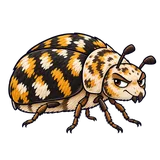 Furniture carpet beetleAnthrenus flavipes
 Multicolored Asian lady beetleHarmonia axyridis