
What are foreign grain beetles?
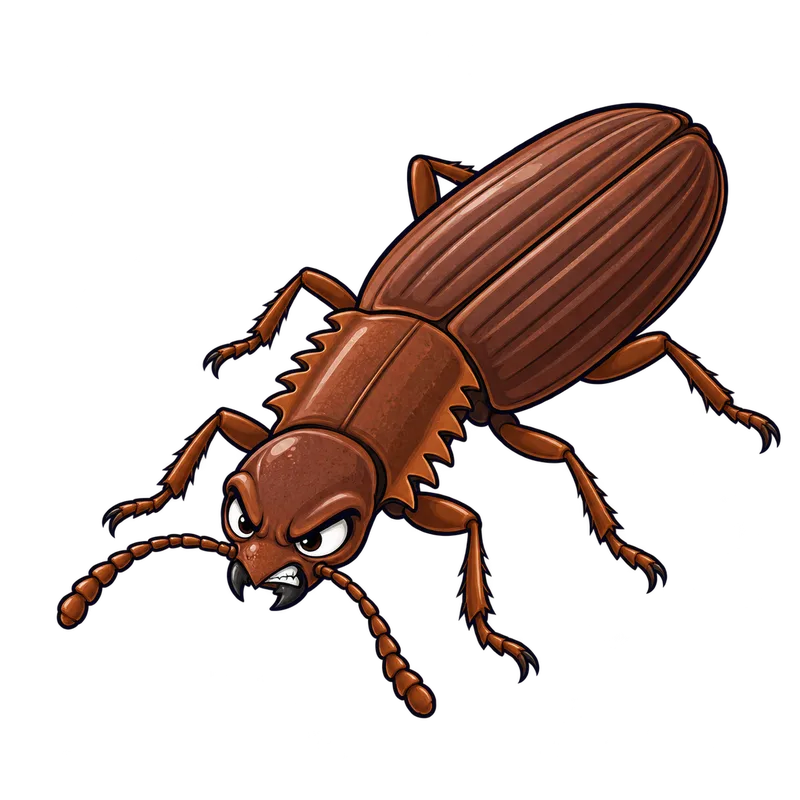
Foreign grain beetles are tiny, flattened insects measuring about 2 mm, or one-twelfth of an inch, in length. They feed entirely on microscopic surface molds and fungi, serving as biological alarms for trapped moisture or hidden dampness in buildings.
What is actually going on
Picture walking into the kitchen on a warm August evening, flipping on the overhead light, and noticing dozens of tiny, reddish-brown bugs skittering across the counter or buzzing lazily around the bulb. Naturally, you might wonder if a bag of flour has gone rogue in the pantry. What is actually going on is a bit different, because those visitors are foreign grain beetles. They are tiny, flattened insects measuring about 2 mm, or one-twelfth of an inch, in length. Despite the name, they are not really pantry pests that bore into sealed cereal boxes or chew through dry pasta.
Instead, foreign grain beetles are moisture lovers and biological alarms. They feed entirely on microscopic surface molds, fungi, and damp organic debris. If you are seeing them in numbers, especially in a house that was built within the last year or two, you are likely witnessing what experts call new construction syndrome. A freshly built house acts like a giant, slow-drying sponge. Framing lumber, poured concrete, and wet drywall hold gallons of water that take seasons to fully evaporate. That trapped moisture creates invisible fungal blooms inside unsealed wall cavities, which serves as a feast for these beetles.
When the larvae finish developing in late summer, the adult beetles emerge from behind baseboards, electrical outlet plates, and recessed lighting fixtures, looking for a way out. They happen to be strong fliers and get drawn to artificial lights, which explains why you find them clustering around lamps and windows. Are they chewing through your woodwork or contaminating your boxed goods? Usually not. They are just following the mold, and the mold is following the dampness.
How to tell for sure
Figuring out what you are looking at usually requires looking past the general shape. At a glance, a foreign grain beetle looks remarkably like a sawtoothed grain beetle, but there are distinct differences if you take a closer look under a ten-power hand lens. A sawtoothed grain beetle has six sharp, saw-like teeth along each side of its thorax, which is the middle section right behind the head, and it cannot fly. A foreign grain beetle has functional wings and lacks those jagged saw teeth entirely.
Instead, the diagnostic giveaway for a foreign grain beetle is a single, tiny, peg-like projection or tooth-like lobe at each front corner of the prothorax, right behind the head. Think of them as microscopic shoulder pads that set this species apart from its relatives. People often mistake these beetles for gnats, fruit flies, or even fleas because of their size and the way they swarm near lights. Yet, unlike flies, they have hard, shell-like wing covers on their backs, and unlike fleas, they do not jump.
If you are trying to confirm the identification before taking any steps, checking for that corner peg under magnification is the most reliable method. If you cannot spot it clearly, local university extension offices usually examine physical specimens or clear macro photographs to give you a definitive answer.
What usually comes next
Once you realize you are dealing with moisture-seeking beetles instead of a ruined pantry, your energy shifts away from throwing out groceries and toward drying out the house. Reaching for a chemical spray and treating the baseboards usually falls flat, and there is a solid reason for that. Spraying poison across the floor fails to reach the hidden mold deep inside wall voids, and it does nothing to lower the humidity that caused the fungus in the first place.
The most effective strategy depends entirely on physical removal and environmental control. Use a vacuum cleaner to gather up the adults wandering over windowsills, baseboards, and light fixtures, and empty that vacuum bag outside immediately. More importantly, tackle the moisture issue directly. Running dehumidifiers in the affected rooms brings the relative humidity down below the sixty percent threshold these beetles need to survive and reproduce. Increasing indoor air circulation, running bathroom exhaust fans during and after showers, and letting new building materials dry out naturally over time will cause the population to vanish on its own.
If you live in an older home rather than a brand-new build, finding these beetles usually points toward a hidden structural leak, an unventilated crawlspace, or a neglected roofline that needs a contractor's attention.
When to get help
While foreign grain beetles do not bite, sting, carry diseases, or damage sound structural wood and furniture, their presence should not be ignored entirely. If your home is more than a couple of years old and you keep seeing these beetles year after year, the insects are telling you that an ongoing moisture fault exists somewhere in the building envelope.
At that stage, it is wise to involve a licensed building contractor or a moisture specialist to inspect plumbing lines, crawlspaces, and exterior flashing for leaks. If the infestation is happening in bulk commercial grain storage rather than a residential setting, the situation calls for professional agricultural management, such as aeration, drying, or commercial fumigation, rather than simple indoor dehumidification.
For persistent identification questions that defy a home hand lens, a local university extension service can provide the professional diagnostic clarity you need to move forward correctly.