
Are larder beetles harmful?
No, larder beetles are not harmful to your health because they do not bite, sting, or carry diseases. However, constant exposure to the microscopic hairs left behind by the larvae can trigger a mild skin irritation or rash for sensitive people.
What is actually going on
You are standing in the kitchen on a bright Saturday morning, wiping down the counters, when you spot a dark, armored bug crawling with deliberate speed across your baseboard. It is about a third of an inch long with a pale yellow band across its back, dotted with a few dark spots. Naturally, you wonder if it is about to turn your house upside down or send you running to urgent care.
The short answer is no, larder beetles are not harmful to your health. They do not bite, they do not sting, and they certainly do not carry diseases. They are not out for your blood, which should come as an immediate relief if you just found one near your cereal cabinet. Think of them in the wild as nature's cleanup crew, acting as forest janitors that break down dry animal carcasses, feathers, and hides.
So why are they sharing your living space? They wandered in because your house is surprisingly full of things they love to eat, though none of them are you. They do not care about your fresh apples or your house plants. Instead, they are hunting for concentrated animal protein and fats. If they are thriving indoors, it is usually because they found an open bag of cat kibble in the pantry, a forgotten box of dried pet treats, or even a collection of dead insects trapped inside your wall voids over the winter.
How to tell for sure
Before you start tossing out groceries, you want to make sure you are actually dealing with a larder beetle and not some other wandering crawler. The adult beetle is usually fairly distinct, measuring about one-fourth to one-third of an inch long. Its body is dark brown or black, cut across the middle by a broad, pale yellow-tan band marked with six small dark spots, three on each wing cover.
If you are seeing the immature stage instead, you are usually looking at a hairy brown grub. The larvae grow up to half an inch long, look somewhat worm-like, and are densely covered in bristly brown hairs. If you happen to have a magnifying glass handy, you can usually spot a pair of tiny, upward-curving horns on their tail ends. Those little hooks help entomologists tell them apart from other beetles, but for you at home, that furry, elongated appearance is usually enough of a giveaway.
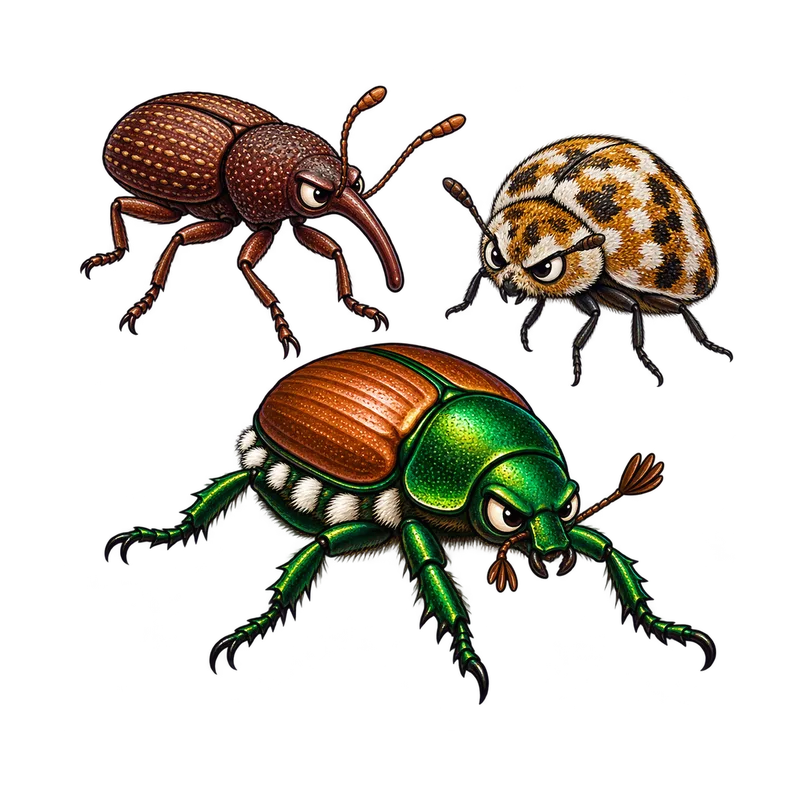
You might also wonder how they differ from carpet beetles, since both belong to the same broader family. Carpet beetles tend to be smaller and rounder, looking more like tiny ladybugs with mottled patterns, while larder beetles are usually larger and feature that unmistakable pale midsection band. More importantly, you will rarely find larder beetles eating clean clothes in a closet unless those fabrics are heavily soiled with food oils, sweat, or animal fats.
What usually comes next
Spotting a solitary adult beetle in the spring usually means one just strolled in from the yard searching for a meal. But if you keep running into multiple adults, or worse yet, those bristly brown grubs marching along your baseboards, you need to track down the breeding site. Begin your hunt inside the pantry, inspecting every container of dry pet food, birdseed, cured ham, or aged cheese. If you open a bag of dog kibble and notice chewed edges, fine dust, or discarded skins at the bottom, your search is over.
Your smartest operational step involves thorough cleaning and secure storage right away. Toss heavily infested food into a tied trash bag and take it straight to an outside bin, then vacuum all cracks, pantry shelves, and neglected spaces underneath heavy refrigerators. Above all, quit leaving dry pet meals and protein-rich snacks inside flimsy paper bags or thin cardboard boxes, which those hungry larvae can easily chew right through. Move everything into thick plastic storage tubs or glass jars fitted with tight rubber seals.
A rather bizarre habit of these bugs often surprises homeowners just as the grubs finish growing. When they get ready to change into adults, they abandon their food source and crawl away to find a firm, secure nook where they can safely rest and transform. They will happily bore small round tunnels half an inch deep into drywall, soft wood trim, cork boards, or insulation panels. It hardly ever threatens the actual structure of your house, but stumbling upon those neat little holes can certainly cause a scare if you have no clue what made them.
When to get help
Even though these critters do not bite, keep one minor physical nuisance in mind. Constant exposure to the microscopic, barbed hairs left behind by the larvae can trigger a mild skin irritation or rash for sensitive people, a condition sometimes linked to household insect dermatitis. If you notice a strange skin flare-up or breathing trouble, skip the guesswork and do not assume it is a bug bite. Talk to a doctor or medical professional to get a proper evaluation of what is happening.
When dealing with the infestation itself, typical household flare-ups can usually be fixed through deep cleaning, throwing out tainted food, and keeping future groceries in sealed containers. That said, bringing in a licensed pest control operator makes sense if the breeding ground sits completely out of reach inside deep wall cavities, chimneys, or crawl spaces. Calling in an expert also helps when infestations stubbornly return every season because dead wildlife or trapped insects are rotting inside the building shell, needing specialized exclusion work instead of a basic pantry sweep.