
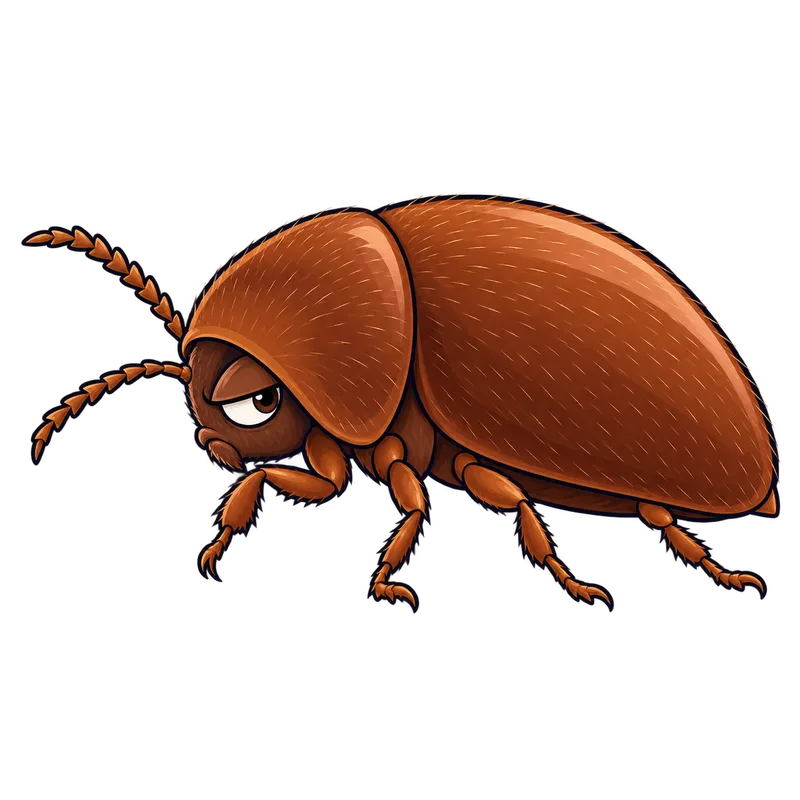
Cigarette beetle
Lasioderma serricorne
- Size
- 1.8 to 3.0 mm
- Color
- Uniform reddish-brown to brownish-red
- Habitat
- Heated buildings, pantries, and commercial storage worldwide
- Diet
- Stored tobacco, grains, spices, pet food, and dried botanicals
- Life cycle
- 45 to 50 days from egg to adult
You are likely looking at a tiny, stout insect measuring between 1.8 and 3.0 mm in length, which translates to roughly one-tenth of an inch. At a glance, it is a uniform reddish-brown or brownish-red. To confirm what you have, you really need a 10x hand lens. Under that magnification, look at the antennae. They are uniformly saw-toothed along their entire length from base to tip, without any sort of club at the end. Next, check the hard wing covers, known as elytra. They are smooth and covered in fine hairs, completely lacking the longitudinal grooves or pitted rows you would see on similar pantry pests. When viewed from the side, the insect has a distinct humpbacked profile because the head is tucked steeply downward at a right angle, almost as if it is ducking its head into its shoulders.
Habitat & behaviour
This species is cosmopolitan, meaning it turns up just about anywhere humans store dried organic goods, though it thrives best in warm tropical regions and heated indoor environments. In a home, you might spot them on pantry shelves, in pet food containers, or milling about near old floral arrangements and spices. Temperature dictates much of their routine. They become sluggish and dormant when ambient temperatures drop below 16 degrees Celsius, but once things warm past 18 degrees, adults take to the air. They are nocturnal fliers and show a strong attraction to artificial light. In fact, homeowners frequently discover an infestation not by rummaging through the flour bin, but by watching tiny beetles flutter clumsily around reading lamps, television screens, or kitchen ceiling fixtures in the evening.
Visual variations
The life stages look entirely different as the insect develops through complete metamorphosis. Eggs are oval, white, and microscopic, deposited singly directly onto a food source. From those hatch the larvae, which do all the real destruction. The mature larva is about 4 mm long, C-shaped, and off-white with a reddish-brown head capsule. Unlike smooth grubs, these larvae are covered in long, fine hairs that give them a noticeably fuzzy appearance under magnification. Pupae are whitish and encased in a delicate cocoon made of bits of food and debris stuck together with silk. Adults emerge as fully winged, hard-bodied beetles. There are no soldier or worker castes, and males and females look remarkably similar to the naked eye, meaning you cannot easily tell them apart without microscopic examination.
Why it matters
An indoor population of these beetles means something in your pantry, craft room, or storage area has been compromised by larvae feeding away out of sight. They chew right through cardboard boxes, paper bags, and thin plastics, tunneling through stored tobacco, milled flour, cereals, paprika, dried chili flakes, leather, and even dried pet kibble. Thanks to internal symbiotic yeasts that supply them with B vitamins, the larvae can survive on remarkably low-nutrient materials. Despite their capacity to ruin groceries, collections, and packaged goods with their frass, cast skins, and cocoons, they are completely harmless to people and pets. They do not bite, they do not sting, and they do not vector human diseases. Precise identification becomes necessary when deciding whether you are dealing with cigarette beetles or structural wood-boring pests, as the former require checking dried food sources rather than calling for timber treatments. When separating them from look-alikes, the drugstore beetle stands out as the most common point of confusion. While the cigarette beetle features saw-toothed antennae and smooth wing covers, the drugstore beetle has an antennae club made of three distinct segments and distinct pitted lines running down its back.
Similar species
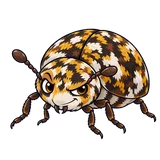 Varied carpet beetleAnthrenus verbasci
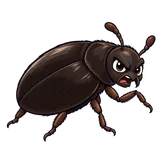 Black carpet beetleAttagenus unicolor
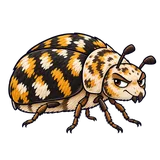 Furniture carpet beetleAnthrenus flavipes
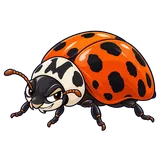 Multicolored Asian lady beetleHarmonia axyridis
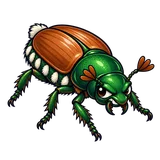 Japanese beetlePopillia japonica
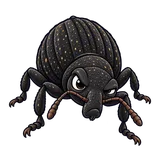 Black vine weevilOtiorhynchus sulcatus