
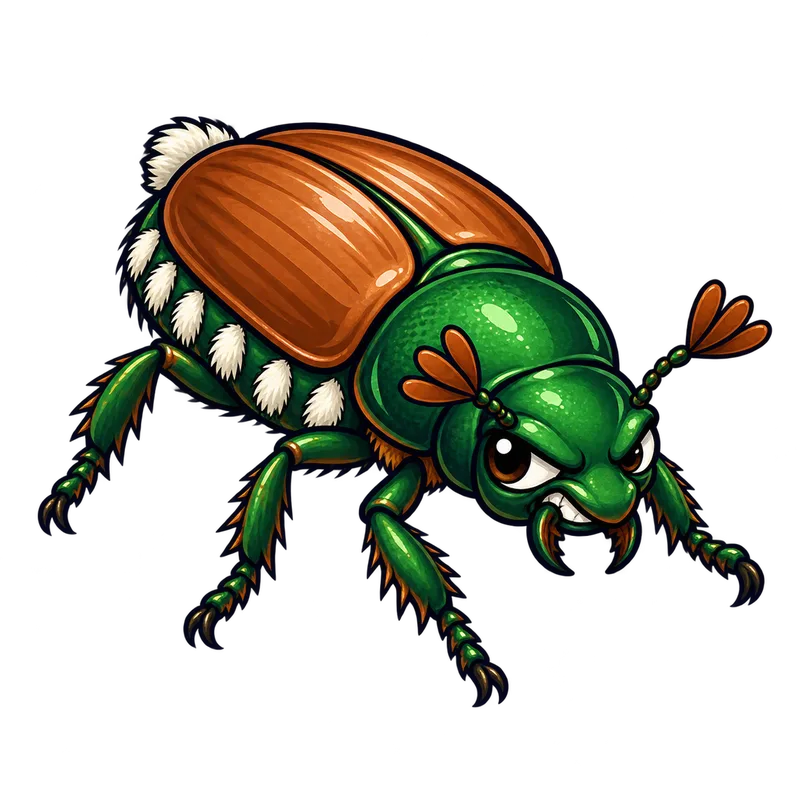
Japanese beetle
Popillia japonica
- Size
- 1/2 to 1 1/2 inches long
- Color
- Shiny metallic green, milky white, or tan
- Habitat
- Upper soil layers and sunny garden foliage
- Diet
- Turfgrass roots, ornamental leaves, and crop silks
- Life cycle
- Complete metamorphosis over 1 or 2 years
The Japanese beetle, scientifically known as Popillia japonica Newman, is a pest that gardeners and turf managers frequently encounter across much of North America. You spot the adult beetle by its high-gloss, metallic green armor, flashing in the midsummer sun as it lands on a rose petal. It is a compact scarab beetle that catches the eye immediately because nothing else in the garden shines quite that intensely. Underground, the story changes entirely. You find the larval stage, known as a white grub, tucked into the soil in a tight, plump C-shaped posture. It measures anywhere from 1/2 to 1 1/2 inches long, featuring a milky white or pale yellow body and a hard, tan head capsule. If you dig one up and want to be sure what you are looking at, count the legs. A true scarab grub has three distinct pairs of jointed legs right behind its head. Legless look-alikes, such as billbug larvae, lack these appendages entirely and tend to stay inside plant stems rather than munching freely on turf roots. This species is notably absent from Florida, while in Canada it is managed as a regulated plant pest under strict surveillance programs.
Identity
The working scientific identity for this entry is Popillia japonica Newman, belonging to the insect order Coleoptera and the family Scarabaeidae. In primary English-language markets, the pest is universally designated as the Japanese beetle, and in turfgrass management, the larval stage falls under the white grub pest complex alongside related scarab species like European chafers and May beetles. The adult beetle is easily recognized by its shiny metallic green body and active day-flying habits. The larva is a plump, C-shaped grub measuring 1/2 to 1 1/2 inches long when fully grown, possessing a milky white to light yellow body, a dark posterior region where soil contents show through the body wall, a hard tan or dark brown head, and exactly three pairs of jointed thoracic legs. This six-legged structure separates it reliably from legless billbug larvae and crane fly leatherjackets.
Habitat & behaviour
This creature leads a double life, dividing its time between the dark, damp subterranean world and the bright, sun-baked canopy. In late spring and summer, adult beetles emerge from the soil to fly continuously, seeking out preferred host plants like hibiscus, roses, sweet corn, and apple foliage. They do not scatter randomly. Instead, they exhibit strong aggregation behavior, piling onto favorite individual plants by the dozens while leaving neighboring plants untouched. Cool mornings slow them down, making it easy to flick them into a bucket of soapy water before they warm up and take flight. Below ground, the larvae inhabit the top 3 inches of soil in lawns, golf courses, and pastures. They stay active there through late summer and fall, chewing on grass roots before descending deeper below the frost line to overwinter. When spring arrives and soil temperatures climb, the surviving grubs head back up toward the surface to feed briefly before pupating.
Visual variations
There are no workers, soldiers, or hidden castes here, as the entry represents a single species undergoing complete metamorphosis through egg, larva, pupa, and adult stages. The egg stage starts as tiny spheres deposited by females deep in moist summer soil. From those hatch the plump, C-shaped grubs with their characteristic dark rear ends and three pairs of jointed legs. Once the pupal stage runs its course inside an earthen cell, the adult emerges with fully developed hard wing covers that shield its flying wings and give the beetle its signature metallic gleam. Males and females share this striking coloration, and visible physical differences between the sexes remain subtle enough to require magnification rather than a casual glance.
Why it matters
An infestation manifests in two distinct waves of frustration. In late summer, the underground grubs prune away turf roots until the grass turns brown and spongy, allowing you to peel the turf back from the bare soil like an unanchored carpet. A month earlier, the adults turn above-ground foliage into skeletonized lacework, chewing every bit of green tissue between the leaf veins and chewing off corn silks just as the crop needs them for pollination. You might be tempted to hang a pheromone trap by the patio to clear them out, but those commercial traps act like dinner bells, pulling in every beetle from the surrounding neighborhood and landing more pests on your prize roses than you started with. Meanwhile, furry visitors like raccoons and skunks can tear up your lawn overnight, digging furiously to unearth a protein-rich meal of white grubs. Correct identification matters because chemical treatments and biological controls fail entirely if you mistake a Japanese beetle for a non-target insect, and regulatory agencies watch the spread of this pest closely when plant stock crosses regional boundaries.
Similar species
 Black vine weevilOtiorhynchus sulcatus
 Striped cucumber beetleAcalymma vittatum
 Colorado potato beetleLeptinotarsa decemlineata
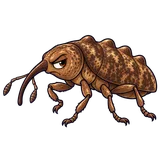 Plum curculioConotrachelus nenuphar
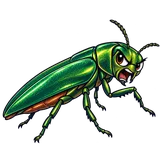 Emerald ash borerAgrilus planipennis
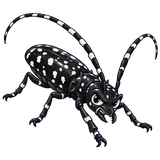 Asian longhorned beetleAnoplophora glabripennis