
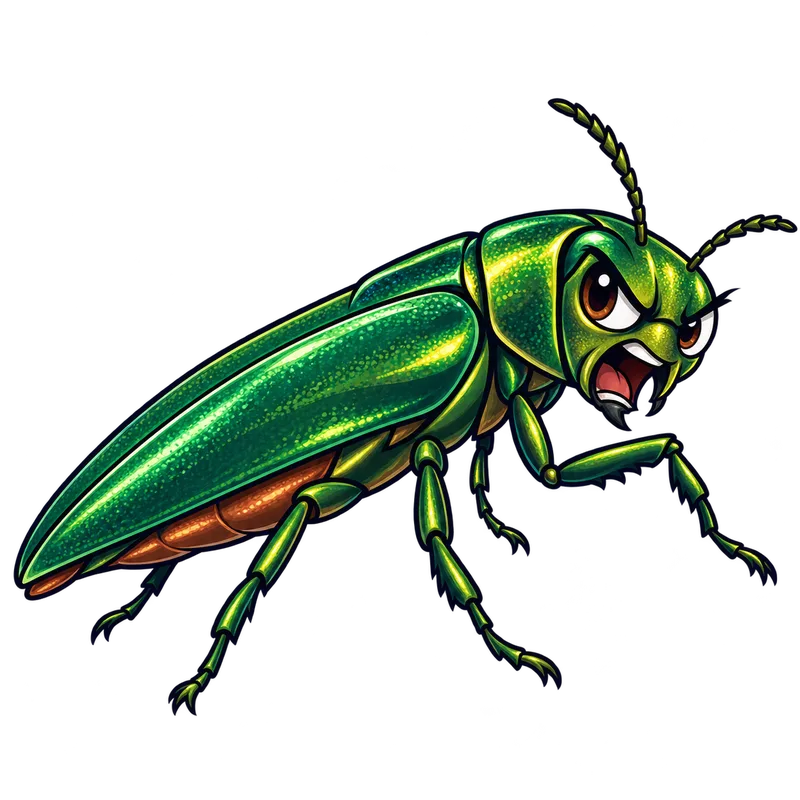
Emerald ash borer
Agrilus planipennis
- Size
- 7.5 mm to 13.5 mm long
- Color
- Bright metallic green
- Habitat
- Hardwood forests and urban canopies
- Diet
- Ash and select alternative hardwood trees
- Life cycle
- One year per generation, occasionally two years
The emerald ash borer is a slender, brilliantly iridescent beetle that catches the light like a scrap of metallic foil. At roughly 7.5 mm to 13.5 mm long, it is small enough to fit comfortably on a fingernail, meaning you will need a close look or a magnifying glass to appreciate its uniform bright green elytra and narrow pronotum.
Identity
Spotting the adult on the bark takes patience, so most people find them through the architectural clues they leave behind. The most reliable field mark is the exit hole left when the adult chews its way out of the trunk. It is shaped like a capital letter D and measures 3 mm to 4 mm across.
Confusing it with other wood-boring insects is easy if you rely on general impressions. The bronze birch borer is a similar size, but it wears a metallic copper coat and restricts its attacks to birch trees while leaving rust-colored sap stains. The two-lined chestnut borer sports a distinct yellowish stripe down each wing cover and targets oaks and chestnuts.
For a truly oversized intruder, the Asian longhorned beetle is a massive creature that punches perfectly round exit holes rather than the signature D-shaped cut of the ash borer. In parts of Europe, the native oak jewel beetle attacks oaks and enjoys legal protection, making correct identification essential before anyone jumps to conclusions.
Habitat & behaviour
This beetle belongs in the hardwood forests and urban streetscapes of North America and Asia, where its entire existence revolves around living trees in the ash genus, alongside a few secondary hosts like select walnuts and elms. It does not infest seasoned lumber, indoor furniture, or dry firewood sitting in a shed. Instead, it targets trees that are stressed, declining, or standing perfectly healthy in a sunny yard.
Activity aligns strictly with the calendar of the seasons. Adults emerge from the wood in late spring, usually stepping out in May and June to feed on foliage and find mates. The primary driver of long-distance dispersal is not natural flight, which covers only short distances, but human-assisted transport. Moving raw firewood and uncertified nursery stock across county or provincial lines remains the fastest way this pest colonizes new watersheds.
When the females choose a host, they are drawn to the chemical signatures of the tree. Once established, the larvae tunnel beneath the bark, disrupting the water and nutrient transport systems of the host. This internal destruction eventually starves the upper canopy, leading to the progressive decline that homeowners often notice too late.
Visual variations
Life unfolds in distinct physical chapters, each looking completely different from the last. The egg stage gives way to the larval form, which is a flat, broad, cream-white grub with no legs, designed for a subterranean life hidden beneath the outer bark. This larval stage spends its months carving serpentine or sinuous galleries that look like squiggly ribbons pressed into the wood.
The pupal stage happens entirely out of sight within the bark layers, transforming the pale grub into the hard-bodied, winged adult. When the adult emerges, it possesses fully formed elytra and membranous flight wings beneath, allowing it to take to the canopy in search of a mate.
External differences between males and females are subtle enough to escape casual observation, requiring microscopic examination of anatomical details that field guides rarely bother with. Unlike ants or termites, these beetles do not build colonies or divide themselves into social castes. Every individual operates as a solitary wood-boring agent, focused entirely on feeding and reproduction before the season turns.
Why it matters
An infestation means serious trouble for any ash tree standing on the property. The feeding galleries underneath the bark cut off the flow of sap, triggering crown dieback from the top down, yellowing leaves, and epicormic shoots sprouting frantically along the lower trunk. Within a year or two of continuous larval feeding, the outer bark begins to slough off in pieces, revealing the ruined wood beneath and inviting heavy woodpecker predation as birds flake away the bark to eat the grubs.
As the tree dies, it transforms into a brittle structural hazard that can drop heavy branches onto driveways, roofs, or utility lines. While the beetle itself poses no direct health risk to humans or pets since it does not bite, sting, or carry pathogens, its economic and ecological toll on urban canopies is immense.
Because the insect is a regulated quarantine pest under national agricultural laws, discovering its presence on a property typically triggers a mandatory reporting duty to forestry agencies or departments of agriculture. Managing the problem requires professional insight, especially since DIY treatments have strict limits. Systemic treatments like imidacloprid require careful timing during spring root uptake, and powerful trunk injections of emamectin benzoate must be handled exclusively by certified arborists using specialized equipment. If the tree has already declined past the point of rescue, the only safe option is to have tree care professionals remove the standing hazard before it fails on its own.
Similar species
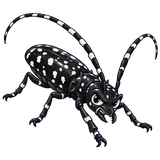 Asian longhorned beetleAnoplophora glabripennis
 Common furniture beetleAnobium punctatum
 Old house borerHylotrupes bajulus
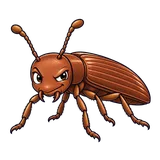 Powderpost beetlesSubfamily Lyctinae
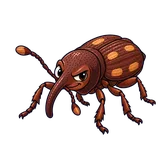 Rice weevilSitophilus oryzae
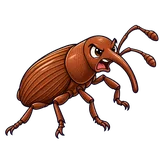 Granary weevilSitophilus granarius