
What are the signs of emerald ash borer damage?
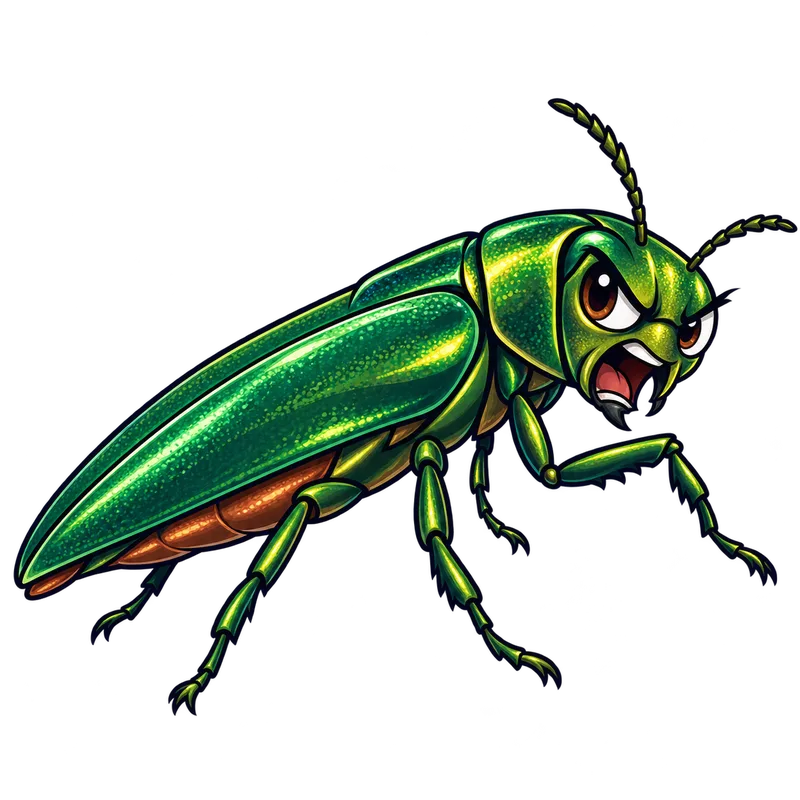
Emerald ash borer damage signs include a thin upper canopy, vertical bark cracks, pale shaved patches from woodpeckers, and precise D-shaped exit holes measuring 3 to 4 mm in diameter. Peeking beneath loose bark reveals winding, S-shaped larval galleries packed with fine sawdust, while the lower trunk may push out dense clusters of new sprouts.
What is actually going on
You look up at the stately ash tree in your front yard on a bright Tuesday morning, and something just feels off. The canopy up top looks thin, letting way too much sunlight through compared to last summer, and some of the highest branches appear completely bare. You might assume it is just dry weather or a passing season, but when you walk closer to inspect the trunk, you notice the bark has strange vertical cracks, and there are patches where the dark outer layer has been stripped away, revealing stark blond wood underneath. If your ash trees are showing these changes, you could be looking at the early fingerprints of the emerald ash borer, a destructive metallic green beetle that targets ash trees.
The trouble starts because these insects spend most of their lives hidden away from view. Female beetles lay tiny eggs in bark crevices during the warm months, and when the larvae hatch, they chew straight through the outer protective layer into the living tissues beneath. That internal layer is responsible for moving water and sugars up and down the trunk. As the larvae tunnel back and forth, they carve winding, serpentine paths packed with fine sawdust. Because this damage happens entirely under the bark, the tree suffers in silence for a year or two before you ever notice anything wrong in the leafy canopy above.
Eventually, the internal plumbing gets so badly disrupted that the upper branches start to starve, leading to that classic top-down dieback. The tree attempts a desperate survival response by pushing out dense clusters of new sprouts directly from the lower trunk or main branches, trying to catch whatever sunlight it can while its main crown withers. At the same time, hungry woodpeckers catch wind of the fat beetle larvae wriggling underneath the bark and start hammering away, tearing off chunks of the outer layer and creating those pale, shaved patches you can see from across the lawn.
You cannot rely on a vague sense of declining health to confirm this pest, because plenty of things make trees look sick. You need to look for specific physical evidence on the trunk and branches, and you usually need to get close enough to touch the bark. Start by searching the trunk for adult emergence holes. When the larvae mature into adult beetles measuring roughly 7.5 to 13.5 mm long with a slender, metallic emerald green body, they chew their way out of the tree. These exit holes are precisely D-shaped and measure about 3 to 4 mm in diameter, looking almost like someone pressed a tiny uppercase letter into the wood.
Next, check for vertical bark fissures. As the tree tries to heal or callus over the internal larval tunnels, the bark splits open, creating straight cracks measuring 5 to 10 cm long. If you happen to find a piece of loose bark or a recently fallen branch where the outer layer has peeled back, look at the exposed wood underneath. You should see those winding, S-shaped larval galleries tightly packed with frass, which is just fine insect waste that looks like sawdust.
You might wonder why you should bother checking the shape of the holes or the pattern under the bark if the tree is already dying. The distinction matters because native borers leave round or oval holes, and fungal diseases cause different types of bark lesions entirely without the D-shaped exit holes. Verifying the exact shape ensures you are dealing with this specific invasive borer rather than a different garden problem that requires an entirely different approach.
How to tell for sure
Once you spot these signs, your immediate decision usually comes down to whether the tree can still be saved or if it has crossed the line into structural failure. Take a hard look at the upper canopy. If the tree has lost more than 30% of its crown, systemic treatments generally will not work anymore. Those treatments rely on a functional vascular system to draw protective products up from the roots and distribute them through the branches. When a tree is too badly girdled, the chemical simply cannot travel where it needs to go, rendering preventive treatments useless and leaving removal as the only practical path forward.
If the damage is caught very early and the canopy is still mostly full, you face a choice between preventive professional care or taking the tree down before it becomes a hazard. Because dead ash wood dries out and turns dangerously brittle very quickly, a compromised tree near a driveway or roof poses a real risk of sudden branch failure. If you decide to handle firewood on your property, remember that moving logs or unpeeled wood to a new location is the primary way these insects hitchhike into uninfested regions. Always burn your firewood where you buy it, and consult a licensed professional or your local extension office to figure out your next steps based on regional quarantine rules.
What usually comes next
There comes a point in any yard pest situation where DIY observation has to stop and a professional needs to step in. If your ash tree is large, stands close to your house, or has already lost significant branches, do not attempt to cut it down or treat it yourself. The extreme brittleness of dead ash wood makes felling hazardous, and structural tree removal requires specialized rigging equipment and professional experience to avoid damaging property.
Trunk injection treatments also belong strictly in the hands of a certified arborist or licensed pesticide applicator. Drilling into the sapwood with specialized gear requires precise timing and technique to avoid causing permanent decay or injury to the trunk.
When to get help
Plus, if you live in an area where this pest has not yet been officially documented, finding those D-shaped exit holes or suspecting an infestation is not just a private yard issue. You need to report your findings immediately to your local agricultural extension office, state department of agriculture, or national plant health agency. Quick reporting helps biosecurity officials track the spread of regulated quarantine pests and protect surrounding forests before the population explodes.