
How did the emerald ash borer get to America?
The emerald ash borer arrived in America as a hidden hitchhiker inside untreated solid wood packaging material used in international maritime cargo trade, such as wooden shipping crates and pallets. Once those beetles landed, their spread across states and provinces was driven almost entirely by humans moving infested firewood and raw logs.
What is actually going on
You are loading the bed of your pickup truck for a weekend camping trip, tossing in a few dry logs left over from last autumn's backyard cleanup. It feels harmless, almost virtuous, not to waste good firewood. But that stack of dry timber might just be carrying a passenger that has chewed through millions of acres of North American forests. The emerald ash borer did not cross the Pacific Ocean by flying across thousands of miles of open water. It arrived as a hidden hitchhiker inside untreated solid wood packaging material, such as pallets, dunnage, and wooden shipping crates used in international maritime cargo trade.
To understand how it got here, think of those cargo crates as wooden Trojan horses. While international shippers focused on the heavy industrial machinery or stone tiles packed inside the containers, the raw wood used to brace the cargo still had its bark and living layer intact. That thin tissue right beneath the bark was stuffed with wood-boring beetle larvae. To an importer, it was just dunnage holding up the freight. To the larvae, it was an all-expenses-paid ocean cruise straight into a new continent that had no defenses against them.
Once the beetles landed, they hit an ecological jackpot. In their native Asian habitats, specialized predators, parasitic wasps, and natural diseases kept their numbers in check. In North America, native ash trees possessed zero evolutionary resistance against this foreign invader. Without those natural controls, the population exploded. While the initial transoceanic leap happened because of global trade, secondary spread across states and provinces has been driven almost entirely by well-meaning humans moving infested firewood, nursery stock, and raw logs across the landscape.
How to tell for sure
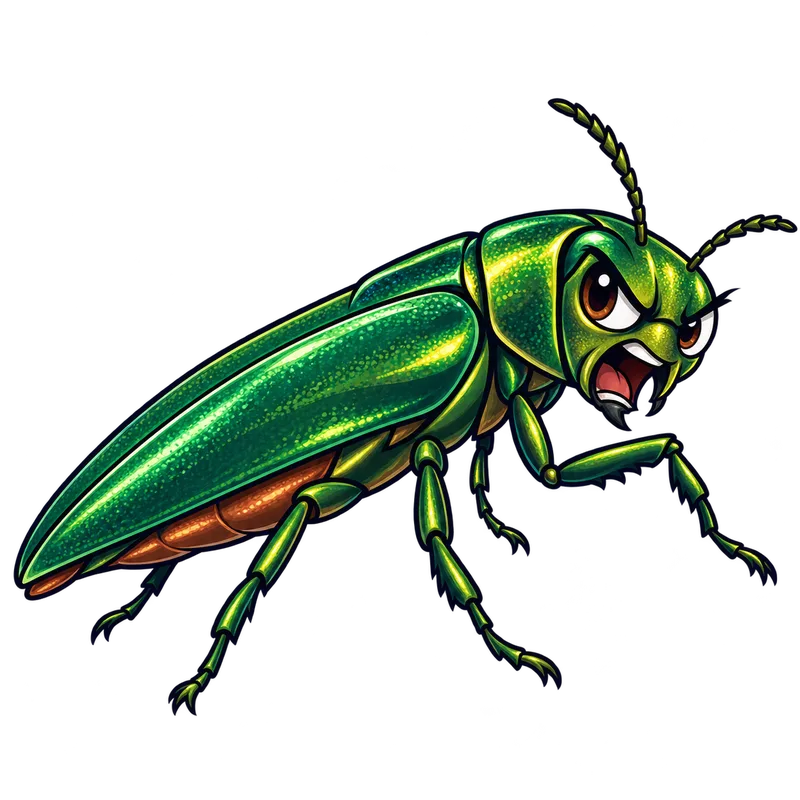
Spotting an emerald ash borer is usually a matter of playing detective with a dying tree rather than catching the bug itself in flight. The adult beetle is quite small, with a very slender body and a bright, metallic emerald-green or brassy exoskeleton. Yet, waiting to spot the insect is tricky since they spend most of their lives hidden. Instead, look at the ash tree itself for the classic warning signs.
The most reliable structural clue is the emergence hole left behind when the adult chews its way out of the tree. It usually measures about three to four millimeters in diameter and has a distinct D-shape, looking almost like someone took a tiny metal stamp of the capital letter D and punched it through the bark. Beneath that bark, if you peel back a loose section, you will usually find serpentine or S-shaped larval galleries packed with fine sawdust and excrement. These winding tunnels are the damage that seals the tree's fate.
The upper canopy is usually where the decline begins to show. You will notice crown thinning and yellowing leaves in the upper third of the tree during summer, which progresses to branch dieback over one to four years. You might also spot vertical bark cracks splitting open along the trunk, or heavy woodpecker activity where birds have flaked away the outer bark to feed on the fat larvae underneath. Positive identification usually requires a captured specimen and a close look with a hand lens, or confirmation by an extension agent, because several native beetles share a similar metallic color.
What usually comes next
When you suspect or confirm an infestation on your property, the main choice boils down to treating the tree early or taking it down before it turns into a hazard. That decision rests almost entirely on how far the damage has gone. Systemic insecticides rely on the tree’s own plumbing to carry the product upward to where the larvae feed.
If your ash tree has already lost a big chunk of its upper canopy, the internal pathways are usually too blocked for any treatment to save it. The chemical simply cannot reach the higher branches, and removal is the only safe route left. On the other hand, if the tree is still mostly healthy and you live in a hotspot for the beetle, preventive treatments put down at the right time of year can protect valued landscape trees. Whichever path you choose, stop hauling firewood around right now. Buying local and burning local keeps you from accidentally launching a brand new infestation miles down the highway.
When to get help
Some jobs around infested trees cross the line from a weekend DIY project into real hazards that demand trained specialists. If you need a systemic insecticide put in via trunk micro-injection, that takes specialized pressure gear and must be handled by a licensed arborist or certified pesticide applicator. Never try to mix or apply restricted-use chemicals in ways that stray from the exact directions printed on the product label.
Structural safety is another huge reason to call in a pro. Infested ash trees dry out fast from the inside, turning brittle and entirely unpredictable. A dead or declining ash tree standing near your house, driveway, or utility lines can drop heavy limbs or topple without warning, which makes professional felling and rigging gear essential.
Wildlife and legal rules also enter the picture. Woodpeckers and other creatures use hollowed trees for nesting, and certain migratory birds or bats might be protected by federal or local environmental laws. If you spot bats or other mammals roosting inside a hollow ash trunk while inspecting, leave them alone because wild mammals carry rabies risks. Contact local public health authorities or animal control services immediately if an exposure happens. Finally, if you live in a regulated quarantine zone, talk to your state department of agriculture or national plant protection agency before moving any ash wood, logs, or nursery stock off your property to steer clear of heavy fines.