
Can carpet beetle larvae cause a rash?
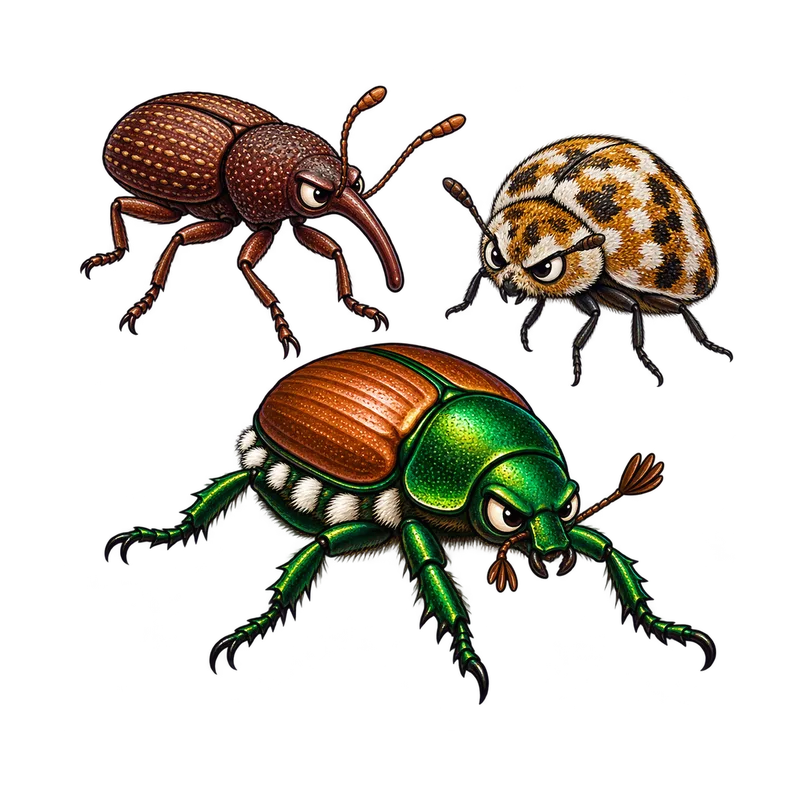
Yes, carpet beetle larvae can cause a rash when their stiff, barbed hairs embed in your skin. This reaction happens because sensitive people mount an immune response to proteins on the shed larval hairs, which looks like an insect bite.
What is actually going on
Imagine pulling a vintage wool blanket out of a dark closet after months of neglect, wrapping yourself in it on the couch, and waking up a few hours later with a scattering of intensely itchy red bumps across your arms and torso. Naturally, your mind jumps straight to bed bugs or fleas. You start frantically inspecting the mattress seams, convinced something is feeding on you while you sleep.
Except there is a twist. Carpet beetles do not bite humans, and they have zero interest in feeding on human blood. If you are reacting to them, the culprit is not a mouthpart or a piercing bite, but rather the microscopic architecture of the insect itself. Carpet beetle larvae are covered in dense coats of stiff, barbed hairs and spear-like bristles. When these larvae crawl across rugs, upholstered furniture, or stored clothing, they leave behind these tiny bristles alongside empty, rigid cast skins.
As you sit on that rug or pull that blanket tight against your skin, those microscopic barbed hairs embed themselves mechanically into the superficial layer of your epidermis. For many people, it causes minor mechanical itching. For those who are more sensitive, the body mounts an immune response to the proteins on those larval hairs, triggering a classic case of allergic contact dermatitis. You end up with papular lesions and red welts that look for all the world like insect bites, even though no insect ever punctured your skin.
It helps to think of these larval hairs much like tiny, invisible shards of fiberglass insulation. If you handle raw fiberglass without gloves, your skin prickles and breaks out in an angry rash, not because the material is venomous or biting you, but because physical shards are irritating your skin. Carpet beetles use these barbed hairs as a defense mechanism against natural predators, and unfortunately, human skin gets caught in the crossfire when our living spaces overlap with their feeding grounds.
How to tell for sure
Trying to diagnose the source of an itchy rash purely by looking at the red bumps is usually a fool's errand. Skin reactions from carpet beetle hairs, bed bug bites, flea punctures, and pantry mite dust look remarkably similar on the surface, and no clinician or photograph can reliably tell them apart without finding physical evidence in the room. To know for sure what is happening, you usually have to look for the insects or their leftovers in the places where natural fibers gather.
Adult carpet beetles are harmless to your skin and your clothes. They are small, oval insects that usually spend their time outdoors feeding on flower pollen and nectar, or occasionally flying toward windows inside the house. If you see tiny, patterned beetles crawling on a windowsill, they are not the ones damaging your woolens or causing your rash.
The damage and the irritating hairs come entirely from the larval stage. Carpet beetle larvae usually avoid light and prefer dark, undisturbed corners. Depending on the species, these larvae can look like carrot-shaped, reddish-brown crawlers covered in short bristles, or fuzzy little creatures often nicknamed woolly bears. You will usually find them tucked away under heavy furniture that rarely moves, along baseboard cracks, inside dark closets, or burrowed into wool rugs, silk garments, or stored pet food. Finding these fuzzy larvae or their translucent cast skins confirms what is happening in your home far better than any skin examination can.
What usually comes next
Once you realize that carpet beetle larvae and their shed skins are driving your skin irritation, your main practical decision comes down to choosing between aggressive chemical spraying and thorough physical sanitation. It is usually best to skip the aerosol cans entirely. Pesticides should never be sprayed directly onto clothing, blankets, bedding, or surfaces that come into direct contact with human skin, as doing so introduces unnecessary chemical exposure risks without solving the root cause of the hair accumulation.
Instead, your most effective path forward relies on mechanical removal and thermal control. You need to strip away the accumulated reservoir of larval hairs and cast skins that are touching your skin. This means hauling exposed textiles to the laundry room for hot-water washing or sending them out for professional dry cleaning, which kills any hidden life stages and washes away the irritating proteins. For items that cannot handle hot water, sealing them in a plastic bag and placing them in a deep freezer for a week will take care of the insects. Coupled with meticulous vacuuming of baseboards, dark corners, and under furniture, this physical cleanup removes the problem at the source.
When to get help
There are moments when a do-it-yourself approach is no longer enough and you need to hand the problem over to someone else. If your skin reaction is severe, painful, spreading rapidly, or showing signs of a secondary infection from scratching, you need to step away from home remedies and schedule an evaluation with a licensed physician or a dermatologist. A healthcare professional can provide proper treatment for the allergic reaction and help manage the discomfort safely.
You should also bring in professional pest management services when the infestation is no longer confined to a single sweater or a localized rug. If carpet beetles have established themselves across multiple rooms, hidden inside wall voids, or settled deep within heating ducts and heavy antique furniture where your standard vacuum cannot reach, a licensed applicator has the structural tools to address the situation safely.
On the regulatory side, if you happen to encounter a high-priority biosecurity threat such as a regulated quarantine pest in imported grain or commercial shipping containers, you must report it immediately to national agricultural authorities. Furthermore, if you are planning to clear out abandoned bird nests or rodent nests from your eaves or attic as part of your cleanup, remember that local and federal wildlife protection laws often protect active nests, so you will need to check the regulations before disturbing them.