
Where can you check an emerald ash borer map?
Official distribution and regulated area maps for the emerald ash borer can be checked through interactive web mapping tools hosted by government forestry agencies. In the United States, federal mapping is coordinated by the Department of Agriculture alongside state and university portals. In Canada, the official regulated area maps are handled by the Canadian Food Inspection Agency.
What is actually going on
You are standing in the garage, staring at a neatly stacked cord of firewood you just hauled home from a campground three hours away, and a sudden thought hits you. Did you just drag a destructive beetle across state or provincial lines? If that wood happens to be ash, you need to know whether your driveway sits inside a regulated quarantine zone before you burn that wood or give it away to a neighbor.
Official distribution and regulated area maps for the emerald ash borer can be checked through interactive web mapping tools and survey dashboards hosted by government agricultural and forestry agencies. In the United States, federal mapping is coordinated by the Department of Agriculture animal and plant health services alongside state department portals and university extension websites. If you are north of the border, the Canadian Food Inspection Agency handles the official regulated area maps and survey tools that track positive detections and statutory quarantine boundaries.
Beyond government portals, regional biosecurity organizations and community science platforms provide public-facing web maps where local sightings are aggregated. These tools matter because the beetle does not just crawl across landscapes on its own power. While adults fly short distances, the real spread happens when people toss raw logs or firewood into the back of a truck and drive down the highway. Checking an official map before you move any ash material is the only reliable way to know if you are legally permitted to transport that wood.
Before you go hunting for maps or worrying about quarantine rules, you need to make sure you are actually looking at an ash tree and dealing with the right insect. Emerald ash borer targets true ash species, stripping them of their ability to move water and nutrients. You usually spot the damage from the ground long before you spot the beetle itself. The canopy typically dies back from the top down, looking a bit like a candle burning down, and the lower trunk will often sprout frantic, bushy shoots in a desperate survival response.
Why does the tree react that way? Plants often throw out emergency growth from dormant buds near the base when their main transport pathways get blocked by feeding insects. It is a last ditch effort to catch sunlight, but it rarely saves a heavily infested tree. Recognizing this growth pattern helps you separate standard seasonal stress from a serious borer problem, which brings us to the physical clues left on the bark.
How to tell for sure
If you walk up closer to the bark, keep an eye out for vertical fissures or cracks forming over the feeding areas. You might also notice what foresters call blonding, which happens when woodpeckers strip away the dark outer bark to feast on the larvae underneath, leaving bright, shaved-looking patches against the trunk. Underneath that peeling bark, you can usually find serpentine tunnels packed tightly with sawdust-like frass.
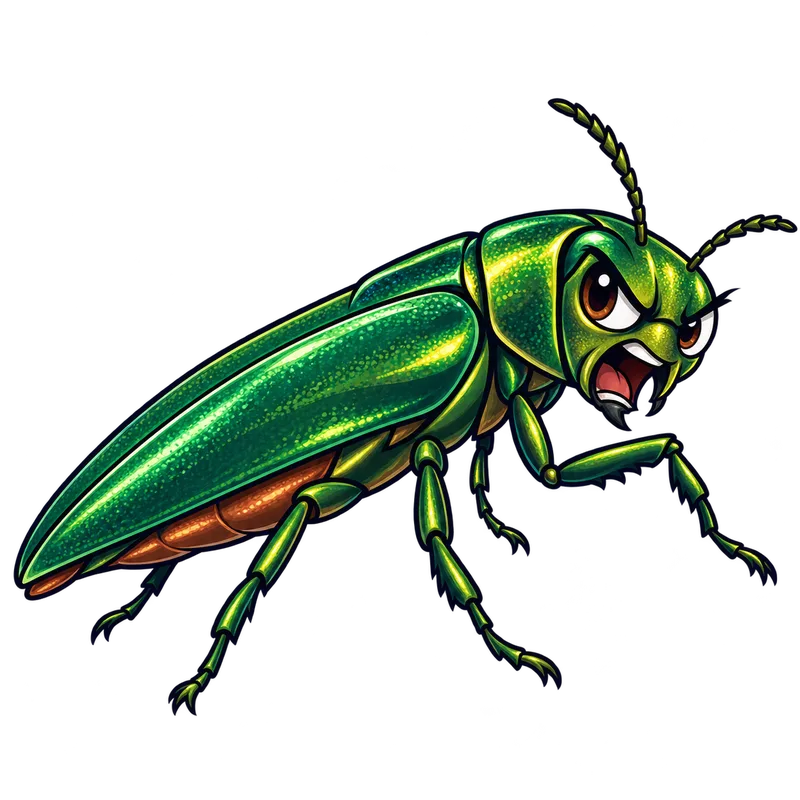
Finding the actual insect requires a careful eye. Adult beetles measure between 7.5 and 13.5 mm long, boasting a slender shape and a brilliant, metallic emerald-green sheen that usually requires a close inspection or a hand lens to fully appreciate. When adults chew their way out of the tree, they leave behind distinct D-shaped exit holes measuring 3 to 4 mm in diameter. The flat edge of that capital letter D shape is a classic giveaway, distinguishing these holes from the round drill marks left by other wood-boring insects.
What usually comes next
Once you check the map and confirm the local status of the pest, your immediate practical decision usually comes down to whether you can save your trees or whether you need to stop moving wood. If you live inside a mapped quarantine zone, the most responsible step is to keep your ash wood right where it is. Buy firewood locally near the place you plan to burn it, and never toss leftover logs into the truck bed for a weekend trip.
If you are a homeowner with healthy ash trees on your property and the local maps show the pest is active in your county or region, you have a brief window to consider preventive treatments. Systemic insecticides can protect healthy trees, but they have to be applied proactively by a professional arborist or through careful soil applications during April or May before the infestation takes hold. Once a tree has lost a large portion of its canopy, the vascular system is usually too damaged for treatments to work. Choosing whether to treat a valuable landscape tree early or let it decline safely is the primary fork in the road for most property owners.
When to get help
There comes a point where observation stops and you need to hand the problem over to someone with credentials. If you find symptoms like canopy dieback and exit holes, but you cannot secure or clearly identify an adult specimen, do not guess. You should submit high-resolution photographs or physical samples to your local university plant diagnostic clinic or a government agricultural extension office for formal verification.
As for treatment, certain chemical options require professional muscle. Direct trunk injections of systemic products must be performed by a licensed arborist to ensure proper dosage and tree safety. Furthermore, ash trees killed by this pest become brittle very quickly, turning into severe hazards with falling limbs that threaten roofs, power lines, and driveways. Taking down a dead or dying ash tree near a structure is not a weekend chainsaw project for an amateur, and it calls for professional tree removal services. Finally, remember that transporting uncertified ash wood or firewood outside a statutory regulated zone violates plant protection laws and can trigger legal enforcement from agricultural authorities.