
How do you tell emerald ash borer exit holes from other bark damage?
You can tell emerald ash borer exit holes from other bark damage by their distinct capital letter D shape, measuring 3 to 4 mm in diameter, which is roughly the size of a matchstick head. One side of the hole is completely flat and straight, while the opposite side arches out in a smooth semicircle.
What is actually going on
You are standing in the backyard with a cup of coffee, staring at the ash tree by the fence. Something looks off with the bark. Maybe you noticed a few dead branches up top last summer, or perhaps a woodpecker has been going to town on the trunk, leaving bright patches of bare wood where the dark bark used to be. Then you spot them: tiny holes punched into the trunk. You grab a pocket knife or a key to check, wondering if you are looking at the calling card of the emerald ash borer, or if it is just weathering, native insects, or some old mechanical damage from the lawnmower.
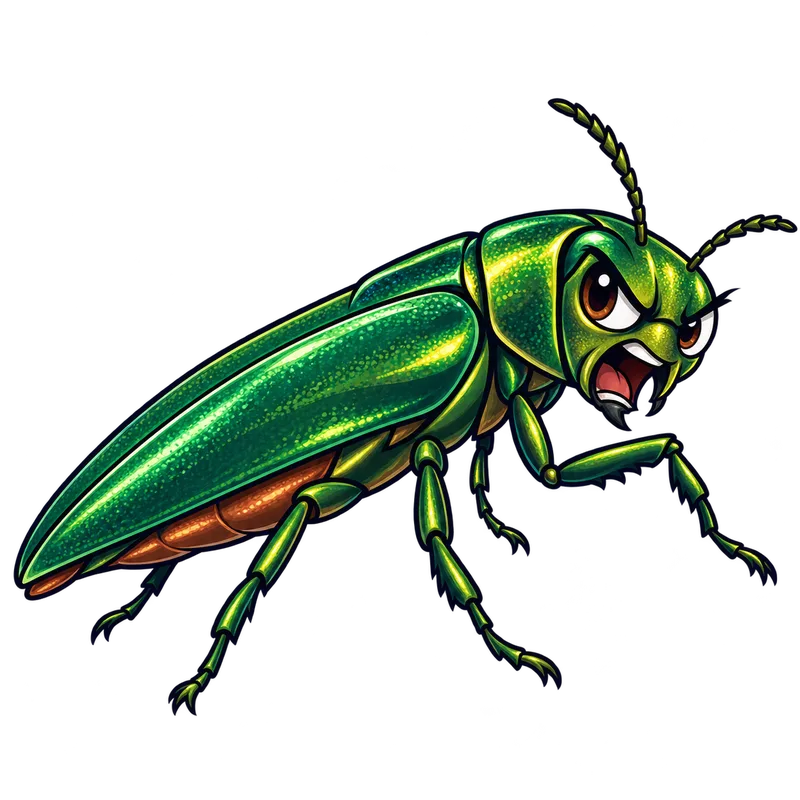
It is a fair thing to worry about because these metallic green beetles have torn through North American and European forests and backyards with staggering efficiency. When an adult beetle finishes its life cycle underneath the bark and chews its way out into the open world, it leaves a distinct signature. It is not just a ragged puncture or a rough round bug hole. It is a crisp, clean cut through the wood that tells you exactly who made it, provided you know what geometry to look for.
The confusion usually happens because trees take a beating from all kinds of sources. Weather cracks, frost splits, string trimmers, and native wood borers all leave marks that can look alarming at first glance. But the emerald ash borer leaves an aperture shaped with architectural precision. Understanding that specific shape, alongside the other clues the tree is giving you, separates a genuine crisis from a false alarm.
How to tell for sure
An emerald ash borer exit hole is defined by a distinct capital letter D shape. If you hold a standard wooden pencil up to the trunk, the metal ferrule or the eraser gives you a pretty good visual of the scale. The hole usually measures 3 to 4 mm in diameter, which is roughly the size of a matchstick head. One side of the hole is completely flat and straight, while the opposite side arches out in a smooth semicircle. That flat edge matches the flat belly of the beetle as it chews its way out, and the curved side matches its rounded back.
You usually need to confirm three things to be sure you are looking at emerald ash borer damage rather than something else. First, check the host tree. This beetle is notoriously picky, usually restricting its primary attacks to ash trees, which you can identify by their opposite branching and compound leaves. If you see D-shaped holes on a birch tree, you are looking at a bronze birch borer. If they are on an oak, it is likely a two-lined chestnut borer.
Second, check what is hiding underneath if a piece of bark has already peeled away. The young grubs carve winding, snake-like tunnels right beneath the surface, and they pack these channels tight with fine, powdery sawdust.
Third, look for the other signs that usually show up alongside the holes. Emerald ash borer attacks rarely happen by themselves. You will typically spot vertical cracks in the bark that span a few inches, heavy pecking by woodpeckers stripping away the dark outer layer to reach the pale wood beneath, and a bunch of weak, bushy shoots sprouting straight out of the lower trunk as the tree tries to survive while its upper branches die off.
What usually comes next
Once you spot those telltale D-shaped holes and make sure you are looking at an ash tree, you have to figure out whether to treat it, cut it down, or call in someone who knows their stuff. If the top of the tree is already more than half dead and the bark is sliding off in sheets, the internal plumbing has usually taken too much damage to recover. Chemical treatments applied to the soil or trunk work well to protect healthy trees or stop an early infestation, but they have to go on in the spring when the roots are drinking actively before the insects chew up the transport system inside.
If the tree leans over your driveway, your patio, or the corner of the house, you also have to think about safety. Infested ash wood dries out fast and gets remarkably brittle. Large branches or the entire trunk can snap with very little warning once the interior is riddled with tunnels. Leaving a dead ash tree standing near a target zone is a gamble you want to avoid before the heavy winds of autumn or winter storms arrive.
When to get help
There are times when standing on the lawn with a cup of coffee is not enough, and you need to bring in professional eyes. If the questionable holes are high up in the upper branches where you cannot get a good look from the grass, a certified tree specialist has the climbing gear and tools to inspect the canopy properly. They can also tell you straight whether the tree is safe to leave standing or if it needs to come down right away.
Local rules matter too, depending on where your property sits. In places where the beetle is heavily managed, such as specific quarantine zones and parts of Canada, moving untreated ash firewood or logs out of the region is restricted by law. If you suspect an infestation in a neighborhood where the beetle has not been officially recorded yet, let your local agriculture department or plant health authorities know so they can track the movement.