
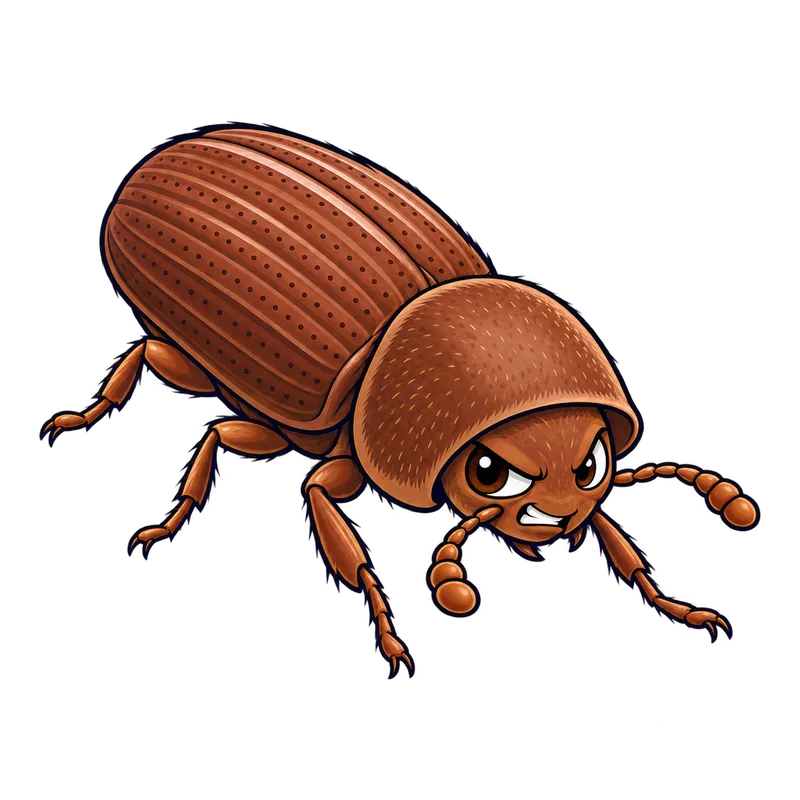
Common furniture beetle
Anobium punctatum
- Size
- 4 to 6 mm
- Color
- Reddish brown to dark brown
- Habitat
- Seasoned timbers in cool, humid indoor microclimates
- Diet
- Cellulose in seasoned softwoods and hardwood sapwood
- Life cycle
- 1 to 3 years from egg to adult emergence
The common furniture beetle is an insect whose larvae bore through seasoned wood, leaving behind a fine powder and circular exit holes measuring 1.5 to 2 mm across. When you spot these tiny holes in a floor joist or an antique table, you are looking at the work of Anobium punctatum, an insect measuring 4 to 6 mm in length with a reddish brown to dark brown body.
Identity
Identifying this beetle comes down to a few distinct field marks you can see with a simple magnifying glass. The adult has an enlarged, hoodlike pronotum, which is the segment just behind the head, extending far enough forward to completely hide the downward-pointing head from a direct overhead view. Its wing covers feature neat, parallel rows of tiny pits running lengthwise, covered in very short, fine yellowish hairs. If you examine the 11-segmented antennae, you will notice the last 3 segments are noticeably enlarged and lengthened, making that terminal trio longer than the preceding 8 segments combined. The tibiae lack any apical spurs, and the tarsi have 5 segments with widely separated claws.
Habitat & behaviour
You will generally run into this beetle in cool, damp microclimates, such as unheated cellars, crawl spaces, subflooring, and old furniture. The species thrives in environments where the wood moisture content stays above 13% to 15% and the relative humidity remains above 60% to 65%.
Female beetles cannot deposit eggs on smooth, painted, varnished, or sandpapered surfaces. They require rough wood, open end-grain, cracks, or existing exit holes to lay their eggs. Once the weather warms up and daily high temperatures exceed 25 degrees C, adult beetles take flight. They are strongly attracted to light bulbs and window glass, which explains why you might find them fluttering around indoor windows during late spring and summer. Long-distance travel, however, rarely happens by flight. Instead, the beetle usually arrives in a home hidden inside imported antique furniture, picture frames, or framing lumber.
Visual variations
Because this beetle undergoes complete metamorphosis, its appearance changes drastically through four distinct stages. The egg stage consists of tiny, pearly-white oval clusters tucked tightly into wood crevices.
From those eggs hatch the larvae, which are the creatures responsible for the actual damage. A larva is a plump, creamy-white, C-shaped grub that can grow up to 7 mm long. It has a yellowish-brown head with dark black mandibles, short 5-segmented legs with terminal claws, and transverse rows of tiny spinules along its back. Unlike some wood-boring pests, these larvae possess digestive enzymes that allow them to process cellulose directly.
After spending 1 to 3 years tunneling along the grain, the larva constructs a small cell just beneath the wood surface to pupate. The soft white pupa eventually transforms into the adult beetle, which chews its way out into the open world. Adults do not feed on wood at all. They emerge between April and August, mate within a day, and die shortly after.
Why it matters
The presence of this beetle means that structural timbers or wooden items are hosting feeding larvae that carve out extensive internal galleries. Over several years of reinfestation, the wood can be reduced to a honeycomb network of tunnels filled with frass beneath a thin outer shell. This frass is highly diagnostic. It feels gritty to the touch like fine dust, and under magnification, you can spot distinct lemon-shaped or bun-shaped fecal pellets mixed inside.
While the damage can eventually weaken floorboards or structural joists if left unchecked for decades, the beetles themselves pose no direct threat to human or pet health. They do not bite, sting, or carry diseases. Furthermore, modern central heating often acts as a natural deterrent. By drying indoor air below 65% relative humidity and bringing structural wood moisture below 15%, modern heating systems frequently create conditions too dry for larvae to survive, causing indoor infestations to die out on their own.
When you need to tell this pest apart from lookalikes, focus on the frass and the exit holes. True powderpost beetles in the family Lyctidae leave behind an extremely fine, talcum-like flour without any pellets, and their adults have heads that are fully visible from above rather than hidden under a hood. The deathwatch beetle is larger, around 7 mm, and leaves behind coarser, lenticular pellets while attacking damp, decayed hardwoods like oak. The bark-anobiid beetle looks similar but only infests softwoods that still retain their bark. Finally, the old house borer produces much larger, broadly oval exit holes measuring up to 3/8 inch and leaves behind rippled galleries packed with fine powder and tiny pellets.
Similar species
 Old house borerHylotrupes bajulus
 Powderpost beetlesSubfamily Lyctinae
 Rice weevilSitophilus oryzae
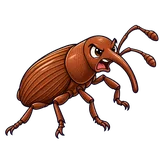 Granary weevilSitophilus granarius
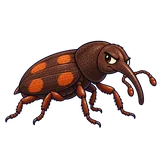 Maize weevilSitophilus zeamais
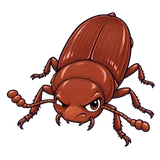 Red flour beetleTribolium castaneum