
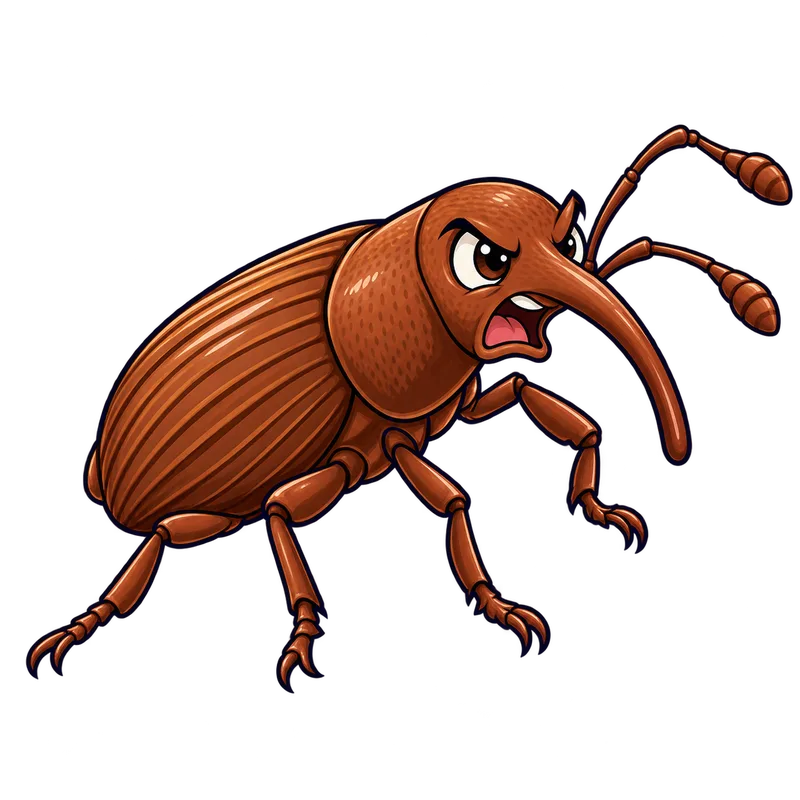
Granary weevil
Sitophilus granarius
- Size
- About 1/8 inch (3.2 mm) long
- Color
- Reddish-brown to dark brown or black
- Habitat
- Stored whole grains in granaries, mills, pantries
- Diet
- Whole cereal grains and hard dried pasta
- Life cycle
- Egg, larva and pupa develop inside grain kernels
The granary weevil, Sitophilus granarius, is a small snout beetle that spends its entire life in stored whole grain, and the place you are most likely to meet one is a pantry shelf, a feed bin or a bag of grain that looked perfectly sound until something started crawling out of it. It is a true weevil, which means the head is drawn out into a slender snout, called a rostrum, with tiny chewing jaws at the tip. That snout is the tool for everything: feeding, and drilling the hole where an egg will go.
Identity
The adult is about 1/8 inch (3.2 mm) long, hard-shelled, and reddish-brown to dark brown or nearly black. From across the counter it reads as a dark seed that has decided to walk. Under a 10x hand lens the useful detail appears: the pronotum, the shield-shaped plate directly behind the head, is pitted with elongated holes rather than round ones. The wing covers carry deep parallel grooves and coarse punctures, and the part that surprises people is underneath: the wings there do not work. This beetle cannot fly. If the little dark insect in your grain takes off when you disturb it, you are looking at a different species.
Habitat & behaviour
This is an insect built entirely around stored grain, what specialists call an obligate stored-product pest. It turns up in farm granaries, grain elevators, flour mills, feed stores, food warehouses and household pantries, and it has no real life outside them.
The larvae need whole, intact kernels or something equally dense. Wheat, corn, oats, barley, sorghum and rye all support development, and so does hard dried pasta like macaroni. Loose flour and fine cornmeal are a different story. They may harbor other pantry insects, but a granary weevil grub cannot develop in powder; it needs a solid kernel to live inside.
So how does a flightless beetle end up in a sealed cupboard? Not through the window. It arrives inside infested grain, pet food, bulk seed, machinery or shipments, which is also how a crawler managed to become a worldwide pest. In heated or otherwise protected storage it can breed all year, and under warm, favorable conditions an egg becomes an adult in about one month. The adults then stick around, commonly living 7 to 8 months and sometimes more than 2 years.
Visual variations
The adult is the only stage you will normally see, because everything else happens out of sight inside a kernel. The female chews a small cavity, lays a single tiny white, translucent egg in it and seals the opening, so grain can look perfectly sound while the next generation is already installed.
The larva that hatches is a white, legless, rounded grub with a distinct brownish head capsule, and it spends its whole life hollowing out that one seed from within. The pupa, white to pale cream, develops in the same chamber. Only when the new adult chews a neat, circular exit hole through the kernel wall does the infestation announce itself. A clean round hole means development is already finished, not that something is nibbling the surface.
Males and females look essentially alike, with no difference you can trust at household magnification. There are no worker or soldier castes, and there is no winged form. Every granary weevil you will ever see is a crawler.
Why it matters
What an infestation means, in plain terms, is grain being hollowed from the inside, sometimes before a single hole shows. Heavy feeding reduces the weight and quality of stored grain and leaves behind fragments and insect waste, and severely degraded grain can take on moisture and turn moldy, at which point it is not fit even for animal feed.
The beetles themselves are medically harmless to people and pets: they do not bite, sting or transmit human disease, and they leave timber, fabrics and furnishings alone. If anyone develops unexplained respiratory symptoms or a significant reaction around moldy grain dust, that is a question for a clinician, urgent care or poison control, not something to pin on the beetles by default.
Precise identification matters most in commercial storage, where the species on record shapes how stocks are assessed and handled. The usual lookalikes are the rice weevil and the maize weevil, both of which can fly and usually show four reddish or yellowish spots on their wing covers. The granary weevil is flightless and uniformly dark, and the 10x lens settles the finer point: elongated pits behind the head mean Sitophilus granarius, while round punctures point to one of its flying relatives.
Similar species
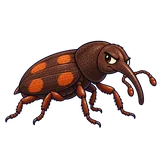 Maize weevilSitophilus zeamais
 Red flour beetleTribolium castaneum
 Confused flour beetleTribolium confusum
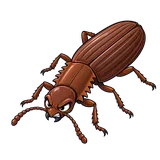 Sawtoothed grain beetleOryzaephilus surinamensis
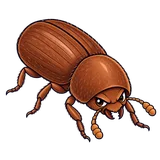 Drugstore beetleStegobium paniceum
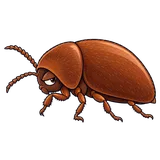 Cigarette beetleLasioderma serricorne