
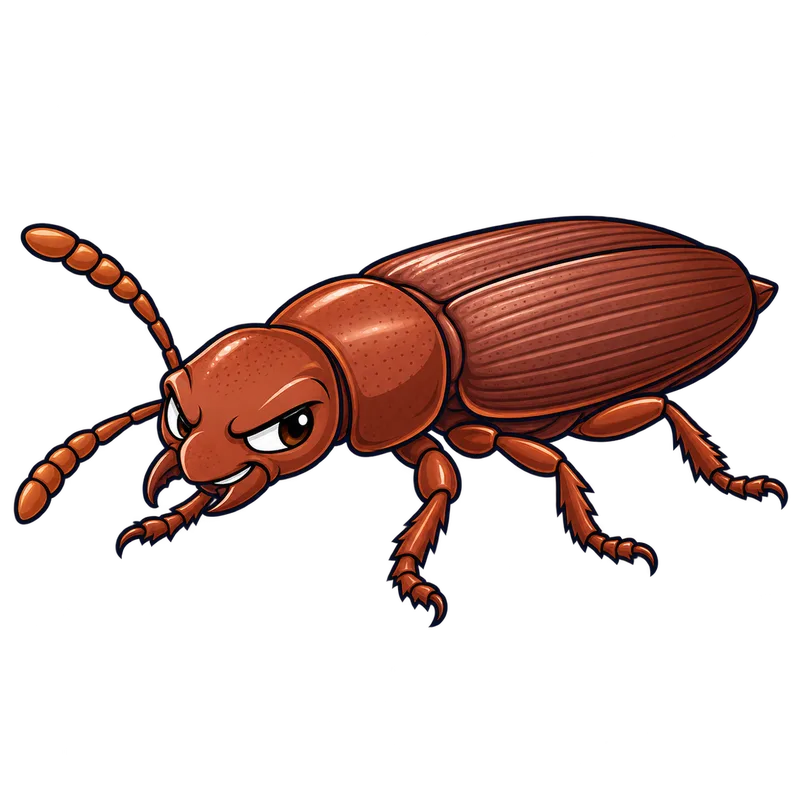
Confused flour beetle
Tribolium confusum
- Size
- Approximately 1/4 inch long (6.35 mm)
- Color
- Uniform reddish-brown to dark brown
- Habitat
- Indoors in pantries and grain storage
- Diet
- Milled grain products, flour, and cereals
- Life cycle
- 40 to 90 days from egg to adult
The confused flour beetle got its name because early entomologists found it nearly impossible to tell apart from the red flour beetle at first glance. If you are standing in your kitchen and spot a tiny, reddish-brown bug crawling through an open bag of flour, you are looking at an insect that has spent centuries hiding in plain sight. Reaching about a quarter of an inch in length, it is small enough to slip through the microscopic gaps of a poorly sealed cardboard box.
Identity
To the naked eye, it looks like a simple, flat-bodied beetle. But if you pull out a 10x magnification hand lens, a few distinct field marks emerge. Its compound eyes have a small notch in them, and its legs follow a 5-5-4 arrangement, meaning five segments on the front legs, five on the middle ones, and four on the back. The sides of its thorax, which is the middle section behind the head, are straight and parallel rather than curved. The antenna widens gradually toward the tip into a loose, 4-segmented club.
Habitat & behaviour
These beetles live wherever humans store grain. You will find them inside packages of flour, cornmeal, breakfast cereal, pasta, spices, dried pet food, and birdseed. They do not care about your wooden cabinets or drywall, meaning they cause zero structural damage to your home. Instead, they are strictly pantry scavengers that cannot penetrate sound, undamaged whole grain kernels, requiring grain that has already been milled or cracked.
One detail that separates this species from similar pantry pests is its total inability to fly. If you see a tiny beetle taking off toward your kitchen ceiling light, it is not a confused flour beetle. This species keeps its feet firmly on the ground, even though it is fully winged under its elytra. When disturbed, adults quickly scurry away from light to hide in dark crevices, underneath shelf liners, or inside the folded paper seams of food packaging. They also prefer warm, protected spaces, so dry grain dust trapped behind the refrigerator can easily turn into a permanent breeding ground.
Visual variations
Like most insects, this beetle goes through complete metamorphosis, starting as an egg, moving to a larva, passing through a pupa stage, and finally emerging as an adult. The eggs are microscopic and coated in a sticky substance, which means bits of flour and dust coat them immediately. This natural camouflage makes the eggs nearly invisible against white flour. When they hatch, the larvae look like slender, cylindrical grubs ranging from creamy-yellow to light brown. They feature a distinct brown head capsule, three pairs of jointed thoracic forelegs, and two dark, pointed spikes at the very end of their abdomen.
The pupae are naked and pale, shifting from white to yellow as they mature without spinning any sort of silken cocoon. Once the adult emerges, it stays a uniform reddish-brown to dark brown. Males and females look identical from the outside, requiring a microscope to tell them apart. Adults are remarkably long-lived, surviving anywhere from 18 months to over 3 years while breeding continuously in heated indoor environments.
Why it matters
Finding these beetles in your pantry usually comes down to discovering a ruined box of cake mix or a dusty bag of oatmeal. Their presence ruins food in two distinct ways. First, they eat the nutrient-rich cereal embryos, leaving behind a powdery mess. Second, adults secrete foul-smelling chemical compounds called quinones. When an infestation gets heavy, these secretions give flour a greyish tint, a musty odor, and a deeply unpleasant taste while actively promoting mold growth.
People frequently confuse the confused flour beetle with the red flour beetle, the cigarette beetle, and the drugstore beetle. The red flour beetle is the closest lookalike, but it has curved thoracic margins, can fly, and its antennae end in an abrupt 3-segmented club rather than a gradual 4-segmented one. Cigarette and drugstore beetles are shorter, sturdier, and humpbacked in profile, with the head tucked downward, completely unlike the flattened, elongate body of the confused flour beetle. If you are dealing with tiny mites instead of beetles, you are looking at eight-legged arachnids that lack wings and antennae altogether. Handling contaminated dust can occasionally trigger occupational IgE-mediated allergies, but the beetles themselves do not bite or sting humans.
Similar species
 Sawtoothed grain beetleOryzaephilus surinamensis
 Drugstore beetleStegobium paniceum
 Cigarette beetleLasioderma serricorne
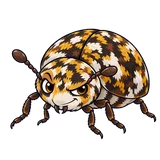 Varied carpet beetleAnthrenus verbasci
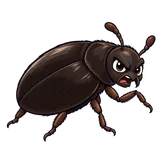 Black carpet beetleAttagenus unicolor
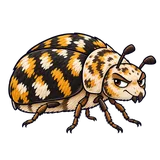 Furniture carpet beetleAnthrenus flavipes