
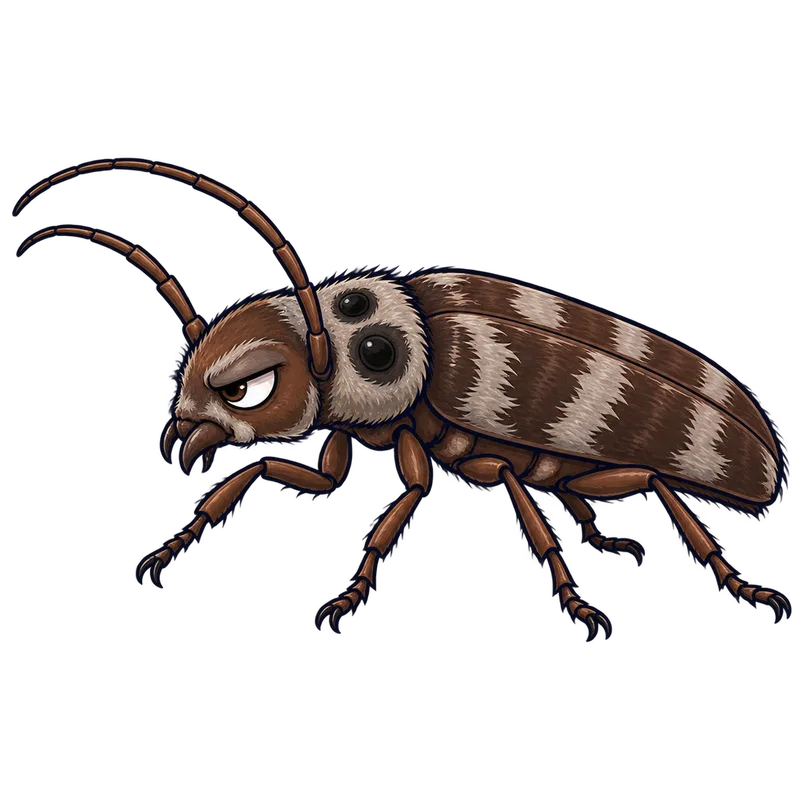
Old house borer
Hylotrupes bajulus
- Size
- 1/2 to 1 inch long
- Color
- Grayish-black to dark brownish-black
- Habitat
- Seasoned softwood structural framing
- Diet
- Sapwood of coniferous trees
- Life cycle
- 3 to 15 years per generation
The old house borer is a beetle that spends years chewing quietly inside structural pine, spruce, or fir before making a sudden appearance in your living space. If you spot an adult beetle inside the house, you are looking at a creature measuring 1/2 to 1 inch long with a grayish-black to dark brownish-black body. The most reliable field mark sits right on the thorax, where two smooth, shiny black knobs resemble a pair of eyes peering out from a dusting of fine gray hairs. On the wing covers behind those knobs, you will notice two faint, grayish-white transverse bands or spots.
Identity
If you are examining the timber rather than the insect itself, you will look for broad, oval exit holes measuring 1/4 to 3/8 inch across. Those holes are distinct from the tiny round shot holes left by other insects or the larger excavations of different wood borers. You might also spot a blistered or rippled surface on the wood. That texture happens because the larvae pack their tunnels with fine, talc-like powder mixed with tiny barrel-shaped pellets, and the sheer volume of that waste pushes against the thin remaining wood veneer.
Habitat & behaviour
This beetle targets seasoned softwoods, which means you are most likely to find it in attic framing, roof rafters, floor joists, and subflooring. It has an odd relationship with the age of a building. Despite its common name, the old house borer prefers structures under 60 years of age because younger, freshly seasoned pine and spruce lumber retains higher levels of protein and nutrients that larvae need to grow.
Development takes time, stretching anywhere from 3 to 15 years depending on the climate and the moisture content of the wood. The larvae thrive in wood with a moisture content between 10% and 30%, and their internal chewing can be surprisingly loud. During quiet evening hours, building occupants often hear a distinct, rhythmic ticking or rasping sound as the mandibles scrape against the dry wood fibers. Adult beetles emerge during the summer months, particularly in June and July, when they seek out mates and deposit new eggs into the cracks and crevices of structural timbers.
Visual variations
The creature goes through four distinct life stages, and each one looks entirely different from the previous. The egg is spindle-shaped, translucent white, and measures about 2 mm long, tucked deep inside wood crevices by the female using a flexible tube at her tail end. From that egg hatches the larva, a creamy white or pale yellow grub that grows up to 1 1/2 inches long. The grub has an enlarged chest region and a dark brown head featuring powerful, deeply toothed jaws that can chew through dry wood and occasionally adjacent materials like plaster or soft metals.
After finishing its long feeding phase hidden inside the timber, the larva constructs a resting chamber near the surface of the wood and transforms into a pupa for about 2 weeks. The adult beetle that emerges from that chamber shows clear size differences between the sexes. Females can reach up to an inch in length, while males are generally smaller, measuring about half that size. Both sexes possess long, thin feelers and the characteristic shiny black knobs on the chest, though older specimens may lose some of the fine gray hairs covering their bodies.
Why it matters
Finding an old house borer in your home means you are dealing with an insect capable of continuous reinfestation, which means the same structural timber can be attacked generation after generation until the sapwood is entirely hollowed out. While the beetle poses zero health risk to humans or pets and does not bite or carry diseases, extensive internal tunneling can compromise the load-bearing capacity of roof rafters and floor joists.
Emergence holes only show where adults have already chewed their way out, so finding a hole does not automatically confirm an active infestation unless you find fresh, fine powder or hear the larvae at work. Because treatments require bare, unsealed wood to penetrate, and because whole-structure fumigation leaves zero residual protection against future attacks, a professional inspection is often needed to evaluate the structural integrity of the timber and determine the correct course of action.
Similar species
 Powderpost beetlesSubfamily Lyctinae
 Rice weevilSitophilus oryzae
 Granary weevilSitophilus granarius
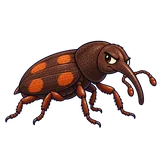 Maize weevilSitophilus zeamais
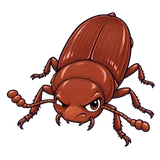 Red flour beetleTribolium castaneum
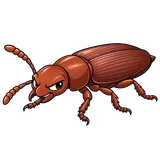 Confused flour beetleTribolium confusum