
What tree symptoms are associated with emerald ash borer?
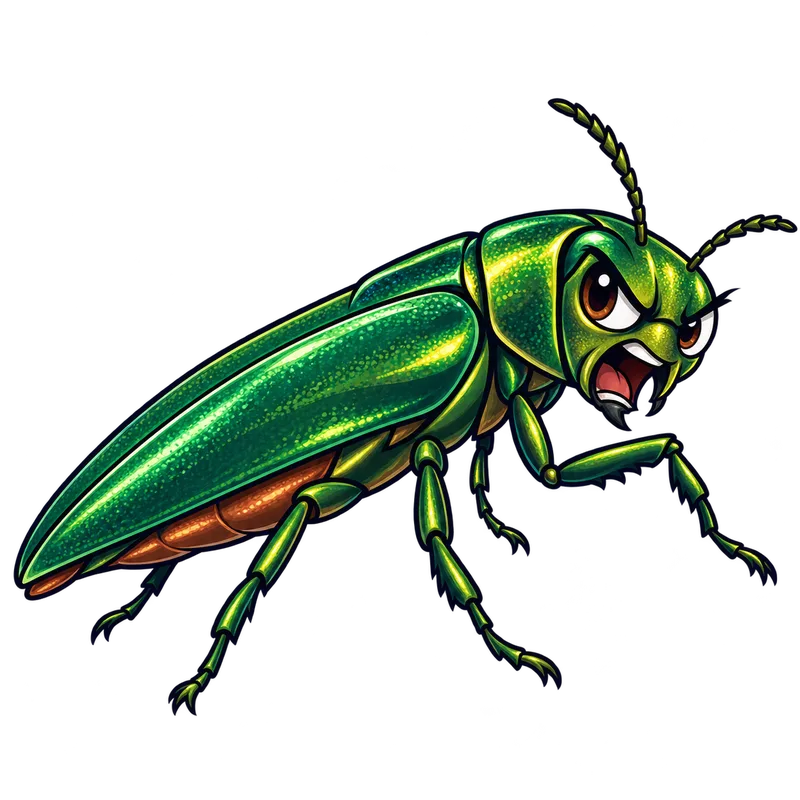
Emerald ash borer infestations cause top-down dieback, with upper leaves turning yellowish before summer, along with new green shoots bursting out at the base. Trees also show D-shaped exit holes, vertical bark cracks, and pale patches of exposed wood where woodpeckers have been feeding on larvae.
What is actually going on
Imagine walking across the backyard on a warm June afternoon and noticing that the old ash tree near the property line looks a bit thin at the very top. The leaves up there are turning yellowish before summer has even hit its stride, and you might figure the tree is just thirsty after a dry spell. But a few weeks later, you spot a strange patch of pale, freshly exposed wood on the trunk where something has been chipping away at the bark, and a cluster of strange little green shoots has suddenly burst out right around the base of the tree.
What is actually happening beneath the surface is a systematic shutdown of the tree plumbing. The culprit is the emerald ash borer, a slender metallic green beetle that lays eggs in the bark crevices of ash trees. Once those eggs hatch, the larvae tunnel under the bark to feed on the inner layers that transport water and nutrients. You can think of the tree trunk like a bundle of drinking straws or a home water line. When the larvae chew horizontal paths through those vital pathways, they effectively cut the flow to the upper floors first. That is why the damage shows up as top-down dieback, starving the highest branches long before the rest of the tree catches on.
This is not a secondary pest that only picks on trees already dying from root rot or drought. The beetle is an aggressive primary attacker that can bring down a completely healthy, vigorous ash tree in just a couple of years. As the tree tries to survive the internal damage, it often forces out a desperate ring of new growth near the bottom, known as epicormic sprouts, while the canopy above continues to thin out.
How to tell for sure
Spotting an infestation usually requires looking for a specific set of physical markers rather than just relying on a general impression that the tree is struggling. The most reliable diagnostic signs are left behind on the bark and just beneath it.
First, look for D-shaped exit holes that measure between 3 and 4 mm wide. When adult beetles finish their development and chew their way out of the trunk, they leave behind an opening with one flat side and one curved side, exactly like the capital letter D printed on a coin. You will usually find these on the main trunk and larger branches.
Second, check for vertical bark fissures or cracks that run about 5 to 10 cm long. These splits form because the tree attempts to heal itself over the active feeding zones of the larvae beneath. If you carefully peel back loose bark on a heavily damaged section, you will usually expose winding, S-shaped larval galleries packed tightly with fine sawdust and waste, cutting across the grain of the wood.
You will also usually notice heavy woodpecker activity on infested trees. Woodpeckers love to feast on these fat larvae, and in doing so, they flake off the dark, weathered outer bark to reveal patches of pale, blonde inner wood beneath. This bark flecking stands out sharply against a normal tree trunk.
Keep in mind that canopy thinning and leaf yellowing can sometimes be caused by ordinary drought or soil compaction, so you usually need to find the D-shaped holes, bark cracks, or subcortical galleries to confirm this specific beetle.
What usually comes next
Once you have identified the signs of an infestation, the most practical decision you face usually depends on how far the damage has progressed and whether you want to try saving the tree or prepare for its removal.
If the upper canopy is already more than a third dead, treatment is usually off the table. Systemic insecticides, which are applied in the spring when roots are actively taking up moisture, need a functioning vascular system to carry the product up into the branches. A severely compromised tree simply cannot pull the chemicals up where they need to go. For trees caught in the very early stages of decline, a licensed professional arborist can apply preventive treatments like trunk injections, but these require ongoing maintenance year after year.
If the tree is too far gone, prompt removal is usually the best path to prevent the insects from spreading to neighboring trees and to eliminate the safety hazard of falling branches. When you do take down an infested ash tree, what you do with the wood matters enormously. Moving firewood across town or across county lines is the primary way this pest jumps to new areas. A dry log sitting in a backyard woodpile can easily harbor hidden larvae under the bark, acting like a Trojan horse that releases adult beetles in a new neighborhood next spring. Buy and burn your firewood locally, and check with local agricultural extension offices or plant health authorities regarding any regional quarantine rules before transporting wood material.
When to get help
There are several moments when you should step back and hand the problem over to professionals, regulators, or clinicians.
First, structural safety is a major concern with dead or dying ash trees. As the vascular system fails, the wood dries out and becomes extremely brittle in a very short time. Large limbs or even the entire trunk can drop without warning. If an infested ash tree stands near your home, driveway, or utility lines, do not attempt to take it down yourself. You need a certified arborist equipped with specialized rigging gear and safe drop zones to handle hazardous tree removals.
Second, chemical management is not a weekend DIY project. Direct trunk micro-injections of systemic pesticides must be performed by a licensed professional applicator to ensure correct dosing and to avoid doing permanent structural damage to the trunk.
Finally, if you live in a region where the emerald ash borer is considered absent or strictly regulated under biosecurity laws, finding suspect signs carries a statutory obligation. You must report suspected sightings immediately to the appropriate national plant health authority, such as the Canadian Food Inspection Agency, the USDA, or local agricultural departments, so they can track and manage regional outbreaks.
On a final note, remember that the emerald ash borer is strictly a plant pest. It does not bite, sting, or transmit diseases to humans. If you or someone in your household experiences skin rashes, mysterious marks, or allergic reactions, do not attribute them to tree pests. Consult a qualified clinician or healthcare provider for proper medical evaluation.