
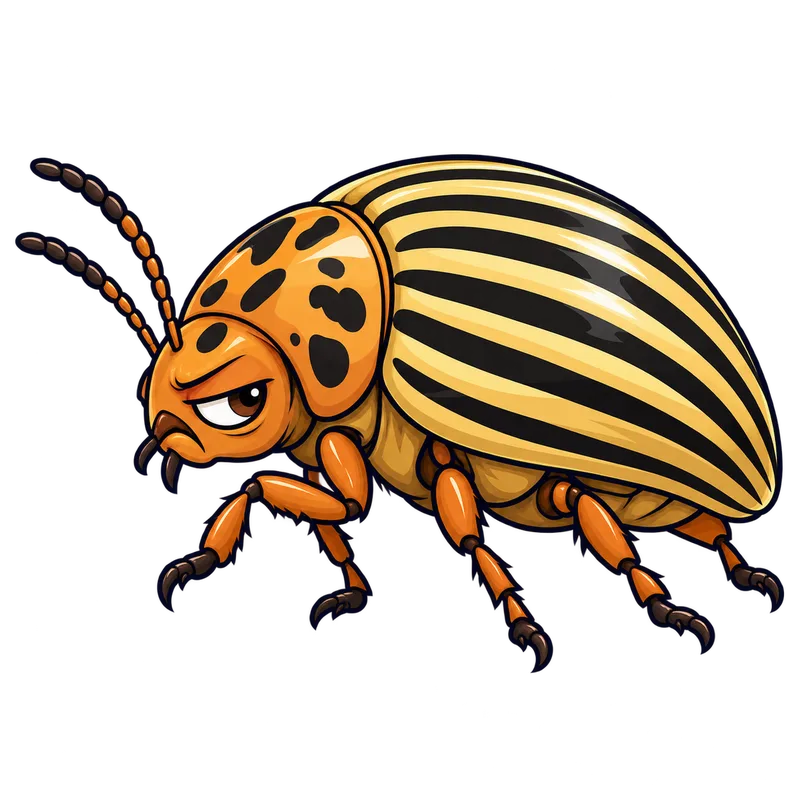
Colorado potato beetle
Leptinotarsa decemlineata
- Size
- 9 to 12 mm long
- Color
- Yellowish-brown with ten black stripes
- Habitat
- Temperate agricultural fields and gardens
- Diet
- Solanaceous crops including potatoes and tomatoes
- Life cycle
- Egg, four larval instars, pupa, and adult
If you are trying to figure out what is currently chewing holes in your garden, the adult beetle leaves very little room for confusion once you get close enough to count its markings. Look for five neat, black pinstripes running down each shiny, cream-colored or yellow wing cover, with the outermost stripe tracing right along the side edge of the shell, giving a total of 10 straight black stripes across its back. Just ahead of those wings, the head and pronotum are a distinct orange color and peppered with irregular black spots. If you pull out a 10x hand lens, you can check the feelers, which are slender and maintain a uniform width right out to the tips without any sort of clubbed thickening at the end. That combination of 10 pinstripes and an orange, spotted head separates it from look-alikes like the striped cucumber beetle, which has only 3 stripes.
Habitat & behaviour
This creature is remarkably fussy about its menu, confining its dining strictly to members of the nightshade family. If you do not grow crops like white potatoes, eggplants, or tomatoes, you are unlikely to cross paths with it in a domestic garden. During the spring and summer growing seasons, adults emerge and fly or walk directly to these host plants to feed and lay eggs. They are also notorious hitchhikers, occasionally catching a ride on harvested vegetables, farm equipment, or transport vehicles, which explains how they turn up in unexpected places. In the United States, it is a widespread garden pest, but in places like Great Britain and Northern Ireland, it is classified as a regulated quarantine pest where finding one carries a mandatory legal duty to report suspected sightings to official plant health authorities immediately.
Visual variations
The insect goes through a striking transformation as it matures, meaning the pest you spot early in the season looks nothing like the final beetle. The eggs start as bright yellow, elongate-oval orbs deposited in tight clusters directly on the host foliage. Once they hatch, they turn into soft-bodied, reddish larvae distinguished visually by two parallel rows of dark black spots running down each side of the body. These larvae grow through voracious feeding before eventually emerging as the hard-shelled, oval, strongly convex adults with the iconic pinstriped wing cases completely covering their abdomens. There are no social castes to worry about here, and male and female adults share a similar visual profile without obvious external differences.
Why it matters
Both the ravenous larvae and the adult beetles chew away leaf tissue with an intensity that can entirely strip a plant, leaving behind only skeletal midribs and main stems, which ruins plant vigor and potato tuber production. Despite their destructive agricultural impact, they are completely harmless to people and pets, as they do not bite or sting, and handling them does not cause skin blisters. When managing them, it pays to know your biological controls, because standard caterpillar sprays will do nothing here. Organic growers must check product labels carefully to ensure they use beetle-specific strains like Bacillus thuringiensis var. tenebrionis, avoiding genetically engineered alternatives like the san diego strain, and natural treatments like neem oil must be timed precisely to catch tiny larvae right as they hatch.
Similar species
 Plum curculioConotrachelus nenuphar
 Emerald ash borerAgrilus planipennis
 Asian longhorned beetleAnoplophora glabripennis
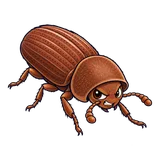 Common furniture beetleAnobium punctatum
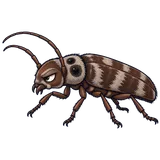 Old house borerHylotrupes bajulus
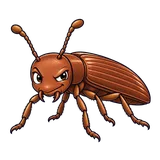 Powderpost beetlesSubfamily Lyctinae