
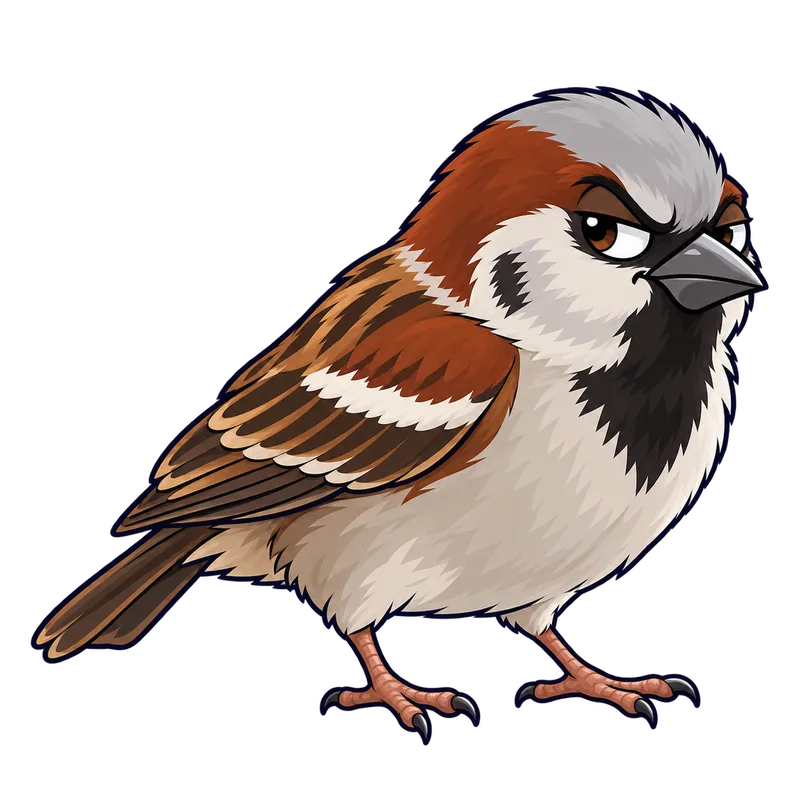
House sparrow
Passer domesticus
- Size
- 14 to 18 cm long
- Color
- Brown, gray, black, and chestnut
- Habitat
- Urban and agricultural areas near human buildings
- Diet
- Seeds, grain, scraps, and insects
- Life cycle
- Multiple broods per year, lives several years
Passer domesticus, known more commonly as the house sparrow or historic English sparrow, is a stocky little bird that has figured out how to live entirely on human terms. You usually spot one hopping across a parking lot or shouting from a commercial sign box rather than resting quietly in a deep forest. Built for an opportunistic life right next to our homes and businesses, it carries a short, stout, conical bill that makes quick work of crushing seeds and scavenging dropped food.
Identity
Sorting the adults is straightforward if you get a decent look at the plumage. Adult males wear a distinct gray crown flanked by a chestnut nape, featuring a prominent black throat bib that sits against a dingy gray-white breast like a tiny ascot. Females and juveniles skip the flashy bib entirely, wearing a more subdued brownish-gray coat with an unstreaked throat and a pale buff stripe sitting just behind the eye.
Distinguishing them from native look-alikes takes a careful eye because native songbirds often share the same neighborhoods. Native American sparrows enjoy full federal protection under the Migratory Bird Treaty Act, while house sparrows are non-native invaders with no such shielding. A casual glance from ten feet away might not cut it. Sorting a female house sparrow from a native cousin often requires close evaluation under magnification to check for the fine details of crown striping and breast streaking.
Mistaking one for the other is a legal trap. Many gardeners assume any small brown bird pecking at newly planted seeds is fair game for control, but destroying an active nest belonging to a native species can violate federal and state wildlife laws. Take a moment to check the bill shape and head markings before you decide what you are looking at.
Habitat & behaviour
House sparrows are permanent, year-round residents that lean heavily on residential housing, commercial warehouses, food processing plants, and livestock barns. Instead of building open cup nests in natural tree branches, they prefer to wedge bulky, unorganized domes of coarse grass, straw, feathers, and trash directly into wall voids, soffits, HVAC intake vents, sign boxes, and pipe chases.
Active primarily during daylight hours, their daily routine revolves around finding food and defending small nesting territories. They move across the ground primarily by hopping rather than walking, leaving behind small bird tracks featuring three forward-pointing toes and one rear-pointing toe. If you inspect their droppings on a building ledge, you will often spot small cylindrical deposits capped with a distinct white uric acid mark, a telltale sign of avian digestion.
What draws them into a yard or commercial property is the sheer abundance of food and shelter. They are opportunistic granivores and scavengers that feed on agricultural seeds, ripening garden produce, outdoor pet food left on a porch, and discarded human refuse. When autumn and winter arrive, their behavior shifts toward communal roosting, gathering by the dozen in sheltered building soffits or dense evergreen foliage to conserve body heat through the colder months.
Scare tactics like plastic owls or ultrasonic noisemakers rarely keep them away for long. These birds habituate to visual and auditory tricks within a few days unless the methods are constantly changed or paired with physical exclusion. If a building provides warmth, safety from predators, and an easy meal, a house sparrow will treat it as a permanent homestead.
Visual variations
Social insect castes do not apply here, since we are talking about a bird moving through familiar avian life stages. Everything starts with eggs laid inside those messy, dome-shaped nests packed tightly into building gaps. Those eggs soon hatch into nestlings and fledglings that rely entirely on constant parental feeding while tucked safely away out of sight.
Give them a little time, and fully grown flight wings let them buzz back and forth between dependable feeding spots and sheltered communal roosts. Those wings are built for quick, darting dashes rather than long seasonal migrations, which keeps the populations locked right where the food and shelter are easiest to find. In plain terms, if your property offers plenty of spilled grain and cozy crevices, the local flock will multiply before you know it.
Plumage changes follow age and sex rather than dramatic seasonal shifts into entirely different coats. Juveniles look a lot like adult females with their dull brownish-gray feathers, completely missing the bold black bib and chestnut head markings that mature males eventually show off. Even their feet keep a steady pattern no matter their age, featuring three toes pointing forward and one pointing back so they can grip rough brick walls or narrow electrical conduits without slipping.
Why it matters
Having house sparrows take over your property is rarely a harmless situation. When they stuff bulky nesting material deep inside soffits, rain gutters, and utility boxes, they create genuine fire hazards and trap moisture that eventually rots wooden framing. Out on building facades, sidewalks, and commercial signs, heavy piles of droppings ruin the appearance and speed up material corrosion through constant contact with uric acid.
Real health risks tag along with large infestations, especially when nesting debris and dry droppings pile up inside enclosed spaces like attics or ceiling voids. Disturbing those old deposits kicks up dust that can carry unwanted germs into the air. If you are cleaning out an abandoned nest site, put on disposable gloves and a properly fitted particulate respirator rated N95 or higher so you do not breathe in the contaminated dust.
If you run into unexplained health issues or suspect an exposure, skip home remedies and do not try to guess the cause. Head straight to a doctor, an urgent care clinic, or your local poison control center for proper advice. Photographs of skin marks can never tell you what bit you, and only a real medical check can sort out what is going on.
Proper identification always comes first if you need to manage these birds around your home. Native songbirds often share the exact same neighborhoods, and mixing them up can land you in trouble with wildlife protection laws. Once you are sure what you are dealing with, let the product label guide any control steps, and leave major structural exclusion work or big cleanups to licensed pest control professionals.